The Letters of Joseph Conrad

I read Conrad’s letters because I find him a powerful if at times impenetrable artist. Unlike with other favourites, whose works may be complex but nevertheless generally manage to be at least somewhat clear to the reader, Conrad’s tales often are opaque in both language and content. I wanted to see whether his letters would help clarify matters. Another reason is that Conrad is one of the English language’s most interesting stylists. His tales are dark, gloomy, illuminated only by brief flashes of lightning. I thought that perhaps by going behind the scenes I might discover the system of cogs and wheels that made possible such great works as Nostromo and Heart of Darkness.

Over the course of five hundred pages we get to know Conrad reasonably well. The author, who spent the first half of his life at sea, has few surviving letters from that time, making him as much of a biographical mystery as any of his characters. Instead, we read the letters of Conrad the writer. These are at times touching, as when he writes to his wife, or funny, as when he writes of his critics (“There is even one abandoned creature who says I am a neo-platonist. What on earth is that?”), and at times merely dull. As with Dostoevsky, Conrad spent most of his life without much money and was always asking to borrow some from his friends. I also got almost as fed up of Conrad denying he was a writer of the sea as he got from being accused of it. And as for his gout…

Joseph Conrad, Writer of Somewhat Oblique Prose

The letters are interesting to people who want to get a feel for how Conrad created his own works. I particularly liked his comment on Lord Jim being but “a hash of episodes, little thumbnail sketches of fellows one has rubbed shoulders with and so on”. But they are more interesting for providing clear – for Conrad – statements about how he wrote and what he thought. Such things we might pick up from his work but when laid out here they may still be useful or at the very least interesting. It is around these areas which this piece will be structured, with the result that my comments will be limited. Conrad can speak, or rather write, for himself.

Life

Conrad’s view of the world is often described as pessimistic, even nihilistic. Fate is cruel, merciless, and incomprehensible. This comes across in his letters too, although it is more pronounced earlier on – at the time of Heart of Darkness and Lord Jim – than when he was more established as a writer:

“Life knows us not and we do not know life – we don’t know even our own thoughts. Half the words we use have no meaning whatever and of the other half each man understands each word after the fashion of his own folly and conceit. Faith is a myth and beliefs shift like mists on the shore; thoughts vanish; words, once pronounced, die; and the memory of yesterday is as shadowy as the hope of to-morrow”

A certain lack of faith in humankind is the keynote. He writes of injustice that the best way to deal with it is to accept it. We might say that he is realistic, rather than pessimistic. It is of no great consequence either way, for a man with a “deep-seated sense of fatality governing this man-inhabited world”.

Our problem, as he sees it, lies in our being conscious of the world. Unlike the brute beasts of the earth, humans are aware of the world’s terrifying valuelessness and suffer all the more for it: “What makes mankind tragic is not that they are the victims of nature, it is that they are conscious of it.” This is a view shared by other pessimists like Thomas Ligotti or Arthur Schopenhauer.

How does Conrad fight off this gloom, what does he believe in? Certainly not Christianity – “Christianity is distasteful to me. I am not blind to its services but the absurd oriental fable from which it starts irritates me”. Instead, Conrad clings to traditional values as his ballast: “What I believe in most is responsibilities of conduct.” When spelled out, his values are spoiled by the sense that they are impossible things, lying beyond our reach:

“I respect courage, truth, fidelity, self-restraint and devotion to the ancient ideals of mankind; and am sorry that, like most men, I fail in the practice of these simple virtues.”

We learn of Conrad’s politics, which are fairly sound. He has sympathy for the Africans and other non-white peoples, even though his views would be old-fashioned today, and his views on slavery are a little tainted by his experience growing up in Poland-Ukraine. Mostly, his politics is marked by the same sense of tireless hopelessness as the rest of his views:

“Every cause is tainted: and you reject this one, espouse that other one as if one were evil and the other good while the same evil you hate is in both, but disguised in different words… What you want to reform are not institutions – it is human nature. … Not that I think mankind intrinsically bad. It is only silly and cowardly. Now You know that in cowardice is every evil – especially that cowardice so characteristic of our civilization”.

Work

So much for Conrad the man. Now we must get to Conrad the writer. This was what I enjoyed the most. Conrad comes across in these letters as a thoroughly human writer. He goes from hope (“labouring against an anxious tomorrow, under the stress of an uncertain future, I have been at times consoled, re-assured and uplifted by a finished page”) to despair (“…writing as I did with a constant, haunting fear of being lost in the midst of thickening untruth”), he struggles with English – his third language – but at no point does he give up completely.

And so, what is his advice to us humble novices?

On le mot juste:

“No word is adequate. The imagination of the reader should be left free to arouse his feeling.” Instead, what you want is “a picture of a mental state”.

On scepticism and truth:

“The fact is you want more scepticism at the very foundation of your work. Scepticism the tonic of minds, the tonic of life, the agent of truth – the way of art and salvation. In a book you should love the idea and be scrupulously faithful to your conception of life. There lies the honour of the writer, not in the fidelity to his personages.”

On the use of detail for establishing reality, and the truth we must hold to, consciously or not:

“A picture of life is saved from failure by the merciless vividness of detail. Like a dream it must be startling, undeniable, absurd, and appalling… Our captivity within the incomprehensible logic of accident is the only fact of the universe. From that reality flows deception and inspiration, error and faith, egoism and sacrifice, love and hate. That truth fearlessly faced becomes an austere and trusted friend, a companion of victory or a giver of peace. While our struggles to escape from it – either through drink or philanthropy; through a theory or through disbelief – make the comedy and the drama of life. To produce a work of art a man must either know or feel that truth – even without knowing it.”

In short, what he recommends is a fidelity to one’s convictions, to one’s vision of the world (though we should know it before we write):

“Everyone must walk in the light of his own heart’s gospel. No man’s light is good to any of his fellows. That’s my creed – from beginning to end. That’s my view of life – a view that rejects all formulas dogmas and principles of other people’s making. These are only a web of illusions. We are too varied. Another man’s truth is only a dismal lie to me.”

And his other useful advice is to be careful about the creation of mystery:

“Explicitness, my dear fellow, is fatal to the glamour of all artistic work, robbing it of all suggestiveness, destroying all illusion”. Explicitness concerns spelling things out, it does not mean that we must rely on deliberately confusing language. On the contrary, “in letters suggestiveness itself – a great quality – must be obtained by precise expression”. There are a number of times when Conrad advises his friends by doing some close reading on a few of their sentences, and changes them to make them less obvious, but much more powerful suggestive, by adding in a perfect turn of phrase.

Conclusion

However much we may struggle at times with Conrad’s own style, and I know I do, it comes from a particular worldview, and fits that view like a glove. The dark world is depicted with a dark and flickering style. And that is what, to me, makes Conrad so great. For it is a style that has only grown more effective over the years and it is the style that is best suited to our own day, with its ambiguity, its dashed hopes, and its great uncertainty.

For readers who have no sympathy for Conrad’s writing, and for those who do, I end on an amusing quote from him about Nostromo, which he had edited lightly over ten years after it had first been published:

“A paragraph of about ten lines has been taken bodily out, for the simple reason that reading it after ten or twelve years I could find no intelligible meaning in it.”

Who has not felt that with Conrad? But who has not, at the same time, felt that even in the vaguest, the most tenebrous of phrases, there lies a suggestion of the dark forces that, like it or not, bubble underneath our world? He’s alright, Conrad, really.

Musil’s Three Women – Grigia, The Lady from Portugal, and Tonka

There are some books which, when I take my notes from page to screen, seem more interesting and more enjoyable than they had been as I was reading them. Robert Musil’s Three Women is such a book. Three Women is interesting – I got awfully excited by the thought of all the essays I’ll be able to write next year on it – but it’s not exactly fun to read. Musil takes three different relationships and uses them to weave an intricate network of ideas and associations which provide an intellectual feast for anyone who hungers for one, built on workable plots.

This is, of course, progress for Musil, whose two stories Unions were also in my edition. These were written earlier, and as Frank Kermode writes of Three Women in the preface to my edition, “the difference from the earlier work could be expressed as a new willingness to find a place in his stories for straight narrative”, which is about as open as any serious literary critic could be about the fact that those two stories make no bloody sense whatsoever, however interesting they might be for someone who has got lost on the way to the philosophy section of the library.

Anyway, as I said at the top, now that I’ve extracted my notes, I can start to “appreciate” the stories. What follows is a teasing out of some of the various meanings I found.

A photo of Robert Musil
Robert Musil, author of Three Women. His most famous work is the unfinished Man without Qualities. However, it’s rather long and I’m not sure I like his writing enough to attempt it just yet.

Three Women and Robert Musil

There are three stories in Three Women, each of them centring on a different woman – “Grigia”, “The Lady from Portugal”, and “Tonka”. The last of these, “Tonka”, as about twice as long as the others, and is also broken up into chapters to make it easier to read. Robert Musil, their author, was an Austrian-German who had seem the Austro-Hungarian Empire collapse, but as Kermode makes clear, this is not the only collapse he witnessed. There is also the sense of “metaphysical collapse”, a sense that modern man (and everyone else) is losing his spiritual anchoring without replacing it with anything. In all of these stories the notion of “will” is of great importance, as is the feeling that looking at the world from only one angle, whether scientific or martial, can lead to our doom. Pretty typical Modernist stuff, to be fair, but Musil does it well.

Grigia

“Grigia” is the first story in Three Women and it takes its name from a peasant woman from Venetia. Homo, the main character, is left home alone by his wife and ailing son as they seek out treatment, so he decides to take up an offer from an old friend to go and attempt to reopen some gold mines in Venetia. Mines are a particularly German setting, taking us back at once to the Romantics. Novalis had studied mining, and Ludwig Tieck’s “The Rune Mountain” and E. T. A. Hofmann’s story “The Mines at Falun” both present classic renditions of the dangers of what lies buried beneath the ground. Of these three, I found “The Mines at Falun” to be the most relevant while I thought about “Grigia”.

In Musil’s story Homo, in an alien mountainous world, begins going “native”. As usual, we have to ask whether that nature has always been there. Homo has an “impression that behind the outward appearance of this district… there was hidden something that he yearningly awaited”; meanwhile, crystals from the mountain are compared to flowers. “Yearningly” and the connection with flowers (also present in Hofmann’s tale) speak to a kind of sexual desire that is hidden, not-fully-acknowledged, within Homo. When the gold starts to flow, Homo finds the attraction of power and wealth too, blotting out memories of his old life. Stars become like “thalers”, and in the villages “they poured out money among the people and held sway like gods”. Homo and his companions, the other mining directors, stop talking as time passes, instead adopting “an animal language”. Power takes away their civility and leaves them beasts.

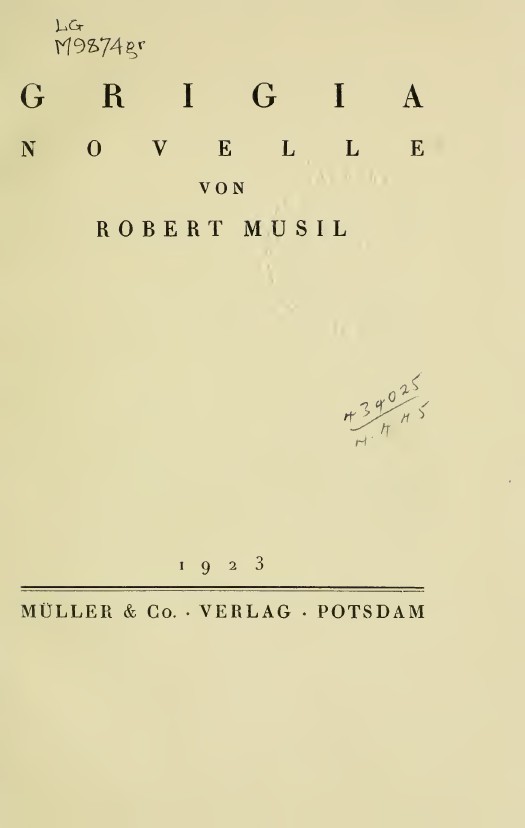
The first page of Musil's Grigia, the first story in Three Women
The first edition of “Grigia”, the first story in Three Women. I quite liked “Grigia” but I wish Musil had focused more on straight narrative.

This power is a temporary state, of course, contingent upon the gold’s flow. “Grigia”, as do all the stories of Three Women, has at its core questions about identity. This is where Musil’s use of sex and eroticism comes in. The peasant women’s husbands all go to America in search of fortune there, and one day Homo hears a story about one who comes back. He goes to one woman, spends time with her until he runs out of money, and then he leaves to the next one. He has been in America and knows the husbands, letting him imitate them. The women do not object, perhaps do not even notice. They are simply glad of his return. Eventually the trickster is caught, but the story speaks to the idea that one can change one’s role at will. For Homo, far from home, the idea is an attractive one.

It is attractive because it absolves him of responsibility. For one going “native” the only possible danger, so long as one stays where one is, is the possibility of guilt. Thinking about everything as acting is much easier. When Homo starts having sex with the peasant women, the language reflects his feeling that everything is in a way unreal, even though in fact it’s a further indication of his moral decline. Of one, he thinks “her passion was so brilliantly and passionately acted”, with a “theatrical quality of it”. And from this a kind of solipsism emerges, the necessary continuation of his growing sense of power. He thinks the women are there for him, and comes to find everything on the mountains as an “enchanted world ordained for him alone”. When he gets close to the peasant woman Grigia, he thinks it will bring him spiritually closer to his wife.

Perhaps it does, but reality intervenes. A vengeful husband traps Homo and Grigia in a cave, but only Grigia has the willpower to escape. Homo, already having had his pleasure, stays where he is. At that moment the mining stops, a failure. To me the story ultimately suggests the dangers of delusions, the need to have a firm grip on things. The need for a kind of spiritual centre. And since Homo’s name isn’t a far cry from Homo Sapiens, perhaps Musil’s message may be meant for us all.

The Lady from Portugal

The second story of Three Women is “The Lady from Portugal”. Unlike the other two stories in Three Women this one is set in the past, in the Alps on the border with Italy during the time of the earlier Holy Roman Empire. Its central characters are the Herr von Ketten (Man of the Chains), a nobleman, and his wife, a Portuguese lady. As with the other stories, the focus here is on identity. The Herr von Ketten is part of a long lineage of warriors, and his entire identity is based on war. For one year of their lives his people court their wives in faraway lands, and for the rest they fight. The Herr von Ketten’s sworn enemies are the forces of the Bishop of Trent. However, the real tension here is between von Ketten and his wife. Can they ever know each other or get close?

The Lady from Portugal imagines, when she reaches the castle, that the Alpine landscape reflects her husband’s character. She hears a story about how no-one has ever seen beyond the mountains, because every time someone sees past one row of peaks, another lies in wait. It is the same with identity – we may think that we know a person, but there is always another layer to be discovered. The castle itself is not to her taste – she finds it hideous, rotting, but she decides to try to make it her own. Meanwhile, her husband has already abandoned her to go to war. Thus begins their period of separation.

A picture of Alpine mountains and forests.
Behind one layer of rocks another always awaits. Musil uses landscape in “The Lady from Portugal” as a metaphor for our essential unknowability by others.

They meet, of course, but rarely. When he returns, he leaves “more hastily than was necessary”, and they both end up laughing awkwardly. She tends to his wounds, performing her duty as wife, but for both of them it becomes a comic action. For von Ketten, she is something outside of war, and thus alien. He has no power over her – she is as if from “some other realm.” War, by contrast, is much easier. Instead of the woman’s complexity, “To command is a thing of clarity”. “The thrust of a spear under an iron collar that has slipped is as simple as pointing one’s finger at something and being able to say: This is. This.” The spear and his finger are connected – for von Ketten there’s scarcely a difference.

He enjoys war because it doesn’t require “that other thing” – women. In fighting, his entire life can be focused on one thing. And indeed, it almost seemed to me that the war von Ketten fights is a war against multiplicity, against women. It is key that the Bishop of Trent is described as wearing “womanish robes” – if von Ketten can destroy him, it’s like he can destroy the presence of women in his life. For the Lady there are also challenges. Her children, which have not seen the sea, do not seem like her children to her. When the two meet she’s almost thankful for the brevity of these meetings – “If he had remained longer, he would have had to be truly as he was.” Things are easier because they are acted, rather than felt.

Von Ketten cannot hide from his wife forever. When the Bishop of Trent dies naturally both sides make peace, leaving von Ketten without the cornerstone of his identity. On the way home he is stung by a fly and almost dies. He suffers fevers and a surgeon. This latter is already a challenge to his old world view – “How strange it was to let pain be inflicted on one and not defend oneself”, he thinks. He drifts between death and life but eventually decides to live, but he doesn’t fully recover. His head has shrunk and his cap no longer fits. He has literally lost a part of himself without war.

At home the Lady from Portugal has a guest – a friend from her homeland. For von Ketten what is unbearable is seeing what real closeness can actually look like. “Their souls seemed to be in harmony with each other”, and when he spies them in the garden “among the leaves the shadows all blurred into one”. He starts to second-guess the past, finding evidence for betrayal everywhere. But he is sick, and a soothsayer tells him he will be cured only when he’s “accomplish[ed] a task” – what task, she doesn’t say. Now, just as once she couldn’t understand him, he cannot understand her. “When he gazed into his wife’s eyes, they were like new-cut glass, and although what the surface showed him was his own reflection, he could not penetrate further” – once again, an image of layers.

One day a kitten appears. At first beloved by all, it later gets ill. All three nobles try to take care of it. Ultimately, they fail and send it away, but it comes back well. When it falls ill again they have it killed. Ketten now decides it is time to get rid of the Portuguese guest. But “he could not make the final decision that he had all his life found it so easy to make”. Something has changed, and killing is no longer in his nature. All the same, one night he climbs onto the castle’s rocks to try to catch his wife and guest together. As he does so, his strength returns. But the man has already vanished. His wife explains: “If God could become man, then He can also become a kitten”.

Through this experience of jealousy and care von Ketten moves on from war to a kind of love.

Tonka

“Tonka” is the last story of Three Women, and the longest. It tells the story of a relationship between a young man from the middle classes and a peasant girl, Tonka. As ever, we are made to think about notions of identity. Tonka is a girl who is like “a snowflake falling all alone in the midst of a summer’s day” – she is always out of place. Moreover, she is hard to pin down, always associated with liminality. For instance, her full name is the German “Antonie” but the shortened form comes from the Czech “Toninka”; in addition, her family is made of an aunt “who was actually her much older cousin” and a grandmother who is actually the grandmother’s sister.

The young man brings her into his household as a nurse for his own ailing grandmother. Tonka is not intelligent – she mostly just says “yes” or “no”. Her mind has an “opacity” to it because she cannot express herself. By contrast, the young man’s relatives are all talkers. They know that speech is “not a medium of thought, but a sort of capital, something they wore like jewellery to impress others”, even if their speech is empty. When the grandmother dies, Tonka doesn’t cry – she doesn’t understand the need to fake emotions. His mother berates the young man for being “out of place” when he tries to help Tonka – his relationship doesn’t conform to the strictures of his class. But at the same time, the young man is part of his class – he gets annoyed when something reminds him of Tonka’s earlier life, when she worked in a shop.

Eventually, Tonka and the young man go to Berlin. They were unable to stay with the family. The young man doesn’t want to become like his mother, forced to carry on a relationship in secret. He and Tonka are now in love, though it is a strange love: “He loved Tonka because he did not love her, because she did not stir his soul, but rinsed it clean and smooth, like fresh water. He loved her more than he himself believed.” Tonka is simple, but she is not stupid. Even to the young man she reveals hidden depths, such as when she tells him about chemistry she has remembered, “like pretty stones whose names one does not know, kept in a box!” For a time, all is well. After some difficulty, “suspended between emotion and theory”, they have sex. And then she gets pregnant.

A painting of a seated woman
Egon Schiele, “Edith Schiele  in gestreiftem Kleid sitzend”. In “Tonka” there is a great tension between who Tonka says she is and what reason dictates she must be. For the rational, scientific young man who is her partner, the gulf between the two is too great to overcome.

Tonka gets pregnant while the young man is away on a journey. There are two possibilities – either an immaculate conception, or infidelity. The young man is a man of science, but Tonka, “impervious to his reasoning”, is a force of her own. She is from “a world that does not know the concept “truth””. She grows ill, her skin peels away, “letting the peasant skeleton peer through the skin.” By contrast, the young man’s “well-bred face” better survives hardship. Illness seems to reveal who they really are. Money grows tight, and the young man’s forced to turn to his mother. But he has broken the unwritten codes – the family alludes to “amorous acts” that Tonka uses to control him. There are none. They simply cannot understand Tonka’s simplicity.

The young man becomes superstitious just as he becomes suspicious, but at the same time his personality splits. Part of him, the superstitious and suspicious part, is Tonka’s lover – the other is a scientist. And as the relationship worsens, the science improves. He stops shaving because he thinks it helps the relationship, only wears a certain ring. When he tries to confront Tonka with the scientific and medical irrefutability of her infidelity, “all she could do was to vouch for the truth of her words with the truth of her whole being.” There is more than one type of truth in the world. But for the scientist it is a torment to have no certainty. Even though he’s sure she’s betrayed him, this feeling is like a “dream” – they are real only while we experience them. Later we see their flimsy construction.

He starts dreaming. His dreams come as warnings that his work is not his true life. He has a repeated memory of disbelieving in religion as a boy and trying to button up his coat during a frost only to find the cold has numbed his fingers. Tonka ends up in the hospital. The young man is unable to tell her “I believe you” – he cannot face the consequences of those words for his worldview. Eventually she dies, without hearing those words. Only then does the young man appreciate that deep inside her “there is a part of her that remains untouched by all this” – where infidelity is irrelevant because it is not a part of her truth. But it is too late. Unlike Herr von Ketten, the young man is unable to save his love. His need for rational certainty has cost him everything.

Conclusion

I have written too much. All the same, I hope this piece gives an idea of why Musil is an interesting writer and Three Women is an interesting collection. At least when you’re looking to write an essay. Musil’s Modernist concerns in Three Women – the shifting nature of identity and the dangers of a worldview that is too focused on one thing – remain pertinent in our own time, as does the importance he sets upon having an appreciation for the possibility of spirituality and irrationality as an antidote to looking at the world in only one way. Unfortunately, I’m still not sure I actually enjoyed reading Three Women. Even though I found parts of it touching, especially the descriptions of an unusual love in “Tonka”, most of Three Women was just too intellectual for my tastes, like Musil’s Posthumous Papers of a Living Author, which I looked at here.

But still, it’s probably worth checking out Three Women. These stories are much shorter than The Man Without Qualities and may help you decide whether that book’s for you. If you enjoyed the piece or have read Three Women and think I seriously have misinterpreted the stories (I probably did), do leave a comment.

Robert Musil’s Posthumous Papers of a Living Author

Robert Musil’s novel, The Man Without Qualities, is the perhaps the foremost German-language contribution to the exceedingly long and perhaps overly cerebral modernist genre, otherwise the domain of Ulysses and In Search of Lost Time. Why the German-speakers and their works have never been as popular as those of the English and French is a complicated and thorny subject. Musil’s magnum opus, at least, is hurt by the fact that its author departed this life before he had completed it – though he managed over a thousand pages, so perhaps we shouldn’t complain. The Man Without Qualities is, according to critical wisdom, the best thing Musil wrote. However, lacking unlimited time, I decided to try a few of Musil’s other works, to get a feel for him. My first attempt is Posthumous Papers of a Living Author, a collection of creative non-fiction and short stories. Below are my thoughts.

An old photo of Robert Musil, author of Posthumous Papers of a Living Author, looking dapper.
Robert Musil, author of Posthumous Papers of a Living Author, is most famous for his The Man Without Qualities. He was born in Austria Hungary in 1880 and died in Switzerland in 1942, his work almost forgotten. Only recently has he found much popularity in the English-speaking world, thanks to new translations.

Of Flies and Worms

The first thing I noticed about Posthumous Papers of a Living Author is that it is a book populated with animals. I don’t know if Musil was a vegetarian, but I had the impression as I read that he had great sympathy for animals, regardless of whether he ate them. I think in them he saw a reflection of our own human selves in the modern era. Fears about mechanised slaughter and technology-driven control, and about the destruction of individuals under the treads of science and social pressures, he expresses through his non-fiction, in particular the pieces “Flypaper” and “Fishermen on the Baltic”.

“Flypaper”

“Flypaper”, the first of these little pieces, describes the killing of flies. We begin with a basic scientific and factual description of the paper in question – “Tangle-foot flypaper is approximately fourteen inches long and eight inches wide; it is coated with a yellow poison paste and comes from Canada”. But this beginning is deceptive, for Musil starts to work in his argument immediately after it. The structure of the piece is simple, describing in only two or three pages the process by which flies are killed by flypaper: they land, they try to fly, and then at last they lose their strength and die. Such a description would hardly affect us if Musil had left it like that. But instead, he uses language to draw us into the fly’s struggle, and make us aware of its brutal nature. And in this verbal magic, not even the form can remain neutral.

Part of this comes through metaphors and similes. Although “Flypaper” is short, it is packed with images. And these images are invariably, consciously, human. Entangled flies are like “the mountain climber”, like “the man lost in the snow”, like “the hunted man” – all this within a single, long, sentence. Musil’s use of multiple images within a single sentence makes the particularly human nature of his images hard to avoid noticing. Then there is his use of “we”, not often but just often enough for us to know that the fly’s struggle is much like our own. Musil’s language is also startlingly colloquial at times, like when the flies “take a breather and try again”. Where technical, scientific language would push us away from the fly, Musil’s particularly casual style does the opposite.

A photo of a fly
As annoying as houseflies are, it still pays, so argues Musil in “Flypaper”, to have an awareness of what they go through when we kill them. It might teach us something about ourselves.

And so the fly dies, and by this point we are almost on its side. We have been made aware of its human qualities. And the attention that Musil gives to it, showing in detail how it tries to escape only to lose its strength and collapse, also alters our view of the fly’s death. By breaking down “flies land and die” into its component parts, by defamiliarizing the process of death, Musil turns the flypaper into something abhorrent, and the fly’s struggle into tragedy. When we learn, in the final sentences, that though the fly stops moving, nevertheless there is “some tiny wiggling organ that still lives a long time”, that “it opens and closes, you can’t describe it without a magnifying glass, it looks like a miniscule human eye that ceaselessly opens and shuts” – when we learn all this it’s hard not to feel horror and shock.

“Fishermen on the Baltic”

What “Flypaper” does for flies, the third piece in Posthumous Papers of a Living Author, “Fishermen on the Baltic”, does for worms. But here Musil alters the approach. In “Fishermen on the Baltic” we focus on fishermen preparing worms for fishing. At first they are “an obscure, mouldy, enticing ugliness in the clean white sand”, but then the men take them, cut them into pieces, and put them in their equipment chests. It is “a very tidy operation”, one where Musil uses the passive voice to further distance the fishermen from their slaughter.

But, as Musil himself hints at the end of the piece, “you have to pay close attention”. (It’s hard not to read this as a command for the reader concerning the text, even as it’s ostensibly about the worm-preparation). Take the placing of worms on hooks by the men, “as carefully as nurses to make sure that each hook gets a worm”. Nurses do not aim to kill people. The image, while fitting on one level – nurses and fishermen need steady hands – is repulsive once you go beneath the surface.

“Fishermen on the Baltic” is even shorter than “Flypaper”, but there is still a lot going on here. We should admire the skill of the fishermen’s craft, but Musil wants us to think also about its cost. The worms are killed mechanically while the fishermen banter. Perhaps there is something of an allegory for fascism here. Posthumous Papers of a Living Author was published in 1936, but I haven’t been able to work out when this particular piece was written. Nonetheless, we have a sense of the worms’ ugliness, a sense that they are only useful for us as objects for fishing and not as living beings in themselves. Perhaps it’s not too much of a stretch?

Cultural and Other Declines

Posthumous Papers of a Living Author is not only concerned with modernity’s crushing effect on the individual – it’s also a record of various sorts of decline that Musil saw taking place around him. Partially, this decline is linguistic. Musil is concerned with the way that language, through advertising and overuse, is losing its meaning. In a piece like “It’s Lovely Here”, Musil takes aim at the clichés of postcards. In “Monuments”, Musil connects the fate of monuments in Europe – ignored, or at best used for directions – with the broader cultural decline. If only they used the new tricks of advertising – “Goethe’s Faust is the best!” would be a great inscription for a statue to the German instead of something so boring as a name and date.

Often, language is simply unable to convey its idea. In “Boardinghouse Nevermore”, Musil notes that words like “harmony” are useless at showing what to the naked eye is obvious. This points to a deeper problem: that people assume, with the encroachment of scientific language into everyday speech, that everything can be explained and translated. Such a view ultimately takes the “magic” out of life. Musil, unlike most writers, had actually had a scientific and technical education – nonetheless he understood the dangers of adopting an overly-scientific worldview. In “Can a Horse Laugh?” this is treated with humour. At first an “acclaimed psychologist” is quoted – “…for animals don’t know how to laugh or smile”. Musil, however, spends the rest of the essay arguing against this through the example of a stable boy and his horse. Personal experience defies the scientist. But we shouldn’t blame the horse for proving him wrong.

Snobbery and State of Consciousness

Against this sense of linguistic decline there are a few attempts here to fight back. In addition to “Flypaper”, there are other stories that make us revaluate the world through taking us into different consciousnesses. “Maidens and Heroes” amusingly puts us inside the head of a canine, while “Clearhearing” shows us the world through the eyes and ears of a convalescent. “Binoculars” makes us think about the way we look at things by showing us, through careful descriptions, a zoomed-in version of the world. Musil’s inventiveness is at times really quite impressive.

However, while Musil’s linguistic ventures can be interesting, the cultural criticism is often less so. The advertising criticism of “Monuments” is just about okay, but in something like the “Paintspreader”, talking about talentless “genre painters”, Musil comes across as simply a snob. In “Surrounded by Poets and Thinkers” he asks the question of why writers don’t write long books anymore, and comes to the conclusion that it’s because the reading public are idiots. There is more to the essay than this – it ultimately is about our loss of belief in experts, and the way that as a result we know longer trust each other. In the end, Musil writes, someone whose views are completely awful will be able to gain popularity simply because everyone has an equally poor claim on respect. It’s a timely point, but one overshadowed by the condescending tone. Musil is no egalitarian champion himself.

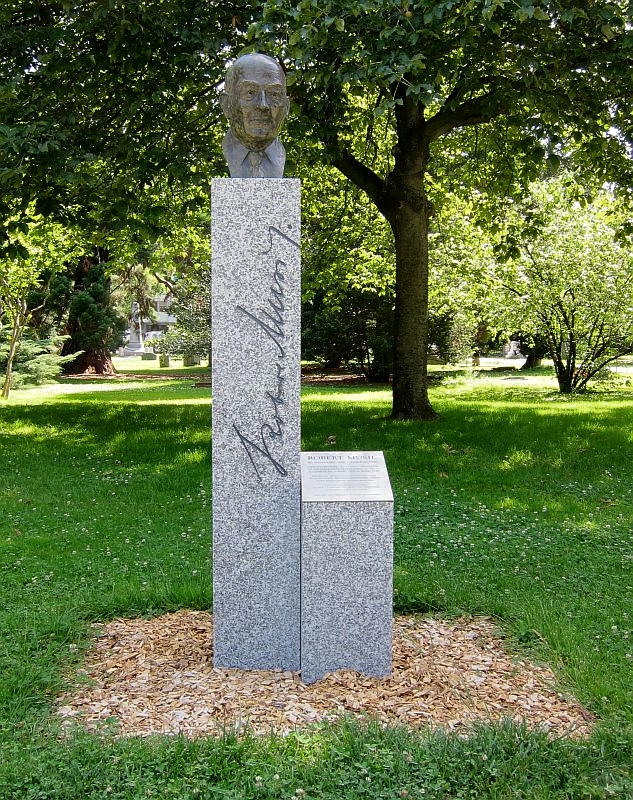
A monument to Musil, showing a bust on a granite column.
A monument to Musil. While I’m going to read more of him, I can’t help but feel like overall Posthumous Papers of a Living Author was a mixed bag. At times it was fascinating – what I wrote about “Flypaper” and “Fishermen on the Baltic”, for example – but at others it was overly intellectual, snobbish, or dull. Photo by Albrecht Conz / CC BY-SA 3.0 DE

Conclusions

I only spoke about a few of the things from Posthumous Papers of a Living Author in this post in part because I ended up having more to say about them than I’d expected – indeed, I had to cut and compress whole themes from my plan. However, another reason I did not speak about many other of the pieces is because, quite frankly, they didn’t leave a great impression on me. Posthumous Papers of a Living Author was, in its author’s words, a “little stop-gap book”, and as a result the quality is very uneven. At times, Musil’s language is fantastic and inventive, while at others it falls victim to modernist overindulgence.

I also think that the ideas of Posthumous Papers of a Living Author are not all equally interesting either. Perhaps I am just jaded, having read more than my fair share of modernist literature, but a lot of Musil’s moaning about cultural and linguistic decline and related matters, however relevant his complaints remain in our own day, just strikes me as picking on easy targets. The fact remains that identifying problems is the first step towards solving them – not the only one. I got the impression that Musil can’t quite pick a side between being art-for-art’s-sake or being engaged with the world, and it hurts these pieces at times.

Overall, Posthumous Papers of a Living Author suffers from much the same problems that Alfred Döblin’s Murder of a Buttercup did – it’s sometimes intellectually satisfying, but it forgets to touch the heart. At its best, Musil seems a worthy precursor to Borges. But unfortunately that isn’t the case often enough. I can only hope that his other works will be more consistent.