Death and Dignity: Tolstoy’s Hadji Murat

Introduction and Background

Hadji Murat was one of the last works of literature that the aging Leo Tolstoy wrote, but you wouldn’t get that impression reading it. Absent is that preaching tone that marks much of Tolstoy’s work from around the time he finished Anna Karenina until his death. Instead we have a tale that is almost Classical in its grandeur, stakes, and larger-than-life characters. It takes place in the Caucasus in the years 1851-1852, at a point where the Russian subjugation of the native peoples – Chechens, Avars, and many others – was in full swing. The natives, under the Imam Shamil, are waging a brutal guerrilla war against Tsar Nicholas I’s Russian forces. Chief among the guerrilla leaders was one Hadji Murat, but when the story begins, he has decided to switch sides and join his hated Russian enemies. Shamil no longer trusts him and has imprisoned his family. He had little choice.

A painting of Hadji Murat, showing him against a mountain backdrop and with many daggers at his waist.
Hadji Murat, an Avar warlord, was given the nickname the “Red Devil” by the Russians he fought against. But Tolstoy’s novel aims to reveal that in spite of that, he was not so different from his enemies after all.

Against the backdrop of war, it is the personal that stands out. Hadji Murat, like War and Peace before it, shows the messy truth that lies behind maps and military manoeuvres. It shows the suffering, the heroism, and the dignity of ordinary people. Harold Bloom once called it “the best story in the world”. I’m not sure I would go that far, but it’s certainly among the best I’ve ever read.

Translations from the Russian are my own.

Characters over Plot – the Structure of Hadji Murat

One of the first things you notice reading Hadji Murat is that for a story with its hero in its title, the man himself isn’t the only prominent person here. Instead, Tolstoy makes sure to give us so many names and faces, and indeed places, that we’d be forgiven for thinking we’re reading something as long as War and Peace or Anna Karenina. Hadji Murat is a short book, but one of its unique strengths is that it acts like a long one. Even though most of the characters are only involved for a few pages, they are treated as though they could be there for longer. Whether this is a local officer, a cook, or somebody’s wife, we never know what role they’ll have to play.

And this makes us pay attention. Tolstoy’s strategy, it seems to me, has two important effects. The uncertainty surrounding the later involvement of characters means we have to consider carefully all of them in turn, instead of skipping hastily over those who other writers might mark (unintentionally) as having no further role to play. It all reflects an attitude that sees human dignity as more important than anything else, even concision and consistency. And that’s nothing to complain about, both because Tolstoy’s characters are drawn so well, and because the message of respect and human dignity is so important, especially in our times, when the statistical value of people seems more important than the idea that behind every number is a living, breathing person with their own hopes and dreams.

Violence and Death

The second important effect, very much related to the first, is that Tolstoy’s care for characters makes the underlying anti-war message in Hadji-Murat all the more powerful. In stories the main characters sometimes die, usually at the end, and any decent author can make such a death have weight for their readers. But Tolstoy’s careful portrayal of his minor characters means that even their deaths leave a mark.

One death that particularly affected me was the death of a simple soldier, Avdeev. He is introduced as one soldier among a small group, heading out for a quick smoke beyond the walls of their outpost. He doesn’t take a major part in their conversation, and we would likely forget him without a second thought. Tolstoy does not let us. When the soldiers fight a battle with the natives later on, one of them is wounded. “It was none other than that Avdeev who had been out smoking earlier”.

The wounded man is suddenly given a history not because Tolstoy has delved into his dying thoughts, but because he has connected a dying man with the life he had innocently led earlier, a life we ourselves had scarcely noticed. Avdeev’s life is banal, but it is life all the same, and that life has been robbed from him, and Tolstoy, rightly, wants us to be outraged. In dying he has achieved nothing. No grandeur nor glory surrounds him. He hadn’t even managed to load his rifle before he was hit. And as his comrades gather round him, the overwhelming impression is one of the pointlessness of his end, of the stupidity of it. “What, mate, does it feel bad?” One of them asks him. And then Avdeev dies.

But still Tolstoy does not leave him alone. The eighth chapter of Hadji Murat takes us to his home, where his family are hard at work. Avdeev, the virtuous youth, had volunteered to be conscripted in place of his brother, who had children of his own to look after, while Avdeev had only his wife. The family go around doing their simple tasks like threshing oats and bantering, and it’s painful to watch. They do not know that Avdeev is dead. The brother he has left behind is no good at the work and the family scold him for it. And though they all try to forget about Avdeev, to save themselves the worry, they think of him all the time – he was a good worker and they want to send him a letter and money.

The whole chapter is pointless. A modern editor, probably, would cut it. It does not advance the plot an inch. But its pointlessness is its very strength. The stupidity of the chapter within Hadji Murat reflects the stupidity of war and death itself, suddenly removing human joy and life. When at the end of the chapter the family finally hears that Avdeev has died, “protecting the Tsar, the motherland, and the Orthodox faith”, we feel disgusted. It’s a lie that provides no consolation for these lives. And it’s easy to understand, at this point, why his mother wails.
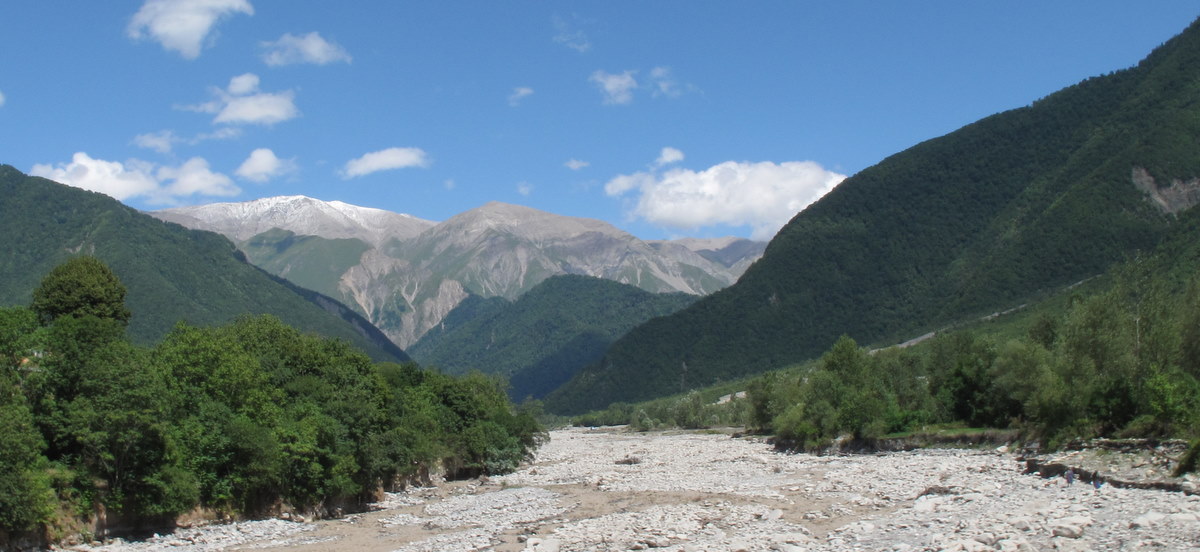
A photo of the mountains and forests of the Caucasus
The landscapes of the Caucasus are breathtaking, but for the Russians they also held a dangerous enemy. Photo from Peretz Partensky of San Francisco CC BY-SA

Authority

The message to Avdeev’s family connects the theme of pointless war-time death with its – in Tolstoy’s view – main cause: misguided authority. People are moved around, killed, and suffer, all because of people who are not affected by their decisions. And so they fail to appreciate them. If they did, Tolstoy would no doubt say, then there would be no more war. Hadji Murat, having lost Shamil’s trust and joined the Russians, finds himself trapped between two tyrants. Both Shamil and Nicholas I receive a chapter’s inspection by Tolstoy’s pen, and neither comes out particularly well. Shamil knows he is fighting a losing battle but refuses to surrender or find a compromise that would result in reduced bloodshed. Instead, he allows his men to believe they are winning against the Russians after all. But Shamil’s treatment is nothing next to Nicholas’s.

Hadji Murat is not a funny book, but the chapter detailing a moment in the life of Nicholas I’s is simultaneously tragic and hilarious. We find him receiving a report on the “capture” of Hadji Murat by the Russians. Tolstoy emphasises the contingency of Hadji Murat’s fate here. If Nicholas hadn’t been in a “bad mood” when he received the report, perhaps history might have been completely different. Nicholas, however, was. He is a petty womaniser, chasing after a married woman at a party, refusing to acknowledge any moral authority except his own, looking at the world through “lifeless eyes” (Tolstoy repeats the description three or four times in just as many pages). He is cruel and stupid. When worried, he begins “to think about what always calmed him: how great he was.” If he had no power, he would be funny, but he does, and the implications are terrifying.

Culture and Blood

Avdeev’s death is not the only one that is sprung on us. The first chapter of Hadji Murat details its eponymous hero’s arrival into a mountain village, where he is offered shelter by a friend. Once again, we are introduced to characters who we would otherwise forget. But Tolstoy, as the book draws towards its closing chapters, returns our attention to them. The Russians, chasing Shamil’s army, torch the village to the ground, kill the animals, and destroy the land. We see them come back from their shelter in the mountains to find their world in ruins.

“Nobody spoke about hatred towards the Russians. What they all felt, from the youngest to the oldest, was stronger than hatred. It was not hatred, but an unwillingness even to acknowledge these Russian dogs as people.”

Tolstoy fought in Chechnya as a young man. We have several short stories and the novel The Cossacks to show for it. But in Hadji Murat his attention goes beyond the Russians to their enemies. I cannot say if Tolstoy accurately portrays the Chechens, but I can say without a doubt that he portrays them with respect. By contrast, he has little love for the Russian army, with the pettiness of its commanders and brutality among much of its rank and file. Their tactics, of destroying the native forests and burning all they can, puts Hadji Murat next to Heart of Darkness as being a powerful Western critique of our own imperialism. Unfortunately, even now, I find most Russians expressing opinions about their southernly neighbours (now successfully “pacified” and “integrated”) that show they still haven’t learned the lessons Tolstoy was trying to teach them a hundred years ago.

We may have our differences, but we aren’t so different.

An Epic Figure – who was Hadji Murat?

No review of Hadji Murat could be complete without the man himself. But like Nostromo in Conrad’s novel of the same name, the figure of Hadji Murat is hard to pin down. While in Conrad’s work we rarely get a glimpse within Nostromo’s mind, Tolstoy freely tells us what Hadji Murat is thinking. But all the same, there is a tension in the story between rumour and official reports, and what Hadji Murat is actually like as a person. Legendary warlord Hadji Murat, we discover early on, is a human being. His main motivation in life is not some epic hatred of the Russians but simply protecting his own family – a universal concern.

The Russians he meets cannot believe that. They are always trying to work out how he’s planning to betray them. The Russians have a kind of mythic view of Hadji Murat that scarcely corresponds to reality. He’s never been scared, so one rumour goes. But when, in Tbilisi (then Tiflis), he recounts his life’s story to a Russian scribe, we find he has been scared like any other person, if only once. He has one leg short than the other – he’s no monstrous figure. But the Russians almost don’t want to see him like that. When they meet him they aren’t concerned with his personality. At public events in Tbilisi they only ask him one and the same question – “how do you find it here?”. It’s as if they only want to go home and say they’ve met the legendary warlord, rather than actually get to know him.
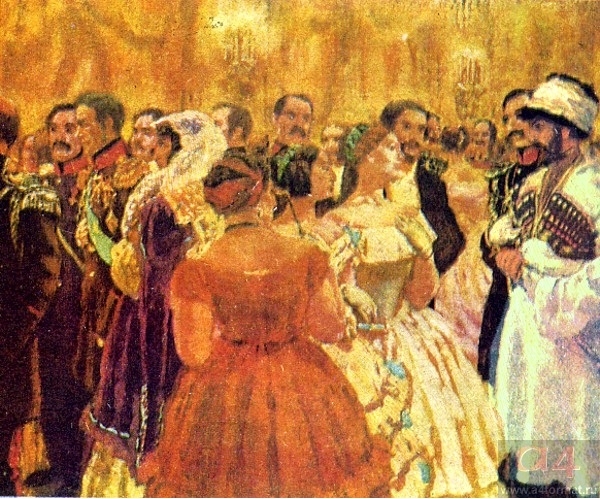
A painting illustrating Hadji Murat's time in the high society world of Tbilisi. He stands off to one side while various women fawn over him.
An illustration from an early edition of Hadji Murat. The man himself is on the right. Speaking little Russian and unwilling to conform to the arbitrary rules and customs of Russian high society, his first appearance draws plenty of attention.

And what is he really like? A heroic figure, yes, but not only. He scarcely fights during the book. Instead, he’s full of life, with a “child-like” smile – exactly the sort of person who shouldn’t need to die. When he is given a Breguet pocket watch with a minute repeater function he spends hours listening to its chimes. He is also devout, constantly making time to pray and perform his ablutions. In short, he is a good man. If he is once described as like a caged beast, it is not because he’s an animal in Tolstoy’s eyes but rather because he is a victim of the Russian bureaucratic machine, which gradually dehumanises everyone. For Tolstoy the answer to the question “who is to blame” is obvious: the leaders, surrounded by sycophants and insulated from the pain their actions cause. Alas, not much has changed.

Conclusion

I had read ­Hadji Murat once before now, but then I barely understood a thing. My Russian wasn’t good enough, and I wasn’t willing to read slowly enough to compensate for it. This time I was better prepared. Tolstoy’s story demands slow and careful reading, though it is short, because otherwise we run the risk of denying the characters their own dignity. And there are so many exciting people here that I was spoiled for choice when it came to writing this review. Alongside Avdeev and Nicholas I, another one I was particularly struck by was the character of Butler, a young man who loses everything (and then some) at cards after striking up a friendship with Hadji Murat. Even though his role in the overall book is not great, his short story is so perfectly written that I would gladly have read an entire book that carried on his tale.

That, perhaps, is Tolstoy’s ultimate gift. He not only creates characters who are so real that the best of them live inside us, but he also creates characters who are so interesting that they make us realise that everyone around us has their own personal dignity, and everyone deserves attention and respect. Whether man or woman, Chechen or Russian, everyone has their own story, and the world would be better if only we stopped to listen.

For more Tolstoy, I made a translation of a late and fragmentary short story of his here. If you want to know about the spiritual changes that came over Tolstoy after Anna Karenina was finished, and why they spoil his writing, check out this essay of mine.

An Autobiography of the Spirit – Kazantzakis’s Report to Greco

Report to Greco was pretty much the last thing the great Greek author Nikos Kazantzakis wrote, and though it is complete in and of itself, it was only really a first draft. It is an autobiography, but not of the sort that most of us are used to. In spite of a fascinating life full of adventure and travels, in Report to Greco the focus is very much on the internal adventures of the mind. Kazantzakis explores the spiritual discoveries, challenges, and epiphanies that made him who he was as a person and, equally importantly, as a writer. It is a beautifully written book, challenging and rewarding in equal measure, and easy to recommend to one tormented by those accursed questions: what must we believe, and what must we do?

I loved it. For the truth is, except for the pressures of reading lists and friends’ recommendations, I read for the same reasons I live – to find a justification for my life, and a way of looking at the world that redeems it and all its suffering. In this journey many writers have helped me – Tolstoy, Dostoevsky, Whitman, and Rilke come to mind – but no author of fiction, in a single book, has been so determined to find answers as Nikos Kazantzakis in Report to Greco.

“My life’s greatest benefactors have been journeys and dreams. Very few people, living or dead, have aided my struggle.”

At times the dominant force is Nietzsche, at times Homer or Bergson or Buddha or Lenin. To go through Report to Greco trying to plot the exact nature of Kazantzakis’ growth is a fool’s errand. He contradicts himself, forgets himself, and repeats himself. As we ourselves do, in our own development through life. To read this book is to be bourn along a river whose current and banks are ever-changing. The journey is more important than the specifics precisely because it is Kazantzakis’ attitude that is most memorable here. In Report to Greco he demonstrates how life can truly be lived according to the injunction memorably stated by the dying Tolstoy “Search, always keep on searching”.

A photograph of Kazantzakis's gravestone
Kazantzakis’s grave in Crete. Photo by Frente (CC BY-SA 3.0)

It is not enough to know that Kazantzakis had engraved on his gravestone: “I hope for nothing. I fear nothing. I am free”. It is not even enough to know his intellectual forebears. It is necessary to know the attitude that could guide a man’s life such that at the end of his days he truly could believe in those words and rest. That story of a life is Report to Greco’s gift to us.

The Structure and Messages

Report to Greco is not really an autobiography, and trying to read it as one is a little foolish. Comparing it even to Kazantzakis’s Wikipedia page is going to lead to a lot of confusion. In spite of the book’s length and variety, it seems that there remained a huge amount of Kazantzakis that he nonetheless conceals, or else thinks is not worth writing about – “rinds they were. You tossed them into the garbage of the abyss and I did the same”. The book’s introduction by Kazantzakis’s widow, Helen, explains that as Kazantzakis lay dying he was nonetheless remembering still more events, still more travels, which would have made it into a second draft. These passed away with him. But so much is here that we have little to complain about.

Report to Greco begins in Kazantzakis’ home in Crete. It talks of his quiet mother and warlike father, and of ancestors on both sides. The teachers who influenced him, the schoolfellows who first accompanied him, and later disappointed him, are all described lavishly. I have not been to Crete or even Greece, but after Report to Greco and Zorba the Greek I feel like I need to go soon. Still, Kazantzakis doesn’t stay long in his homeland. Soon he begins the travels that make up the majority of the book. To Italy, to France, to Germany, Austria, Russia, the Caucasus, Jerusalem… the list is almost endless. And certainly, if Kazantzakis had lived longer, no doubt it would have been. His companions are monks and priests and poets and thinkers. Their conversations range widely, but always reflect Kazantzakis’s occupation with the big questions. What must we do, and what must we believe?

From everyone he gets a different answer. From the monks on Mt Athos he gets one, from the monks on Mt Sinai another. The revolutionaries of Russia give him faith in humankind – at other moments it disappears. At times God exists, at times a void. And when we reach the end of the book I’m not sure we’re all the wiser as to what Kazantzakis actually believes, except for in those big ideas that would seem cheap without the whole of Report to Greco to serve as their explanation and justification.

A young Nikos Kazantzakis. Report to Greco doesn’t follow a strict timeline, but flits between spiritual events in the author’s life to showcase his development.

Of freedom he writes:

“love of liberty, the refusal to accept your soul’s enslavement, not even in exchange for paradise; stalwart games over and above love and pain, over and above death; smashing even the most sacrosanct of the old moulds when they are unable to contain you any longer”

And then of his own life there is this cryptic message:

“I was becoming a sea, an endless voyage full of distant adventures, a proud despairing poem sailing with black and red sails over the abyss.”

God is not important, because “the very act of ascending, for us, was happiness, salvation, and paradise.” But God, perhaps, lurks at the end. The achievement of Report to Greco is to make God irrelevant by showing how much of His creation can be enjoyed and savoured by us while we are still among the living. Affirmation requires a creator, but it doesn’t require a Beyond at all.

Travel and the Language of Affirmation

Report to Greco is a journey of the body as well as of the spirit. In some way, the journey of the latter needs the journey of the former. Through different people, and through different books, Kazantzakis comes to flourish. But as I reader I loved the places too, and though this is not a travel book, Report to Greco still has a lot to say about the locations Kazantzakis passed through during his life. We get the sense that places were inhabited by their ideas and beliefs just as much as they were by people. As he heads towards Mt Sinai Kazantzakis writes of the place: “This arid, treeless, inhuman ravine we were traversing had been Jehovah’s fearsome sheath. Through here He had passed, bellowing.” I too have had the experience, in the Himalayas and the desolate Pamir mountains of Tajikistan, of feeling a spirit passing in the wind.

Kazantzakis’ language also contributes to the feeling in Report to Greco of being closer to these big questions. His prose is always straightforward, and his images are influenced by his upbringing on Crete and his love of the Classics. These images reflect the rawness of his passion in searching for answers, and drag us after him. Our own images are often cliched and soulless and keep listeners and readers from truly feeling the truth of our own feelings, our own spiritual upheavals.

A photo of the top of Mt Sinai. Kazantzakis describes the monks of the area at length in Report to Greco
If you are going to try and track down a god, what better place to start than here? Mt Sinai. Photo by Mohammed Moussa CC BY-SA 3.0

Meanwhile, who can read something like this without feeling its power, even if you do not believe it? – “Away, away! To the wilderness! There God blows like a scorching wind; I shall undress and have Him burn me.” Or his words on a statue: “Just as a hawk when it hesitates at the zenith of its flight, its wings beat and yet to us it appears immobile, so in the same way the ancient statue moves imperceptibly and lives”. I myself can scarcely differentiate a hawk from any other such bird, or the trees in the forest. I lack that knowledge, that experience.

On his own style Kazantzakis writes “In vain I toiled to find a simple idiom without a patchwork of adornments, the idiom which would not overload my emotion with riches and deform it.” Kazantzakis’s regular use of such natural images is part, I think, of the whole thread of affirmation in Report to Greco. He lives in this world more closely than I do, and by using the world in his images he shows the value he finds in it. The riches are in the world, not in the virtuosity of the language he uses to describe it. As a result, the language is breath-taking because it’s the product both of love and of experience. Few modern writers have both, at least where nature is concerned.

A Few Complaints

There are problems here, and things that are out of date. The contradictions and repetitions in Kazantzakis’s spiritual development would probably be cut by a harsher editor, even though they likely reflect what he actually experienced. The fact is, a repeated epiphany loses much of its value to a reader. Still, I like the way that the current structure demonstrates just how we can reach the same conclusions from many different circumstances. In some way that reinforces what I feel to be one of the book’s underlying messages: it is the attitude we take to things rather than the specific experiences we have that count for becoming who we are.

Less easily looked past are the instances of old-school sexism, which is really just a little boring. (“Women are simply ornaments for men, and more often a sickness than a necessity”) This is a man’s spiritual journey, and it often feels like women are excluded from the peak Kazantzakis is climbing towards. All the same, the sexism here isn’t as bad as it is in Zorba. Much worse, however, is the tacit defence of Stalin. Report to Greco was written in the years immediately after Stalin’s death so there’s really no reason for Kazantzakis to be so silent on Stalin’s atrocities – in the Soviet Union Khrushchev hadn’t exactly kept quiet himself. I also cannot believe that Kazantzakis wasn’t aware of them either, since he travelled so widely in the Soviet Union. All he has to say, however, is these words, given to his female companion at the time.

“Lenin is the light, Trotsky the flame, but Stalin is the soil, the heavy Russian soil. He received the seed, a grain of wheat. Now, no matter what happens, no matter how much it rains or snows, no matter how much it fails to rain or snow, he will hold that seed, will not abandon it, until finally he turns it into an ear of wheat.”

Well, this, and a little story about Stalin’s bravery while he was a revolutionary in Tbilisi. Isn’t that great? The irony, probably not deliberate, is that Stalin might have had a much easier time growing his seed if he didn’t actively cause huge famines in modern-day Ukraine and Kazakhstan. Genocide doesn’t grow fruits, and I’m disappointed Kazantzakis leaves any dark from his portrayal of Stalin. It would be better not to mention him at all if this bad taste in the mouth is all we’re offered. Kazantzakis’ love of the Revolution’s ideals is perfectly understandable – the chapter taking place in Russia has a particularly memorable moment where Kazantzakis witnesses a large parade and feels a great unity with his fellows. But it’s a real shame he didn’t think Stalin could be separated from his revolutionary origins.

Conclusion

There are many reasons to read Report to Greco, but enjoying it demands an open mind. The book rewards those who are willing to let themselves be bourn across time and space through Kazantzakis’s life. If we ourselves are not searching for answers, Kazantzakis’s desire to find them will no doubt seem somewhat foolish. But if we are, then even if we don’t agree with his conclusions – and why should we? – we will appreciate the spirit that drove him to reach them. Kazantzakis’s attitude towards life is what inspires me most of all. The German-language poet Rilke wrote in his Letters to a Young Poet that we must “live the questions for now”; Kazantzakis shows what such a life can look like. This is the great gift of Report to Greco. The task now, for all of us searchers, is to go out filled with the same faith that animated him and find our own.

And then perhaps, we may come to have upon our headstones the same words that lie on his. “I hope for nothing. I fear nothing. I am free”.

Have you read Report for Greco? What did you think of it? Let me know in the comments below.

For more Kazantzakis, look at Zorba the Greek here. For more affirmation of human existence, look at Platonov, Shalamov, and Rasputin. If you want more old school beauty and simple living, look at Satta’s Day of Judgement.

Literature in the Face of Death and Mourning

Today my father was cremated. Though he had lived an enviable life he was just fifty-nine – not an age at which many would be satisfied to face death. For my brother and me, at sixteen and twenty-one, it feels far too soon to lose him, and more than a little unfair. But so sudden was the cancer that we all had little say in the matter. Death affects us all in different ways, and those of us touched by it must find our own solutions for coping, whether they be fighting bravely against the current, or following it into a numbing despair that seems, all things considered, reasonable enough. I want here to set down a few thoughts about books, and their value, in times of difficulty. Exhaustion has left my mind not entirely clear, so I apologise for mistakes and incoherency. This is, I’m afraid, a personal piece.

Medicine

I am the only one in my family who reads fiction. My father was a great lover of non-fiction and read widely, according to his whimsy, in the way that only one who is naturally intelligent but has never been confined in a university can. When news of his several brain tumours came, just over two months ago, in spite of his inability to read properly he did what he could to try and understand the disease that was killing him, and see if he might not discover a solution that the doctors had passed over or did not know. I myself placed my faith in them, because I know many medics at Cambridge, and they have always struck me as the greatest, hardest working, and best of all the students there. If anybody could save him, it seemed to me that a doctor would be the one.

A picture of Tolstoy
Leo Tolstoy may have ended up with some odd views about God and religion, but at his best his fiction can instil a sense of wonder that lets us weather the storm the death brings into our lives

In Anna Karenina Tolstoy on several occasions displays a sort of scorn towards medicine. Doctors come to try to rescue Kitty from her despair, proscribing contradictory remedies that never work and looking like fools in the process. Of course, Tolstoy has a point that is still relevant today, when it has been proven how much our mental health can affect our physical health. Often the best remedies can be ones of the heart and head, and not things we ingest. Tolstoy’s mistake, at least as I see it, is that he thinks all diseases work this way and doctors have no purpose. But he was as opinionated as they come, and I can understand why he thought that way – at least in the late 19th century medicine still had something alchemical to it. Now we are much luckier. My father’s problems were in his head, yes, but not his mind.

Wonder

I thought of Tolstoy a lot as my father rapidly declined. The Death of Ivan Ilych, Hadji Murat, and Anna Karenina in particular were sources of comfort. They made death real, but Tolstoy, the spiritual man, also made death valuable and sacred by imbuing it with a sense of wonder and mystery. He makes us see its horror, yes, but he also shows that through it there may also come a kind of salvation. There was a sense of wonder in seeing my father’s casket, and a sense of wonder in hearing our bagpiper piping us all in. In moments of such wonder you can feel that death is but a stepping-stone to something that lies beyond.

Tolstoy, like the best of our writers and artists, instils this sense of wonder. They make us see that death is not an end, but a new beginning. By making us aware of the mystical, the spiritual component that accompanies a passing on, they give us the consolation that mere thoughts and intellectual rigor cannot. Schopenhauer’s idea of death as returning to sleep is nice, but not nearly so nice as what Tolstoy, Dostoevsky, and other writers of spiritual conviction can achieve at their best. The Bible, and the other mystical books of our world’s religions, are full of tales that inspire wonder. They give us food for belief in magic, the sort of magic that makes the world glisten and shine with meaning. I’m thinking of Ivan Karamazov’s sticky buds here. And when we feel wonder, nothing, not even death, can hurt us or our love for the world.

A picture of Fyodor Dostoevsky
Fyodor Dostoevsky is another writer who for me can fight against the pain of death. His earnest belief in God and mankind, regardless of one’s own spiritual persuasions, is inspiring. His politics, however, is not.

Dreams and Levin’s Brother

For what consolation can rationalism offer here? The man under the shroud is still dead and cold. Death can lose its sting through thinking about the absence of our perceptions in the tomb, but loss of life will never cease to be painful to contemplate unless we see the mystical opportunities that surround it. My father came to me in a dream. He was in the Saint Petersburg Metro, healthy and well again, and heading onwards. He did not speak, but we embraced. The dream came during his final night alive – he died the next afternoon. Of course, it could have been just luck that made him appear at that time. But I see no reason to favour seeing it as mere chance instead of a holy and hopeful sign.

I cannot explain my dream, except as a revelation of the magic and mystery of our human souls. I remember clearly the death of Levin’s brother in Anna Karenina – his death was not one, but twofold. He said his final words and departed in dignity as a soul – “Don’t leave me”. And then he struggled on for another day, and when the characters gathered round his deathbed mention he has finished his struggling he suddenly comes back to life to say: “Not yet… just a little longer”. And then he dies as a body as well.

Conclusion: Narratives against Death

I have an advantage as a reader and as a writer. I live in stories, and I build them. Death, as Walter Benjamin remarks, destroys the placidity of our bourgeois existence – it is the one thing that breaks through even the strongest of our illusions and delusions about our lives. It creates a rupture and destroys the meaning of our world. In the initial weeks of my father’s illness I was almost glad to have, for the first time, a real reason to be depressed. It felt right for once to be in mental anguish. But of all my family I have been the one to cope with the fewest tears and the least pain, and I can’t help but think that reading has something to do with that.

Against the rupture of death, I was able to create a narrative, to come to an understanding with what has happened. I had read about death many times, and when the grief came, I saw how it reflected countless moods I’d seen in books. It gave me the community of fellow-sufferers and their strengths, and their own attempts to move on. And it made me feel less alone. By understanding that stories are the way we give meaning to our lives, I was able to reconfigure the meaning of my own to take into account my father’s death. Perhaps I am deluding myself in talking of wonder, in seeing signs in dreams and the dewy grass. But it is the power of books that they give you the choice to do so. They give you the tools to choose your fate. And that is a magical thing, whatever you believe.

Have you found literature to be a consolation in times of great suffering? Or have all our great scribblings become petty and unreal for you under the harsh light of death? Do leave a comment and let me know what you think