Thomas Carlyle, Prophet or Petty Pamphleteer?

There are, it seems, two ways of coming to Thomas Carlyle. The first, and tamest, is through the likes of Borges, who praised Carlyle’s experimental novel Sartor Resartus as a model to be emulated. The second route is far less innocent. Carlyle is perhaps the best known these days for his “fascism”. Carlyle’s dates obviously don’t have anything to do with fascism – he was born in 1795 and died in 1881. However, the man’s politics have aged extraordinarily badly. We may overlook or even, unthinkingly, admire his theory of Great Men, at least from a distance, but as soon as his authoritarianism comes out in his writing it only gets louder and louder, and less and less reasonable or coherent.

I have spent a few weeks with the Penguin edition of Carlyle’s Selected Writings, and in this post I suppose my goal is simply to suggest why there might be a reason to read this side of Carlyle, however reprehensible it may be.

Why read him?

One way to read Carlyle is less as a thinker so much as a character. Carlyle was a Scot. His parents wanted him to be a preacher but he ended up losing his faith. Nevertheless, there’s a strong prophetic tone to his writing that is impossible to avoid. Carlyle is completely incapable of writing in clear English. Not prophecy, but “vaticination”, not a standard sentence but all sorts of inversion. There are plenty of allusions, lists, and terrible images. From the back of my book – “Roar with all your throats, of cartilage and metal… for it is the hour!”

One gets the sense that Carlyle was rather disappointed to be born after the French Revolution, the subject of his major historical work. He has a certain relish for chaos that is distinctly Romantic. And indeed, it’s best to think of Carlyle as a Romantic, one born to late and who lived too long. His fearful view of technology, his praise of the individual and their genius, his loathing for the conforming masses, are all in their essence Romantic. In particular, Carlyle takes a lot from the German Romantics, and was a huge fan of Goethe (seemingly without noticing that Goethe renounced Romanticism later in his life). And these German Romantics were, it must be said, politically suspect. Aside from their support of Revolution, the sheer anti-rationality of the likes of Novalis has left a painful legacy in the intellectual history of the world.

Out of the Romantics grew Carlyle’s views of Great Men. In “On Heroes, Hero-Worship, and the Heroic in History” Carlyle laid out his view of Great Men as those who take the “dry dead fuel” of “common languid Times” and exploit it to achieve great things. Their conviction is at the heart of their strength. Except, wait a moment, haven’t we by this point in human history noticed that conviction often is little indication of goodness? Stalin, of course, had his convictions, as did Hitler. Generally I disapprove of bringing in these two, because they are classic examples which end up stifling arguments. But in Carlyle’s case the comparison really is appropriate. When he writes that the average man is nothing more than a “dumb creature” saying in “inarticulate prayers: “Guide me, govern me! I am mad and miserable, and cannot guide myself!”” we see a man who has so little respect for the average human being as to approve of any authority capable of guiding them, without ever questioning their true nature.

So, Carlyle was a fool. That’s no reason to read him, for there have been plenty of fools in history. But I think as a character, he’s interesting. The introduction to my copy is heavy with irony – a particular favourite line is “nothing is more remarkable in Carlyle than the way in which he simply stopped thinking.” But once we get beyond such humour, there’s a sense of sadness in Carlyle’s gradual collapse into authoritarianism. Friends and admirers, even philosophical opponents such as J. S. Mill, turned their backs on him as he grew more and more extreme. Conservatives rejected him for his distrust of the landowners and new money, while those on the side of progress had no time for him at all, even though much of what he said – the criticism of his world – was in line with their own ideas.

Ah, it is not easy, this apologetics business! Carlyle’s works speak for themselves, and not altogether to his credit. The gradual turning inwards of their creator, his isolation, his sense of being outside of time and in a hostile, incorrect world – these are more interesting in a novel’s main character, than in a writer of tracts who had real influence. Carlyle is not without his similarities to Kurtz from Heart of Darkness, which I looked at last week. But still we should read him, I think, and not just because we should always try to engage with ideas we do not call our own. For one, he was incredibly influential in his day, and he has a rather unique style (I shan’t call it good). But most importantly, his criticisms are powerful, however inadequate are his solutions.

Through a look at the essays “Signs of the Times” and “Chartism” I’ll try to demonstrate Carlyle’s worth as a thinker as well as a character.

Thomas Carlyle, in all his glory. What is there in those eyes?

Signs of the Times

“Signs of the Times”, written in 1829, begins by criticising of the world Carlyle was living in. It is a world of prophecy, rather than living in the moment. Nations and thinkers were all in an apocalyptic frame of mind – whether the Utilitarians in Britain under Bentham or the Millenarians who predicted the return of Christ to earth and its somewhat rapid end thereafter. Carlyle’s main problem with all this constant prophesying is that it’s a symptom of an unhealthy age – an “Age of Machinery”. And not just in the simple sense, of spinning jennies and railway engines and steam – things every British schoolchild, even me, manages to learn about. No, if it were only that, perhaps Carlyle would not have to complain, though he does have sympathy for the weavers who lose their jobs to “iron fingers”, or the sailors who are replaced by steam’s “vaporous wings”.

Instead, the “Age of Machinery” is really about what we might nowadays call systems. It is an age of “adapting means to ends” which at first leads to great advances in wellbeing, as machines come into mass use. But then we start becoming so goal-orientated that people become means in themselves, rather than ends. “The internal and spiritual” side of us is overtaken by this thinking. We lose our spontaneity, our sense of individuality. The Romanticism is visible in Carlyle’s idea that instead of a genius weaver, we now only have talented machine users. Skill, which can be made to a pattern, replaces whatever lies deeply inside of us.

Our institutions, whether the church or the arts or the sciences, are all affected by this way of thinking. Christianity, Carlyle enjoys reminding us, spread because of the force of its “Idea” and the passion of missionaries. It did not spread because everyone was organising meetings or giving our pamphlets. In sum, his enemy is a materialism, a belief in science far greater than even the previous century had had. But it is also a hugely destructive belief, for we end up turning our backs on and denying all that “cannot be investigated and understood mechanically”. The spiritual side of human beings is denied in favour a simple happiness – the sort that lets itself be measured.

However appealing this is on the surface, I have a great deal of hesitation about it. It seems to me that there are two ways of looking at human value. One says that the goal of any theory should be the happiness of the many, while the other looks only at the peak of human achievement, vaguely defined. The former is utilitarian, while the latter is Carlylean (or Nietzschean). The danger is that in pursuing personal human achievement, we achieve general human degradation. Nietzsche’s solution, and I suspect Carlyle’s, is simply not to care about the masses. But it’s not a view which I myself much enjoy, even as I agree with Carlyle that any theory that deflates the spiritual side of humanity is pretty awful too.

This essay is interesting, of course, because the problems have not gone away. In our own age we are under the thumb of great systems, with nary a thought given to our spiritual, internal workings. Indeed, much of what Carlyle says seems in line with contemporary thought about capitalism’s effects on the individual. And when Carlyle speaks of the power of passion, of the Idea, to break through the stultifying frames of these systems, it’s a view that appeals. Carlyle’s piece ends with a muted optimism, a sense that out of this conflict between old and new a better world will be born. Alas, it’s taking a long time to come.

Chartism

“Chartism” was written ten years after “Signs of the Times” and is an altogether less pleasant essay to read. All the same, again there are some things here that are pretty sensible. It was written during a time of great working-class upheaval in Britain and asks what the solution is to the problem. Although the Chartists – the group in revolt – had a charter (it’s in the name), Carlyle does not trust them to know what they want – “these wild inarticulate souls, struggling there, with inarticulate uproar, like dumb creatures in pain, unable to speak what is in them!” Still, he still less trusts the politicians of the day to know what is wrong.

Carlyle is scathing of Britain’s political elite, and also of the “statisticians”. There is an impressive paragraph when he takes statisticians to task for asking the wrong questions. Impressive because Carlyle lists all of the things that one would need to measure, from social mobility to stability of work, to actually know whether the condition of the working class was good. Simply saying that wages are rising is not enough – that fact alone does not mean that things are getting better. It is a criticism that has lost none of its force. Charitably speaking, there are too many of us unconsciously thinking that a healthy “economy” is the solution to all of the world’s woes, without thinking about such questions as how that wealth is actually distributed or accessed. It’s impressive that Carlyle does not miss this point.

And just as importantly, he sees that an overreliance on statistics is bad in another way, because it devalues life, and reduces us to just a number. Carlyle sees that workers – and human beings – struggle for “just wages” not just in the sense of money, but in terms of dignity too. But just when he seems to be saying something sensible, Carlyle gets started on the Irish. “The time has come when the Irish population must either be improved a little, or else exterminated.” Yeah, I’m not going to defend this rubbish. Nor what Carlyle says about the Irish spreading bad values like a contagion into Britain itself.

Carlyle talks about dignity, and for him it comes down to justice. But where he goes from there is pretty ridiculous. Might is apparently right. Anyone who has governed a place we must believe is a just ruler, because otherwise they would not have been able to continue ruling. England is fine for Ireland because the Irish haven’t overthrown us (they did). Secret police, guards on every street corner, and a military presence have absolutely nothing to do with control – justice is the reason we continue to rule. “Might and right, so frightfully discrepant at first, are ever in the long-run one and the same”. Carlyle, of course, did not live in the twentieth century. His heart, I am sure, never left the eighteenth. But it must be said that if anything, might has very rarely equalled right, and he’s very much mistaken to think that it ever has.

So, anyway, what do we do with the working class, and with England? Though Carlyle complains that the solutions to poverty in Britain (the “Poor Law”) was a simple solution to a complex problem, and a disaster, his own solutions are no more complex. We do not exterminate the Irish – we merely deport them. Mr Carlyle has heard there’s plenty of land over in Canada where we could send them. As for the British, a bit of forced emigration wouldn’t go amiss either, alongside some education. Now, it is the case that we have some political problems in this country too, so we’d better get a “real aristocracy”. No, Carlyle doesn’t want any of that democracy trash. Strong leaders, powerful Ideas! Man, what a great ideologue Carlyle would have made.

Carlyle, clearly, was struggling for people to support him. In chapter eight he invents (!) a fake book, “History of the Teuton Kindred”, which he quotes for several pages, to support his own ideas. Again, if Carlyle were a literary creation, this would be funny – a little postmodern flourish. As it happens, he was a man, and this just suggests a kind of sad isolation. “Chartism” begins so well, with its diagnosis of the times and how they short-change the individual, but it ends so badly. It was rejected by all the journals of the day and Carlyle had to publish it himself.

Conclusion

Alan Shelston, who penned my edition’s introduction, ultimately gives up on trying to defend Carlyle’s politics and just says they the result of “not ideological belief but rather psychological disturbance and intellectual deterioration”. Maybe. Any belief is the result of something, but finding the correct origin doesn’t change the belief itself. Carlyle is a strange writer. Full of good ideas and bad, unlike a poet or fiction writer it’s much harder to overlook the bad in him. As a man of his time, he is fascinating, but as a thinker, he is deeply concerning. I keep coming back to this idea of him as a character in some postmodern adventure. Ultimately, I think that’s the best way to approach him. Carlyle is someone to look at from a distance, to analyse from one’s armchair, but not to emulate, not to love. That, I think, is fair.


Joseph Conrad – Heart of Darkness

Introduction

Heart of Darkness is a novella by Joseph Conrad – you’ve probably heard of it. Based, at least in part, on his own experiences, Conrad’s tale tells the story of a sailor, Marlow, who rides up the Congo river towards the end of the 19th century in search of the mysterious Kurtz. One evening much later, while waiting for the tide to change on a boat with his friends, Marlow tells his story. The horrors of what Marlow finds – Imperialism at its very worst – have inspired countless works of art, including the film Apocalypse Now! and the game Spec Ops: The Line.

But this book does not need adaptation. It remains, even now, a frightening, monstrous, and brilliant story in its own right. And this time, my third time reading it, it shocked me more than ever.

Kurtz

Kurtz, the head of the farthest station along the Congo River, is at the centre of Heart of Darkness like Nostromo is at the centre of his own novel. But if anything Heart of Darkness is the more adventurous work when it comes to characterisation. We hear of Kurtz slowly, as Marlow heads up the Congo river. “Oh, he will go far, very far” we hear from one man. “He is a prodigy,” we hear from another. Once or twice we hear Kurtz himself, from a year ago, his words filtered through someone else. At first positive, later on the reports grow more concerning. It is impossible to know what to believe. What is impressive is the way that we are led, initially, to expect to see in Kurtz the model colonialist. It makes the revelation that he has gone mad all the more horrific.

We find a report, written by him, filled with the hope for positive change that others had so confidently placed in him. He writes that we “must necessarily appear to them [savages] in the nature of supernatural beings – we approach them with the might of a deity”. “By the simple exercise of our will we can exert a power for good practically unbounded”. But Kurtz, ultimately, does not exert his power for good. Perhaps he is too taken by the power itself. In a wonderful image, we find that at the bottom of his report he has scrawled the words “exterminate all the brutes!”. It is a wonderful image because we go from the sensible, measured, and hopeful report to the brutal world that Kurtz actually encountered – or made for himself.

Loneliness

“We live, as we dream – alone” Marlow’s words stand at the centre of the book, of its feeling. That Heart of Darkness is not a cheery book is no surprise, but that its bleakness takes the form of loneliness is nonetheless surprising. Marlow’s time in the Congo is marked by his dislocation from other human beings. The other people on the steamer he commands – black and white – have no connection to him. The whites are disgraceful looters, ready to shoot at the slightest excuse and steal without a moment’s thought. As for the blacks Marlow, prejudiced as most of us were back then, has no desire to speak with them, whatever his sympathy for their suffering.

He is alone, and I think it is loneliness that destroys us far from home, not anything else. Kurtz has left “civilization”, yes, but he has also left people: “Being alone in the wilderness, [Kurtz’s soul] had looked within itself, and, by heavens! I tell you it had gone mad!” To the Africans he is a God, not a man – he and they can have no dialogue. The images Marlow uses to describe Kurtz are characterised by their suggestions of distance and isolation. “I looked at him as you peer down at a man who is lying at the bottom of a precipice where the sun never shines”. The way that people describe him also distances us from the real man. It’s so hard to see who he really is because we are eternally filtering him through other people’s ideas, and then finally through Marlow’s own increasingly cagey narration.

Conrad’s Style

Conrad’s style, I now realise, contributes greatly to this feeling of loneliness and detachment. Yes, it is turgid, swampy – Conrad is guilty of never leaving a noun without a grave and lumpy adjective. But it is precisely this feeling of swampiness that slows the narrative down, and allows it, at times, to stop altogether, presenting simply an image in all its horror:

“There was a pause of profound stillness, then a match flared, and Marlow’s lean face appeared – worn, hollow, with downward folds and dropped eyelids, with an aspect of concentrated attention; and as he took vigorous draws at his pipe, it seemed to retreat and advance out of the night in the regular flicker of the tiny flame. The match went out.”

Perhaps horror is not right word. Marlow here is frozen apart from us, the only light in the darkness of the boat where he narrates his story. We see him, but even though the image of the face is a close-up, we feel that the distance between us and him is unbridgeable. So it is, Conrad seems to say, between any of us. A photo, a snapshot, is necessarily limited – though we see something, there is no life in it. And there is no way of putting life in it, short of the imagination. And imagination is always personal, subjective, and therefore a lie.

Work

What is it that destroys us? That is the central question of Heart of Darkness. Chinua Achebe might say that Conrad, the “bloody racist”, saw an Africa-made-other and Africans-made-savages to be the source of Kurtz’s decline and Marlow’s teetering. But the truth is certainly more complicated than that, if that is the case at all. I think work, and an idea of work, fits into this. Towards the end of the novella’s first part Marlow says “I don’t like work – no man does – but I like what is in the work – the chance to find yourself.” His at this point is a naïve view. It mistakenly assumes that the self we find in work is necessarily our “true self.” It allows Marlow to be sucked into the same admiration of Kurtz as many other characters are guilty of.

Kurtz gathers a great deal of ivory – he is, by some measure, a great worker. But he is also, in Marlow’s sense, himself. His life has an apparent authenticity that Marlow’s hesitant, questioning life does not. The constant reverence with which others talk about Kurtz’s ideals only emphasises this. Kurtz is a thinker, a philosopher. Everyone expects great things of him. The belief he inspires is dangerous because for those who have no beliefs, he is someone to be envied, followed, or perhaps even worshipped.

It is only later that Marlow begins to see the full meaninglessness of all that work – when he comes to find Kurtz’s spoils – “Ivory? I should think so. Heaps of it, stacks of it. The old mud shanty was bursting with it. You would think there was not a single tusk left either above or below ground in the whole country”. The goal has been achieved, the ivory gotten, and yet we are still in a mud shanty, and Kurtz is ill. And all the dead Africans will never get their lives back.

Early on, in the stations closer to the coast, Marlow encountered people without ideas of their own, simply scheming and hoping to gain money. There is nothing noble in that either. What Heart of Darkness does quite well, perhaps without realising it, is demonstrate the sheer bankruptcy of the colonial project. Kurtz, the idealist, becomes a monster and forgets whatever mighty aims had once motivated him in favour of slaughter, while the rest are so concerned only with enriching themselves that they care not for what happens to the Africans around them, so long as they get paid. Both Kurtz and the others ultimately come to see people as means, rather than ends.

Marlow

And Marlow? Marlow can only observe, report back to us. He is overwhelmed by the world he discovers – by the strangeness of Africa and its people, black and white. He achieves nothing at all except his own survival, and even that is tainted in its way by his own complicity in Kurtz’s world. Heart of Darkness simply ends. Marlow meets Kurtz’s intended wife and hands over his final papers, but he fails to tell her the truth of his life in the Congo. His final action in the story is one of cowardice – or perhaps of kindness. In not telling her of Kurtz’s breakdown or challenging her ideas of him Marlow continues to let the myth of the noble colonist survive to destroy further lives.

Towards the end I kept coming back to Yeats. “The best lack all conviction, while the worst are filled with a passionate intensity”. What is frightening about Heart of Darkness for me, an educated Westerner, is the paradox of those lines. Everyone truly believes that Kurtz is a great man with a great future before him. His passion, his beliefs, are contagious. And yet this man, who should be the best, turns out to be the worst of us. And if he is the worst, where does that leave the rest of us? Useless, weak, able only to not do evil ourselves, we have not the strength to stop it. We are the bankrupt heirs to a bankrupt world.

When I look inside myself I see very little to cheer me. Hatred, violence, and despair are at the heart of my soul. I do not know another’s heart upon this earth; I feel the sheer loneliness that Marlow’s story speaks of. So in the end I can only assume that others are just the same, constantly engaged in the battle for their own souls, restrained from committing horrors only by their flagging willpower and fear of the shame that comes from turning away from civilisation and their fellows. It is not a pretty picture. I am perhaps being dramatic. But also, in a way, honest too.

Conclusion

“Droll thing life is – that mysterious arrangement of merciless logic for a futile purpose. The most you can hope for is some knowledge of yourself – that comes too late – a crop of unextinguishable regrets.”

On this blog, unconsciously perhaps, I prefer to write about books and stories that are less well known. With many books, I have a feeling that everything has already been said. Heart of Darkness is certainly such a book. But I have felt this book. It is really quite extraordinary how, the third time through, Conrad’s story has affected me. Chinua Achebe lamented that Conrad had turned all Africa into “props for the break-up of one petty European mind”. If I wanted to argue with him, this post would look very different. I have a petty mind, a petty European mind. I cannot say whether this book speaks to others as it does to me. But for me it has been like a bolt of lightning, a frightening horrific flash of knowledge. But in that that horror – of all I am, of all I may be – there is something else:

There is joy. Heart of Darkness is absolutely fantastic literature and I can’t wait to read it and love it again.


For more Conrad, I have a piece on Nostromo. For another book which also looks at our inner darkness, John Williams’s Butcher’s Crossing is great too.

Death and Dignity: Tolstoy’s Hadji Murat

Introduction and Background

Hadji Murat was one of the last works of literature that the aging Leo Tolstoy wrote, but you wouldn’t get that impression reading it. Absent is that preaching tone that marks much of Tolstoy’s work from around the time he finished Anna Karenina until his death. Instead we have a tale that is almost Classical in its grandeur, stakes, and larger-than-life characters. It takes place in the Caucasus in the years 1851-1852, at a point where the Russian subjugation of the native peoples – Chechens, Avars, and many others – was in full swing. The natives, under the Imam Shamil, are waging a brutal guerrilla war against Tsar Nicholas I’s Russian forces. Chief among the guerrilla leaders was one Hadji Murat, but when the story begins, he has decided to switch sides and join his hated Russian enemies. Shamil no longer trusts him and has imprisoned his family. He had little choice.

A painting of Hadji Murat, showing him against a mountain backdrop and with many daggers at his waist.
Hadji Murat, an Avar warlord, was given the nickname the “Red Devil” by the Russians he fought against. But Tolstoy’s novel aims to reveal that in spite of that, he was not so different from his enemies after all.

Against the backdrop of war, it is the personal that stands out. Hadji Murat, like War and Peace before it, shows the messy truth that lies behind maps and military manoeuvres. It shows the suffering, the heroism, and the dignity of ordinary people. Harold Bloom once called it “the best story in the world”. I’m not sure I would go that far, but it’s certainly among the best I’ve ever read.

Translations from the Russian are my own.

Characters over Plot – the Structure of Hadji Murat

One of the first things you notice reading Hadji Murat is that for a story with its hero in its title, the man himself isn’t the only prominent person here. Instead, Tolstoy makes sure to give us so many names and faces, and indeed places, that we’d be forgiven for thinking we’re reading something as long as War and Peace or Anna Karenina. Hadji Murat is a short book, but one of its unique strengths is that it acts like a long one. Even though most of the characters are only involved for a few pages, they are treated as though they could be there for longer. Whether this is a local officer, a cook, or somebody’s wife, we never know what role they’ll have to play.

And this makes us pay attention. Tolstoy’s strategy, it seems to me, has two important effects. The uncertainty surrounding the later involvement of characters means we have to consider carefully all of them in turn, instead of skipping hastily over those who other writers might mark (unintentionally) as having no further role to play. It all reflects an attitude that sees human dignity as more important than anything else, even concision and consistency. And that’s nothing to complain about, both because Tolstoy’s characters are drawn so well, and because the message of respect and human dignity is so important, especially in our times, when the statistical value of people seems more important than the idea that behind every number is a living, breathing person with their own hopes and dreams.

Violence and Death

The second important effect, very much related to the first, is that Tolstoy’s care for characters makes the underlying anti-war message in Hadji-Murat all the more powerful. In stories the main characters sometimes die, usually at the end, and any decent author can make such a death have weight for their readers. But Tolstoy’s careful portrayal of his minor characters means that even their deaths leave a mark.

One death that particularly affected me was the death of a simple soldier, Avdeev. He is introduced as one soldier among a small group, heading out for a quick smoke beyond the walls of their outpost. He doesn’t take a major part in their conversation, and we would likely forget him without a second thought. Tolstoy does not let us. When the soldiers fight a battle with the natives later on, one of them is wounded. “It was none other than that Avdeev who had been out smoking earlier”.

The wounded man is suddenly given a history not because Tolstoy has delved into his dying thoughts, but because he has connected a dying man with the life he had innocently led earlier, a life we ourselves had scarcely noticed. Avdeev’s life is banal, but it is life all the same, and that life has been robbed from him, and Tolstoy, rightly, wants us to be outraged. In dying he has achieved nothing. No grandeur nor glory surrounds him. He hadn’t even managed to load his rifle before he was hit. And as his comrades gather round him, the overwhelming impression is one of the pointlessness of his end, of the stupidity of it. “What, mate, does it feel bad?” One of them asks him. And then Avdeev dies.

But still Tolstoy does not leave him alone. The eighth chapter of Hadji Murat takes us to his home, where his family are hard at work. Avdeev, the virtuous youth, had volunteered to be conscripted in place of his brother, who had children of his own to look after, while Avdeev had only his wife. The family go around doing their simple tasks like threshing oats and bantering, and it’s painful to watch. They do not know that Avdeev is dead. The brother he has left behind is no good at the work and the family scold him for it. And though they all try to forget about Avdeev, to save themselves the worry, they think of him all the time – he was a good worker and they want to send him a letter and money.

The whole chapter is pointless. A modern editor, probably, would cut it. It does not advance the plot an inch. But its pointlessness is its very strength. The stupidity of the chapter within Hadji Murat reflects the stupidity of war and death itself, suddenly removing human joy and life. When at the end of the chapter the family finally hears that Avdeev has died, “protecting the Tsar, the motherland, and the Orthodox faith”, we feel disgusted. It’s a lie that provides no consolation for these lives. And it’s easy to understand, at this point, why his mother wails.

A photo of the mountains and forests of the Caucasus
The landscapes of the Caucasus are breathtaking, but for the Russians they also held a dangerous enemy. Photo from Peretz Partensky of San Francisco CC BY-SA

Authority

The message to Avdeev’s family connects the theme of pointless war-time death with its – in Tolstoy’s view – main cause: misguided authority. People are moved around, killed, and suffer, all because of people who are not affected by their decisions. And so they fail to appreciate them. If they did, Tolstoy would no doubt say, then there would be no more war. Hadji Murat, having lost Shamil’s trust and joined the Russians, finds himself trapped between two tyrants. Both Shamil and Nicholas I receive a chapter’s inspection by Tolstoy’s pen, and neither comes out particularly well. Shamil knows he is fighting a losing battle but refuses to surrender or find a compromise that would result in reduced bloodshed. Instead, he allows his men to believe they are winning against the Russians after all. But Shamil’s treatment is nothing next to Nicholas’s.

Hadji Murat is not a funny book, but the chapter detailing a moment in the life of Nicholas I’s is simultaneously tragic and hilarious. We find him receiving a report on the “capture” of Hadji Murat by the Russians. Tolstoy emphasises the contingency of Hadji Murat’s fate here. If Nicholas hadn’t been in a “bad mood” when he received the report, perhaps history might have been completely different. Nicholas, however, was. He is a petty womaniser, chasing after a married woman at a party, refusing to acknowledge any moral authority except his own, looking at the world through “lifeless eyes” (Tolstoy repeats the description three or four times in just as many pages). He is cruel and stupid. When worried, he begins “to think about what always calmed him: how great he was.” If he had no power, he would be funny, but he does, and the implications are terrifying.

Culture and Blood

Avdeev’s death is not the only one that is sprung on us. The first chapter of Hadji Murat details its eponymous hero’s arrival into a mountain village, where he is offered shelter by a friend. Once again, we are introduced to characters who we would otherwise forget. But Tolstoy, as the book draws towards its closing chapters, returns our attention to them. The Russians, chasing Shamil’s army, torch the village to the ground, kill the animals, and destroy the land. We see them come back from their shelter in the mountains to find their world in ruins.

“Nobody spoke about hatred towards the Russians. What they all felt, from the youngest to the oldest, was stronger than hatred. It was not hatred, but an unwillingness even to acknowledge these Russian dogs as people.”

Tolstoy fought in Chechnya as a young man. We have several short stories and the novel The Cossacks to show for it. But in Hadji Murat his attention goes beyond the Russians to their enemies. I cannot say if Tolstoy accurately portrays the Chechens, but I can say without a doubt that he portrays them with respect. By contrast, he has little love for the Russian army, with the pettiness of its commanders and brutality among much of its rank and file. Their tactics, of destroying the native forests and burning all they can, puts Hadji Murat next to Heart of Darkness as being a powerful Western critique of our own imperialism. Unfortunately, even now, I find most Russians expressing opinions about their southernly neighbours (now successfully “pacified” and “integrated”) that show they still haven’t learned the lessons Tolstoy was trying to teach them a hundred years ago.

We may have our differences, but we aren’t so different.

An Epic Figure – who was Hadji Murat?

No review of Hadji Murat could be complete without the man himself. But like Nostromo in Conrad’s novel of the same name, the figure of Hadji Murat is hard to pin down. While in Conrad’s work we rarely get a glimpse within Nostromo’s mind, Tolstoy freely tells us what Hadji Murat is thinking. But all the same, there is a tension in the story between rumour and official reports, and what Hadji Murat is actually like as a person. Legendary warlord Hadji Murat, we discover early on, is a human being. His main motivation in life is not some epic hatred of the Russians but simply protecting his own family – a universal concern.

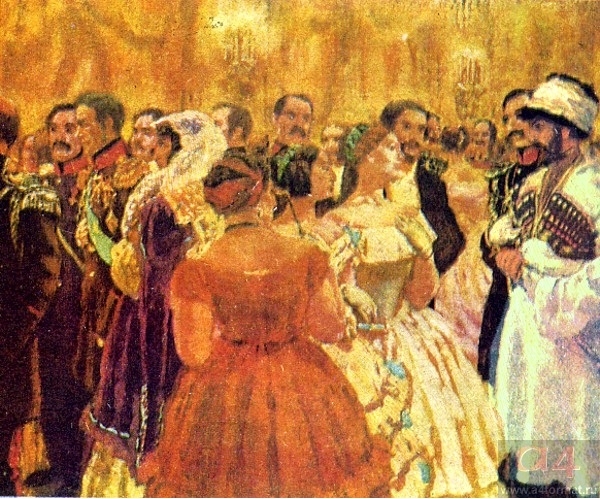
The Russians he meets cannot believe that. They are always trying to work out how he’s planning to betray them. The Russians have a kind of mythic view of Hadji Murat that scarcely corresponds to reality. He’s never been scared, so one rumour goes. But when, in Tbilisi (then Tiflis), he recounts his life’s story to a Russian scribe, we find he has been scared like any other person, if only once. He has one leg short than the other – he’s no monstrous figure. But the Russians almost don’t want to see him like that. When they meet him they aren’t concerned with his personality. At public events in Tbilisi they only ask him one and the same question – “how do you find it here?”. It’s as if they only want to go home and say they’ve met the legendary warlord, rather than actually get to know him.

A painting illustrating Hadji Murat's time in the high society world of Tbilisi. He stands off to one side while various women fawn over him.
An illustration from an early edition of Hadji Murat. The man himself is on the right. Speaking little Russian and unwilling to conform to the arbitrary rules and customs of Russian high society, his first appearance draws plenty of attention.

And what is he really like? A heroic figure, yes, but not only. He scarcely fights during the book. Instead, he’s full of life, with a “child-like” smile – exactly the sort of person who shouldn’t need to die. When he is given a Breguet pocket watch with a minute repeater function he spends hours listening to its chimes. He is also devout, constantly making time to pray and perform his ablutions. In short, he is a good man. If he is once described as like a caged beast, it is not because he’s an animal in Tolstoy’s eyes but rather because he is a victim of the Russian bureaucratic machine, which gradually dehumanises everyone. For Tolstoy the answer to the question “who is to blame” is obvious: the leaders, surrounded by sycophants and insulated from the pain their actions cause. Alas, not much has changed.

Conclusion

I had read ­Hadji Murat once before now, but then I barely understood a thing. My Russian wasn’t good enough, and I wasn’t willing to read slowly enough to compensate for it. This time I was better prepared. Tolstoy’s story demands slow and careful reading, though it is short, because otherwise we run the risk of denying the characters their own dignity. And there are so many exciting people here that I was spoiled for choice when it came to writing this review. Alongside Avdeev and Nicholas I, another one I was particularly struck by was the character of Butler, a young man who loses everything (and then some) at cards after striking up a friendship with Hadji Murat. Even though his role in the overall book is not great, his short story is so perfectly written that I would gladly have read an entire book that carried on his tale.

That, perhaps, is Tolstoy’s ultimate gift. He not only creates characters who are so real that the best of them live inside us, but he also creates characters who are so interesting that they make us realise that everyone around us has their own personal dignity, and everyone deserves attention and respect. Whether man or woman, Chechen or Russian, everyone has their own story, and the world would be better if only we stopped to listen.

For more Tolstoy, I made a translation of a late and fragmentary short story of his here. If you want to know about the spiritual changes that came over Tolstoy after Anna Karenina was finished, and why they spoil his writing, check out this essay of mine.