The Joy of Ideas – Isaiah Berlin’s The Crooked Timber of Humanity

Whether or not we ultimately see the French Revolution as stemming from a disillusionment with the monarchy, bourgeois self-assertion, or hungry peasants, it is obvious enough that after the initial turmoil the leaders who came to share power and chop heads were motivated by ideas of what society should look like, and where it was heading. The Russian Revolution and the early Soviet Union too, for all their betrayals of pure Marxian and Marxist thought, nevertheless contained many actors who took their cues from ideology, and often added their own lines to the drama. Thinkers, both on the right and the left, have been driven by ideas, consciously or unconsciously. And passionately held belief is something that many of us admire and envy, whatever the belief’s content. It is one of the attractions of the fictions of Dostoevsky that his characters believe so passionately in ideas.

Isaiah Berlin is a historian of ideas, but to my mind his closest affinity is to the Russian novelists of the 19th century, including his favourite Turgenev, and not to other historians. Berlin’s work is filled with a serious and excited engagement with ideas, good and bad, hopeful and hateful, so that we ourselves become aware of the sheer force which animates them as well as if we had seen someone slaughtering a pawnbroker with an axe over them or dissecting frogs. This is perhaps no surprise. Born in Riga in the Russian Empire in 1909, Berlin and his family moved to Petrograd (now Saint Petersburg) just in time to witness the Russian capital be torn apart, repeatedly, by revolutions coloured by ideological thought. He moved to the United Kingdom with his family shortly thereafter, studied at Oxford, and became one of the greatest thinkers of his time.

The Crooked Timber of Humanity, subtitled “Chapters in the History of Ideas”, is a collection of Berlin’s essays in which his principle concerns are on full display – the Enlightenment and Romanticism and both of their troubled legacies, and his own idea of “value pluralism”. At the centre of the collection is a magnificent, awe-inspiring essay on the Savoyard reactionary Joseph de Maistre. Besides de Maistre, other recurring figures in this collection include Kant, Herder, Machiavelli, Vico, Rousseau and Voltaire. Many of these thinkers will be familiar to us, at least in passing, but Berlin’s great strength – and the reason I adore him so much – is his ability to make their concerns appear fresh and relevant to our own age. In short, he makes us understand ideas from the inside – their excitement and their pleasure.

Rather than explore each of the essays in turn, here I will explore thoughts he develops throughout them, and why it’s exciting.

The Enlightenment Vision of the World and its Problems

These days the Enlightenment, the period in the late 17th and 18th centuries when clever philosophers, predominantly from France, tried to solve all human problems using reason, now has something of a bad name. Firstly, these eminently reasonable men (and they were, pretty much, all men), were often hypocrites. Kant, as is well known now, failed to apply his philosophy to the savages of the world, and was rather racist; Hume was no better. To my mind this charge, which Berlin does not bother addressing, is far less important than the one that out of their thought came the totalitarian systems of the earth. This is the view which Theodor Adorno and Max Horkheimer wrote about in Dialectic of Enlightenment. Karl Popper, another influential mid-20th thinker, called Plato, with the regimented society and clear social stratification of The Republic, one of the first totalitarian thinkers, and also had little love for the Enlightenment.

It is this view of the Enlightenment as a less-than-benign force that Berlin engages with. In The Crooked Timber of Humanity Berlin is keen to moderate criticism of both the Enlightenment and the Romanticism which followed. He explores how a combination of Enlightenment and Romantic ideas created the groundwork for modern totalitarianism, but need not necessarily lead to it.

Lost Unities – The Decline of Universalism

The Enlightenment was the last period of the world where dreaming of a utopia was in some way possible. It was an old idea that all genuine questions – about our place and goals upon the earth – could have only one valid answer. These answers could be found if we looked hard enough and knew how to do so. Finally, people believed that all the answers were compatible. People answered questions differently, whether due to religious or political thoughts, but nevertheless they were mistaken and simply missing the one Truth which could be found and should be propagated by those who found it. Believing all this makes a utopia – a place of stasis and conformity, possible. It allows for Hegel’s idea of progress, Marx’s idea of communism. It also allows for the rationalism of the French philosophes whose ideas came to justify the terrors of revolutionary France.

Killing people is of course a shame, but when you are building a perfect state, sometimes murder is necessary.

Enlightenment Smashers – Vico, Machiavelli, Herder

Berlin credits different thinkers with destroying these ideas and making way of Romanticism. Machiavelli realised that Classical and modern Christian societies had incompatible ideals. He showed that the honour and violence of Ancient Greece and Rome could not be combined with Christian ideals of meekness and piety. Both places, in short, had different ideas of perfection. Vico, meanwhile, who is something of a hero in The Crooked Timber of Humanity, understood that every culture has its own vision of reality, with its own value systems. He saw that through imagination – fantasia – it is possible for us to enter into another society’s view of the world, without adopting it as our own. Finally, Herder showed that each culture has its own centre of gravity, and would only suffer from taking its inspiration from others. Together these thinkers broke down the idea of universal Truth that had driven the French philosophes.  

German Romanticism and its Legacy

In doing so, they opened up a space for German Romanticism, which was far more intellectual and philosophical than its English equivalent (both made for good poetry, tho). The Romantics focused on a cult of self, rather than the universal. In doing so they made utopias impossible, by encouraging us to see that we each have our own utopia, rather than sharing a common one. Rather than feeling and emotion, what the later Romantics were interested in was the idea of will. We each have our own inner ideal within us, and rather than make peace with the world we must do whatever we can to bring that inner ideal out into the open. The idea of being true to yourself was essentially born at this time.

At first, being true to yourself just meant being a starving artist in an attic. But it left the possibility open of a kind of solipsism, wherein your own vision of the world could grow so powerful that it denied the significance of other people. At this point one was no longer an artist of the pen, but an artist of man, shaping others to create one’s own world. It is this idea – of the disregard for others, of the sense that objective truth is impossible and violence the inevitable consequence of clashing ideas – that Berlin considers the most terrible legacy of Romanticism. It allowed for madmen to take Enlightenment ideas and ignore all criticism, creating rationalist monsters in the early Soviet Union, and terror in fascist Germany.

Caspar David Friedrich’s The Sea of Ice, one of my favourite German Romantic paintings.

Neither the Enlightenment nor Romanticism need necessarily lead to totalitarian violence. Berlin, whose whole life consisted of a passionate and earnest engagement with these ideas, naturally was not willing to dismiss them completely. Instead, he makes it clear how Romanticism in particular also leaves open the possibility of humanism: “The maker of values is man himself, and may therefore not be slaughtered in the name of anything higher than himself, for there is nothing higher.” Abstract ideas have no value in themselves, and the worst thing is to get in the way of another’s will – out of such thoughts grew existentialism, a much more positive set of thoughts than those of either Adolf or Joseph.

Value Pluralism vs Relativism

Berlin’s main contribution to thought – he did not consider himself a philosopher – was the idea of value pluralism, which he built out of the ideas of Vico and Herder about the differences between cultures. Pluralism Berlin describes as “the conception that there are many different ends that men may seek and still be fully rational, fully men, capable of understanding each other and sympathising and deriving light from each other.” For example, those who value liberty above all else, and those who value equality above all else, will discover sooner or later that they cannot have a perfectly liberal and equal society – in other words, that their ultimate ideals are incompatible with each other, even though they are both recognisably good, and recognisably “rational”.

We can understand other cultures thanks to the imagination, or Vico’s fantasia, but we do not have to like them. As Berlin put it in one of the pieces included in the appendix to The Crooked Timber of Humanity, “I must be able to imagine myself in a situation in which I could myself pursue [their ideals], even though they may in fact repel me.” Literature, at its best, is in some way the proof of pluralism – we learn to see other ideals by their own internal light, even though we do not necessarily change our own views as a result.

How is this different to relativism? Berlin defines relativism as “a doctrine according to which the judgement of a man or a group, since it is the expression or statement of a taste, or emotional attitude or outlook, is simply what it is, with no objective correlate which determines its truth or falsehood.” In other words, relativism means that other cultures are unquestionable – we have no choice about whether we accept them or not, because there is too much distance suggested between our own values and those of the other group. Another way of looking at this is to suggest that with relativism, we may understand the values of other societies, but we cannot understand why they would be held. There is an insurmountable barrier between us and others, one that ultimately makes deprives us of a feeling of common humanity.

The Bad Guy: Joseph De Maistre

The majority of the pieces in The Crooked Timber of Humanity explore the ways that value pluralism works and the legacy of the Enlightenment and Romanticism; but by far the longest piece, on the Savoyard reactionary thinker Joseph de Maistre, is much more focused. Berlin’s goal here is to revaluate this thinker, dismissed by earlier historians as a simple conservative. Instead, Berlin argues that de Maistre speaks decidedly to our own time, as a prophet whose ideas in many ways suggest those of fascism. In other words, “Maistre may have spoken the language of the past, but the content of what he had to say presaged the future.”

Joseph de Maistre, Savoyard arch-reactionary. Agree or disagree as we may with his views, he comes across as a quite extraordinarily visceral thinker.

De Maistre was for most of his life a diplomat for the Savoyard king, and his most productive years were while he was in Saint Petersburg during the age of Napoleon. He was popular in Russia, and Tolstoy even mentions him in War and Peace. His ideas were reactionary, rather than conservative. Where the likes of Burke tried to explain conservatism through appeals to sunlit uplands, peace and prosperity, Maistre’s approach was almost the opposite – he saw humanity as irredeemable, a creature that needed the violence of the executioner to keep it in check. Reaction, for de Maistre, was about saving humanity, rather than about protecting some historic ideal of playing cricket on the village green.

In practice, this meant doing everything he could against Reason and its followers. He protected irrationalism, kings and queens, by suggesting that only what is irrational can lie beyond question. Indeed, to begin questioning is already to fall foul of the Enlightenment – one must never question. He hated intellectuals, he hated the free traffic of ideas, he thought that suffering was the key to salvation, and that only a strong state and strong elites can keep our evil urges in check. De Maistre is quoted a few times by Berlin, and he comes across as the most extraordinary thinker – I feel a shiver go down my spine just reading even the shortest of excerpts. He is frightening, like Dostoevsky’s Grand Inquisitor is frightening, because he has beliefs that he believes with all his heart and yet which to most people are complete anathema.

Here’s a taste:

“Over all these numerous races of animals man is placed, and his destructive hand spares nothing that lives. He kills to obtain food, he kills to clothe himself, he kills to adorn himself, he kills to attack, he kills to defend himself, he kills to instruct himself, he kills to amuse himself, he kills to kill. Proud and terrible king, he wants everything, and nothing resists him.”

“Don’t you hear the earth shouting its demand for blood? The blood of animals is not enough, nor even the blood of guilty men spilt by the sword of the laws.”

“In this way, from mite to man, the great law of the violent destruction of living creatures is ceaselessly fulfilled. The whole earth, perpetually steeped in blood, is nothing but a vast altar on which all living things must be sacrificed without end, without measure, without pause, until the consummation of things, until evil is extinct, until the death of death.”

All this makes one giddy. It is so violent, so horrible, and yet it fills one with a kind of awe. For Berlin, de Maistre is one of the history of ideas’ great villains, but he is a player in the drama. And we can all learn something from him. He believed that we do not know what we truly want, that ideas are often disappointing, and that the urge for self-sacrifice, for self-immolation, is just as strong as the desire for shelter or food or warmth. This is not the man of the French philosophes, but then again, as de Maistre says, “as for man, I declare that I have never met him in my life; if he exists, he is unknown to me.”

However much we may wish for ourselves, on the whole, to be rational beings, de Maistre offers a necessary dose of reality, and even if his suggestions of our terrible fallenness and the need for God and authority go far beyond what most of us like or want, still he has value. Otherwise we may end up just as foolish, just as idealistic, and just as dangerous as the Enlightenment, for all its light, turned out to be.

Conclusion

Berlin is exciting because he makes ideas feel real. He can transform a little Savoyard reactionary into a frightening, exhilarating, monster of a thinker, and he can do this with every thinker in the book. This is not because he tells us little titbits from their lives, but because he builds their ideas into something that we must engage with and evaluate for ourselves. Where do we stand on matters of the Enlightenment or Romanticism? However much we may think that they are ancient history, Berlin shows in The Crooked Timber of Humanity that their debates continue to be played out in our own era.

More importantly, in his idea of value pluralism, he advocates for a way of looking at the world which is moderate without losing the ability to judge. We can see what is good and bad in our opponents, without establishing such a distance between us and them as to make dialogue impossible. In our own age, when dialogue feels increasingly pointless, and actors increasingly hidden within the shroud of their own bad faith, Berlin provides a message of cautious hope, a guide to how to approach politics, and one that is hard not to like.

I have also read Berlin’s Russian Thinkers, available as Penguin Classic, and that is another work that I would recommend heartily. Berlin turns various thinkers, most of whom we would never have heard of otherwise, into living, breathing, arguing human beings. For anyone interested in 19th century Russian literature or history, the book is a must-read. As for this one, it’s pretty good too. Read it, think on it.
Why Live Existentially? Simone de Beauvoir’s The Ethics of Ambiguity

I appreciate that most people are not much interested in philosophy. I myself am not particularly interested in questions about metaphysics or the meaning and origin of knowledge, even though plenty of thinkers believe that without understanding these things we cannot even begin to approach those questions which I do find interesting. Those questions are simple – what is a good life, what must we do, where does our meaning come from, and is it to be found at all? Existentialism appeals because it deals with questions relating to our existence, rather than that which may lie beyond it or beneath it. Its focus is on the concrete, the practical, the real and the possible. For that reason it has appealed to many artists and people who are engaged in the business of being alive.

Simone de Beauvoir’s The Ethics of Ambiguity is an essay, or rather series of essays, that aims to introduce existentialism to the common reader. I cannot compare it with Sartre’s Existentialism and Humanism, which was also written in the period immediately after the end of the Second World War and has a similar goal, because I have not read that work yet. However, I have heard many suggestions that de Beauvoir’s piece is a better introduction than her partner’s is to the existentialist project among primary sources. I certainly came away from the book with some understanding of existentialism, at least as de Beauvoir sees it, and this is what I will try to share in the following piece.

The book’s structure is relatively simple. The first essay is a kind of introduction, the second essay explains why people who do not follow existentialism’s tenets are likely to cause trouble in the world, and the final essay explores all the cool things about life under existentialism. Obviously, de Beauvoir’s views are distinct from those of her fellow existentialists like Sartre or Heidegger, so here when I write “existentialism” I mean de Beauvoir’s particular take on it.

Introduction – The World According to Existentialism

Beyond us, there is nothing. There’s neither a higher power nor any other source for our values that cannot be challenged. Existentialism’s world is a world continually in flux, with nothing to hold on to. To say that things are solid, completely solid, whether tradition or morals or whatever, is to lie to oneself and hide from the nature of things. Instead, “it is in the knowledge of the genuine conditions of our life that we must draw our strength to live and our reason for acting”. In other words, we need to work things out for ourselves without relying on the old certainties of life. For each one of us “it is a matter of knowing whether [we] want to live and under what conditions”. Once we have worked out the answers for ourselves, we must live them. But this is much easier said than done.

Dostoevsky is often considered an early existentialist. In The Brothers Karamazov, Ivan forcefully and terribly argues that if there is no God, then “everything is permitted”. De Beauvoir equally forcefully disagrees. On the contrary, “far from God’s absence authorizing all license, the contrary is the case, because man is abandoned on the earth, because his acts are definitive, absolute engagements.” There is no redemption except that which we give ourselves, and no redeeming grace. Freedom in de Beauvoir’s world is dizzying, and it requires us to assume responsibility for our actions. Her enemies in The Ethics of Ambiguity are those people who, consciously or unconsciously, hide from that responsibility.

We are free to do what we want without being bound by past values, but as stated above that does not mean we are given license to do anything. “To be free is not to have the power to do anything you like; it is to be able to surpass the given toward an open future”. By freedom de Beauvoir means the opportunity to create our own paths in life and follow them, acting to grow and develop ourselves. Defined in this way, freedom means we should not impede others as they pursue their own paths, because although our projects are personal, our freedom is increased when more people are free around us. A despot can do what he or she wants, but they are less free when their people are not free. This is because we are connected with other people, whether we want it or not: “no project can be defined except by its interference with other projects”. The more projects are successfully being pursued, the more our collective freedom is increased.

This means that we must be individualistic, according to de Beauvoir, but not solipsistic. And the fact that we need others to be free in order to fully realise our own freedom is where the ethical component of The Ethics of Ambiguity comes from. For although there are no absolute and unchallengeable values, anyone who cares for freedom must necessarily desire its increase. (Hey, isn’t freedom an absolute value for de Beauvoir?)

Women and colonised peoples were the main targets of de Beauvoir’s rallying cry. In many cases unaware of their freedom, the women of the mid-20th century lived sad, deprived lives. Likewise, many colonised peoples did not realise they could and should be free. Under existentialism, we have a duty to help them free themselves from oppression, because in their freedom “new possibilities might be opened to the liberated slave and through him to all men”.

What’s so bad about not being an existentialist?

This mumbling about freedom is probably slightly less vague in the original than in my retelling of it, but nevertheless readers may say that they don’t want freedom for the women, or perhaps more reasonably, that they value tradition, order, organisation. De Beauvoir has no love for conservatives, and the second essay of The Ethics of Ambiguity explores why we have an obligation – a responsibility – to be free. Looking at various groups – the “sub-man”, the “serious man”, “nihilist,” “adventurer”, and others, she explains how their lack of freedom is harmful not just to them, but to everyone.

The Sub-Man

The “sub-man” is someone who merely exists. He acts without a plan or unifying idea. “By the incoherence of his plans, by his haphazard whims, or by his indifference, he reduces to nothingness the meaning of his surpassing” – in other words, he destroys his freedom by hiding from it. As a result, he enters a vicious circle: “the less he exists, the less is there reason for him to exist, since these reasons are created only by existing”. Such a man suffers through life, or at best, is indifferent to it. But because he does not grasp his freedom, he is vulnerable to being grasped by others. A sub-man is dangerous because others can control him and use him for evil ends – de Beauvoir might have had in mind the widely-publicised trials of Nazis in the postwar period, and the ambiguous condition of the German people themselves, who had in many cases so blindly followed orders.

The Serious Man

The “serious man” is by contrast someone who does have an idea. He sets himself up with an ideal and allows nothing to challenge it. He betrays his own freedom by ignoring it as soon as he has used it once – in the act of choosing his ideological goal. The serious man “puts nothing into question” and thereby sees the whole world through the prism of utility. Is something useful for his goals, or not? And this means that he comes to devalue everything around him, especially people. De Beauvoir gives as an example the colonial administrators who valued Empire more than they did the lives of the inhabitants of their colonies, with the result that the building of a railroad became infinitely more important to them than any native lives lost in the process. At the same time though, these men are dependent upon their idol. As soon as they lose it, their life is filled with anxiety and despair. One thinks here of certain businessmen or generals whose retirement deprives their lives of their meaning. Because they do not value freedom, but only the governing idea they choose for themselves, their life collapses when that same idea is removed or fails.

The Nihilist

“Nihilism is disappointed seriousness which has turned back upon itself”. A nihilist wishes to believe in the same idols that serious people do, but they can’t, making them revolt against them. Revolt is an important part of The Ethics of Ambiguity, but not as the nihilist does it. Unable to find the seriousness within themselves, they destroy the sources of seriousness – the idols – of others. They end up destroying anything that anyone values, in order to confirm their own view of the world as meaningless. This is a mistake, in de Beauvoir’s view. “The nihilist is right in thinking that the world possesses no justification and that he himself is nothing. But he forgets that it is up to him to justify the world and to make himself exist validly”. The nihilist basically forgets to be free; he forgets that beyond the idols there lies something worth valuing – freedom itself.

The Adventurer

Adventurers are fun characters. At first they seem to be perfect existentialists – they focus on action, not on idols or rumination. They also are driven by a swashbuckling enjoyment of life – one thinks of Don Juan. All this is good, but there are a number of issues within the adventurer’s hedonism which de Beauvoir highlights. The first is solipsism – the adventurer does not value freedom for itself, so they do not care about others at all – “the adventurer shares the nihilist’s contempt for men”. Also, adventurers often have secret goals, making them serious, even though they hide it – for example, the pursuit of glory, money, power. The main problem is this lack of respect for freedom, however, because it means that “favourable circumstances are enough to transform the adventurer into a dictator.” And in 1948 nobody was a fan of those.

What’s so good about being an existentialist?

Those were the bad guys, but what I liked about The Ethics of Ambiguity is de Beauvoir’s depiction of the good guys and how existentialism makes life exciting. Of all the ways of being, existentialism is the one, in de Beauvoir’s view, that is most firmly rooted in lived experience. It has its virtues, ones that are unambiguous: “What is called vitality, sensitivity, and intelligence are not ready-made qualities, but a way of casting oneself into the world and of disclosing being”. These are valuable because “the reward for these spontaneous qualities issues from the fact that they make significances and goals appear in the world. They discover reasons for existing”.

To be free is to live in a world of ambiguity, but it is also to live in a world of potential. De Beauvoir quotes Heidegger: man is “infinitely more than what he would be if he were reduced to being what he is”. In other words, we should never be treated as what we are because we are always capable of growth. The great power of freedom is that it provides a secular redemption to make up for the religious one we lose – we can always change our path, and no moment is too late to change ourselves.

At the same time, we get on with the business of being alive. Our projects build ourselves up – the future, “prolonging my existence of today, will fulfil my present projects and will surpass them toward new ends”. There is no reason to fear death, because it is precisely through death and failure and our limitations that meaning is possible: “a man who would aspire to act upon the totality of the universe would see the meaning of all action vanish”. If we look too far in the future, as de Beauvoir suggests the Marxists do with their utopian dreaming, then all of our action is devalued: “from that formless night we can draw no justification of our acts, it condemns them with the same indifference; wiping out today’s errors and defeats, it will also wipe out its triumphs”.

The future matters to us only insofar as it exists to us – we must live in the moment, and in the potential of the future. To live entirely in the present is to devalue others, while to live too far in the future is to devalue everything. De Beauvoir has a lovely phrase against those who think too far ahead: “an action which wants to serve man ought to be careful not to forget him on the way”. She wishes our ethics to be concrete, to be focused on specific moments. She does not condemn violence when fighting oppression, but instead asks us each time to consider whether it is what is needed or not. This may seem frustratingly vague, but the point is to make us constantly question ourselves. De Beauvoir’s freedom means we must erect no idols, but instead ask ourselves, again and again, whether what we are doing is right, and how it is contributing towards our goals. We must never say “it is useful”, but rather “it is useful for me, for this goal, now”.  

All this may sound rather challenging. We must choose our projects, we must work constantly upon our growth and the attainment of our goals. Nevertheless, de Beauvoir makes it clear that life needs joy too, for freedom without joy is nothing: “the movement toward freedom assumes its real, flesh and blood figure in the world by thickening into pleasure, into happiness”. All the gains in the world, and all the development, “have no meaning if we are not moved by the laugh of a child at play. If we do not love life on our own account and through others, it is futile to seek to justify it in any way”. As important as it is to worry about freedom and good faith, I’m glad that de Beauvoir remembers that we must have our joy. And indeed, I struggle to see how life would be worth living if we lost our sensitivity to that.

Conclusion

The pursuit of a meaning that “is never fixed, that… must be constantly won”, sounds a reasonable approach to living. It appeals a lot to a 23-year-old who has finally finished university and is now alone in the big world, trying to work out what it is he must do with himself. I cannot critique the philosophy behind de Beauvoir’s suggestions – the first essay has a lot of beings and existences and other such terminology that I struggled to appreciate or fully wrap my head around. Can I critique it as a way of life? Perhaps. If we value happiness more than freedom, we may be dismayed at the unhappiness de Beauvoir’s demands of revolt could potentially cause. To bring consciousness of their oppression to the working classes, to the colonised, to women, is to invite them to become aware of suffering that may sometimes be hidden from them. That they would be happy later is perhaps a not all that important. For that reason, de Beauvoir will convince no conservatives to abandon their values and traditions, and her chaotic ambiguous freedom will never appeal to those who prefer order. It is not clear whether it would necessarily create a better world either.

And yet, for an individual, this philosophy cannot help but be attractive. The consequences for one who is indecisive are great. Existentialism, in de Beauvoir’s mode, is a call to action, to responsibility. That’s cool. I like that. I recently read Sarah Bakewell’s brilliant At the Existentialist Café and one thing I found awesome about it was just how awesome de Beauvoir and Sartre really were. They lived existentialism. Where Kierkegaard’s Christian existentialism, however admirable, had him torturing himself with self-doubt, de Beauvoir and Sartre were having fun, having sex, and being free. To have there be congruence between one’s words, thoughts, and actions – there can be no greater thing. And de Beauvoir’s essays are a valuable call to action to that end.


For more from the Paris of the mid-20th-century, read my piece on Boris Vian’s Mood Indigo, also known as Froth on the Daydream.

Ray Monk’s Ludwig Wittgenstein: The Duty of Genius

What is attractive about Ludwig Wittgenstein is that he was a real genius. I did not gallop through Ray Monk’s Ludwig Wittgenstein: The Duty of Genius because I wanted to know about Wittgenstein’s philosophy – I did it because I wanted to know about the man. Wittgenstein’s thoughts on language are worth knowing about, sure, but certainly not near the top of the pile of philosophies I want to have a grasp of. Though Monk’s biography gave me some sense of Wittgenstein’s thoughts, the focus here was more on his life. This approach works because, for me at least, the parts of Wittgenstein’s thought that are most interesting are precisely those that came from his life – such as the way the mystical sections of the Tractatus came from Wittgenstein’s experience in the First World War.

Rather than summarise a summary of Wittgenstein’s thoughts, I thought I’d note here the parts of his life that struck me as particularly entertaining, saddening, or interesting. Being such a unique personality, Wittgenstein provides plenty of all three.

The Briefest of Biographical Summaries

Wittgenstein was born in Vienna to one of the richest of all Austrian families and had an extremely privileged upbringing. But the Vienna he was born into, at the tail end of the Austro-Hungarian Empire’s life, was not a happy place producing happy people. I counted at least five suicides in the first chapter of Monk’s book alone – three of them Wittgenstein’s brothers. Our hero moves to England for his studies, meets a number of philosophers including Bertrand Russell who all eventually come to consider him a genius. He spends time in Norway and as a soldier, works as a teacher and gardener, goes back to Cambridge to teach, helps out in the Second World War behind the scenes, and finally dies. Given that the lives of most philosophers are little more interesting than that of Immanuel Kant, who never left his province, Wittgenstein’s life of action is rather exciting.

Genius and its Duty

One thing making Wittgenstein interesting is that he was not a scientist and did not see philosophy as scientific. Instead, he approached philosophy creatively. At one point he shocked the boring old gits of the Vienna Circle of philosophers by recommending they read Heidegger and Kierkegaard. He also lectured primarily using the power of inspiration, standing in the lecture hall or else pacing until a thought came to him, and then announcing it to enraptured onlookers. Most importantly, Wittgenstein’s whole character was artistic. Monk quotes Russell here:

“His disposition is that of an artist, intuitive and moody. He says every morning he begins his work with hope, and every evening he ends in despair.”

At another point Russell had Wittgenstein pace up and down his room for three hours in silence before Russell finally asked: “Are you thinking about logic or your sins?” “Both,” Wittgenstein replies, and continues his pacing. 

The language of sins is surprising to people who like me think of Wittgenstein as a boring logician. In reality, Wittgenstein was of a decidedly religious sensibility. His major influences appear to be Tolstoy and Dostoevsky – Hadji Murat and The Brothers Karamazov are just two of several books by the authors that Wittgenstein adored and passed out among his friends. Acquaintances compared him to Levin from Anna Karenina and Prince Myshkin from The Idiot. Though he was raised a Catholic, Wittgenstein did not believe in the Church’s dogmas, even as he believed in a kind of God and definitely believed in his own sinfulness.

Sin, for Wittgenstein (as it was for Tolstoy), was determined by his own conscience: “The God who in my bosom dwells”. What Wittgenstein feared most of all was judgement – “God may say to me: “I am judging you out of your own mouth. Your own actions have made you shudder with disgust when you have seen other people do them.”” He was never happy with himself. He expected nothing less than perfection from himself, that beautiful but impossible congruence between one’s thoughts and one’s actions. At one point he made a confession to all of his friends in an attempt to rid himself of his pride. Instead, he just annoyed them. Few were interested in listening to all of his minor failings.

But Wittgenstein believed that he had a duty to be perfect – the duty of genius that Monk uses as his biography’s title. By perfect I do not mean in conduct so much as in the sense of squeezing out of himself as much philosophy as possible, by any means possible. At one point Wittgenstein was struggling from overwork, but rather than take a break as his friends suggested, he decided to try hypnotherapy to help him concentrate even more successfully. At another point he decides to abandon the world to live in a hut in Norway and write philosophy.

Russell, ever sensible, warns him against it:

“I said it would be dark, & he said he hated daylight. I said it would be lonely, & he said he prostituted his mind talking to intelligent people. I said he was mad & he said God preserve him from sanity. (God certainly will.)”

Wittgenstein does not listen. He does not listen to anybody at all. In many ways he reminded me of Tolstoy, who like him was sceptical of doctors and medicine, and had an all-consuming desire to be perfect: “How can I be a logician before I’m a human being! Far the most important thing is to settle accounts with myself!”

And Wittgenstein is miserable as a result: “My day passes between logic, whistling, going for walks, and being depressed.”

As he gets older Wittgenstein mellows in some ways, thanks in part to his loves, male and female. The sheer obstinacy of his youth is less visible, and there is less of the humorous, if sad, determination to ignore everyone else’s opinions or suggestions. 

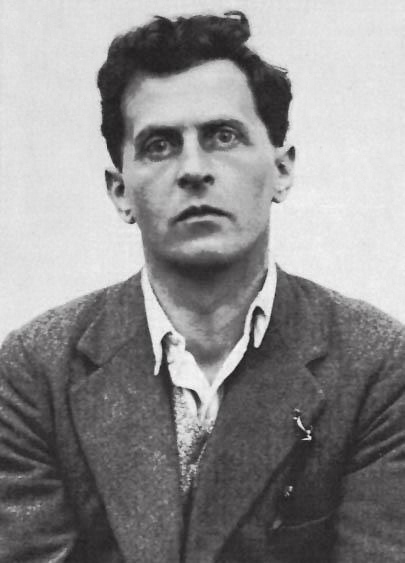
A photo of Ludwig Wittgenstein
Rather than reading this piece one should really just stare at this face for five minutes or so. I cannot be alone in thinking that Wittgenstein’s gaze pierces into the soul.

The Dark Side of Genius

Wittgenstein’s perfectionist demands upon himself were ones that affected everyone around him, and rarely positively. He shows a remarkable lack of concern for others’ feelings and emotions, especially those of his partners. Even though when asked how to improve the world he declared that all we could do was improve ourselves, his attempts at self-improvement rarely seem to improve either him or the world. He loses friends at every turn – including Russell himself. His vaguely Tolstoyan ideal of a good life – working with one’s hands while developing spiritually – is not one he himself follows, stuck in Cambridge, but is one he forces on others, including Francis Skinner, one of his partners.

When Wittgenstein actually encounters “the common man”, said man rarely proves the best of us. Wittgenstein dislikes his soldierly comrades in the Austro-Hungarian army, and during his years of teaching in the mountains of rural Austria he ends up being a dreadful teacher for anyone lacking ability. Wittgenstein preferred to use fists to ensure mathematics got into his pupils’ heads, rather than patient and repeated explanations. At one point he even knocks a poor child unconscious, for which he is taken to court.

As for the intelligent people in his life, they are rarely treated by Wittgenstein to any greater kindness or concern. Of one friend he said: “he shows you how far a man can go who has absolutely no intelligence whatsoever.” When another writes to him, wishing him well in his work and social endeavours, Wittgenstein responds especially pleasantly: “It is obvious to me that you are becoming thoughtless and stupid. How could you imagine I would ever have “lots of friends”?” And indeed, after reading such a letter, how could we doubt his social abilities?

Wittgenstein’s determination to destroy himself in the name of perfection ruined any chance at happiness, even though he thought that perfection would be what would finally provide him with it. In this Wittgenstein is no different from many other depressed people, your blogger included, who set themselves impossible tasks and achieve nothing but their own misery thereby. I found one moment particularly amusing in connection with this. Wittgenstein finally sees a doctor for some exhaustion and pain he was suffering from and gets given some vitamins. Once he takes them, he immediately recovers and returns to work. Rather than lying in his moral failings, perhaps his inability to work could have just lain in his poor health. However, in his determination to see everything through the lens of his own sinfulness, Wittgenstein obviously never considered the possibility that he might just need to live a little more healthily, eat well and sleep.

Conclusion

Wittgenstein wrote that “the way to solve the problem you see in life is to live in a way that will make what is problematic disappear”. It’s a good idea, but Wittgenstein clearly chose the wrong way to live. Clearly? Wittgenstein achieved a great deal, his work revolutionised philosophy, and on his deathbed he was able to request that his friends be told he’d “had a wonderful life”. Alas, his life rather epitomises that dreadful, unbridgeable divide between happiness and achievement. The best happiness demands limited goals, while the greatest goals demand the sacrifice of (at least) part of our happiness. We may read Ludwig Wittgenstein: The Duty of Genius and say that Wittgenstein really just needed some good meds and some CBT for his OCD and other problems, but somehow that doesn’t sound quite right to me.

Would he have been able to work so well if he did not have this way of life, this drive? Wittgenstein was a genius – he had a self-appointed duty to destroy himself in the quest for a better way of philosophising. What is important is that Wittgenstein could squeeze more philosophy out of himself. Can we, depressed perfectionists, really hope to achieve that much more by destroying ourselves, or should we just cut our losses and be sensible, care about ourselves and the world, and eventually find that thing that others talk so lovingly about – happiness?

I don’t know.