What Does it Mean to Hate God? – Misotheism and Literature

I have always been interested in faith. Growing up in a wasteland, with the boundless sea on one end of my vision and high mountains enclosing the other, it would probably be strange if I hadn’t been left feeling like something was out there. But for me, the faith itself has always been more interesting than the container into which that faith was poured. Perhaps that’s because I myself have believed in many things, and from each of them in turn departed, disappointed in either myself or in the ideas themselves.

Dostoevsky was my literary catalyst for thinking about faith. Time and time again, he produced characters who believe in something – whether it’s a kind of superman, like Raskolnikov; or God’s injustice, like Ivan; or that menacing nothingness of Stavrogin. For the Russian mind, faith is almost a fact of life. As Dostoevsky himself wrote, only a Russian can believe in atheism.

A photo showing the light and hills of Scotland
The Highlands of Scotland, the place where I grew up. To live in such a place without believing in something is impossible, whether it be named God or nature.

This piece was motivated not by Dostoevsky though, but by two poems, which recently made me think about a particular type of faith. Misotheism, or hating God, is not the same as disbelieving in him. It is an entirely different kettle of fish. It is not to consign oneself to an eternity of void and emptiness, but to actually take arms against a hostile God and willingly go to hell sooner than submit to his will and failed world. To me, it is the ultimate act of bravery, of courage – but it is an act that has lost its meaning. So part of this essay will also ask what action, what rebellion, could today hold the same significance as turning one’s back on God. Could anything?

Two poems of Misotheism

Two writers, both Germans, started me off on this train of thought. Goethe’s “Prometheus”, and Friedrich Hölderlin’s “Hyperion’s Song of Fate”, both present a view of the world where there is a turning against God, a rejection of him without a denial of his existence. It was the height of German Romanticism, where rebellion was valued for rebellion’s sake.

Goethe’s Prometheus

Goethe’s work is the one that most embodies Misotheism. In “Prometheus” Zeus, who stands for all gods, is subjected to an attack from Prometheus himself. There is no respect here, none whatsoever. The gods would die, “If children and beggars / Were not trusting fools”. They have never helped the speaker – his only source of strength and achievement has been “My sacred glowing heart”. The poem shows the journey from a positive belief to Misotheism. “While yet a child”, Goethe writes, “I turned my wandering gaze / Up toward the sun” – nature, the source of almost all great belief, is the source of Prometheus’s belief also, but it is a belief that dies. “Who helped me / Against the Titans’ insolence?” – not the gods, but his heart alone.

Prometheus, in rejecting god, finds strength in that rejection, as the last two stanzas show. He does not learn to hate life, “Because not all / My blossoming dreams grew ripe”. Instead, he builds a new race, a people “To suffer, to weep, / To enjoy, to be glad, / And thee to scorn, / As I!”. In opposition to the boring perfection and isolation of the gods, lopping off the heads of thistles up above, Prometheus demands the birth of a people who will experience life, in all of its colours and shades of feeling. Rebelling, we take our attention away from the gods, and bring it down to earth. In so doing, though we will suffer, we will also be able to create a pride in ourselves. Only in independent opposition to god can we truly love ourselves. Such is the idea of Goethe’s Prometheus.

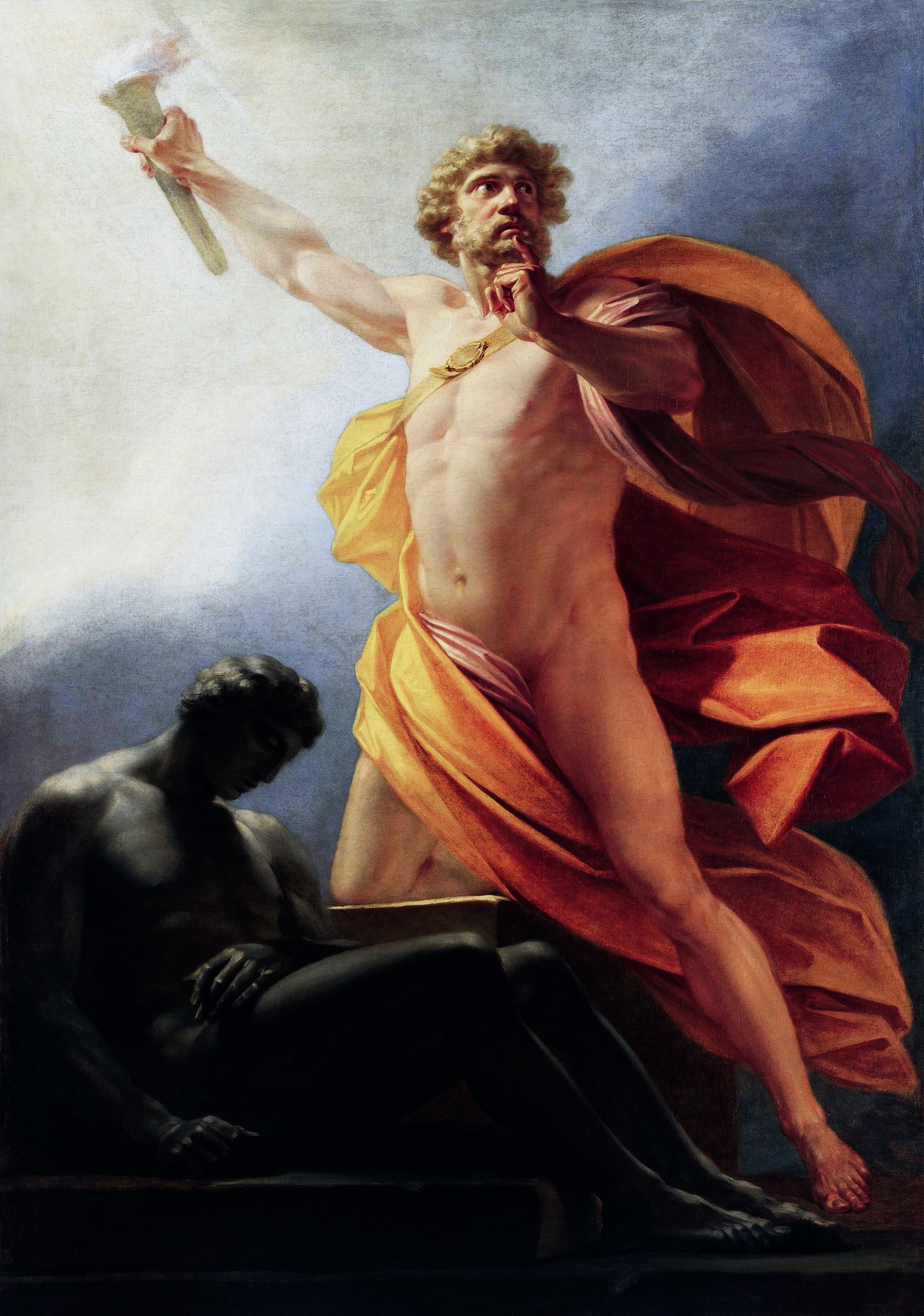
A painting showing Prometheus bringing fire to humankind.
Heinrich Füger, Prometheus Brings Fire to Mankind. Goethe’s poem presents a Misotheism where our suffering becomes our salvation, letting us experience the world more intensely than the gods above.

Hölderlin’s Hyperion and his Song of Fate

Friedrich Hölderlin’s poem, “Hyperion’s Song of Fate”, is not in and of itself an example of Misotheism. As with any poem, it is highly interpretable, and as I tried just now to find a translation for the blog the matter gets even harder because none that I have found really seem to get at what I myself see when I read the German. Given that, I’ll have a go at translating the bits I need myself.

Hölderlin’s poem is broken up into three stanzas. The first two address the gods, who “wander above in the light / On soft ground”. Their life is easy, one of art and of breezes. Unlike us they are “Schicksallos” – fateless, or without a destiny controlling them. But Hölderlin, at least to me, does not find in this situation anything to be envious of. The gods are like children – he compares them to the “Säugling”, or “babe”. And I read in his description of their “eternally blooming” spirit and “eternal clarity” of their eyes, with his repetition of the word “ewig” – eternal – a kind of scorn. In another poem, “To the Fates”, Hölderlin asks the Fates not for eternal life, but just for “one more year” to ensure he can achieve all of his creative potential. He does not want to be a boring god, but a successful human being.

Compared to his treatment of the gods in the first two stanzas, this is how he describes our kind:

But for us it is given,
On no place to rest - 
We fade and we fall,
We sufferers of fate,
Blindly from one
Hour to the next,
Like water that's thrown
From cliff onto cliff,
Year by year down into the unknown.

I read rebellion in these lines. Not in Goethe’s sense, not in the sense of an active revolt. But rather in the sense that Hölderlin wishes to show that in spite of our suffering – he doesn’t shy away from showing it – we still have a kind of dignity. “Year by year” we suffer, the playthings of fate, but it is precisely in this suffering that we find our uniqueness and redemption. I admit my idea’s perhaps too much indebted to Dostoevsky, but I do think Hölderlin may have had something similar in mind. We have “no place to rest”, which sets us apart from the gods, eternally resting up above. But their rest is not valuable – in our struggle we are achieving great things, we are actively living. As with “Prometheus”, “Hyperion’s Song of Fate” finds humankind’s glory in terms of our activeness, versus the gods’ passivity.

Job

Both Goethe and Hölderlin turn to a kind of Misotheism in response to the gods’ passivity. Joseph Roth’s Job: The Story of a Simple Man, which I have written about here, takes a different approach. Here, Mendel Singer, the modern Job that is the hero of his story, turns against God because of God’s cruelty. Mendel teaches children his religion, he has served and believed in God all his life, and yet God has made him lose one son to the Russians, killed another son in war, disappeared the third, and left Mendel’s daughter in a mental asylum. Mendel’s faith has not simply not been rewarded – God has actively spat on it. As Mendel yells, “The devil is kinder than God. Because he is not as powerful, he cannot be as cruel”.

Mendel is ultimately unable to burn his bible, but for a moment his Misotheism has reached heights of emotional intensity that not even Goethe and Hölderlin are able to reach. The reason for this is simple – the distance that Mendel has to travel is greater. He goes not only from faith to hostile faith, but from a loving faith to a hostility that has all the signs of despair.

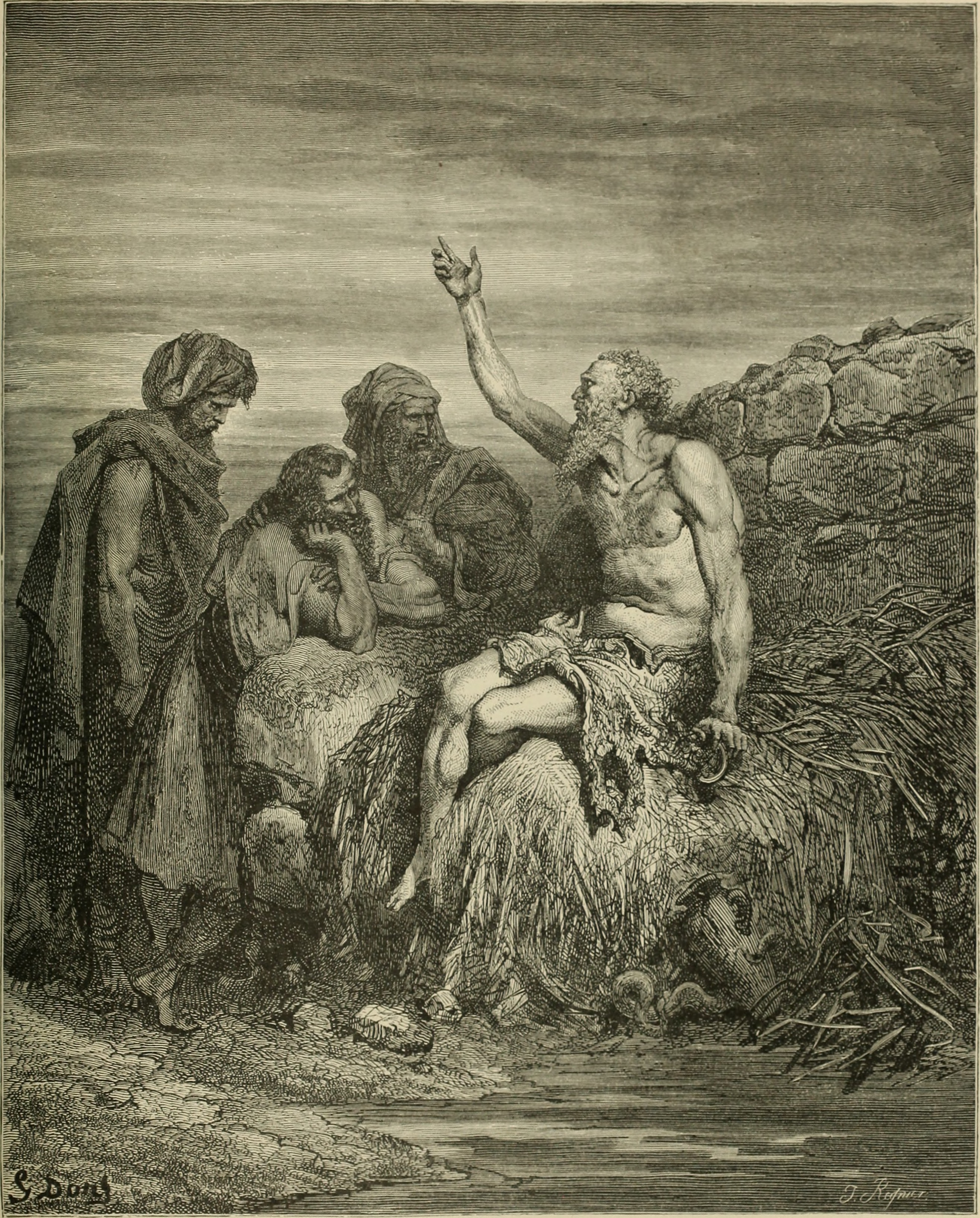
An illustration of Job, conversing with his friends. Job's Misotheism is powerful because of the emotional distance he needs to travel when rebelling.
Job, as illustrated by Gustave Doré. Job’s suffering gains its power by just how far he has to go to turn against God, from love all the way to hate.

Ivan

Ivan Karamazov, of Dostoevsky’s Brothers Karamazov, is no Job, but his Misotheism is equally powerful. When he declares that he is “returning his ticket to God” his reasons are not personal, but universal. He is concerned with the problem of evil, that thorny thicket that poses a challenge for anyone with religious belief – why does an omnipotent, omniscient God allow evil to exist? In the great chapter, “Rebellion”, Ivan tallies up God’s injustices not against adults, who after all have had time to sin, but against the children. For the suffering of children is the hardest suffering to justify, emotionally speaking, and for Ivan it is too much. He returns his ticket, turning his back on God without denying his existence. But unlike Job, or Goethe or Hölderlin, Ivan’s rebellion is not only Misotheism, but also a kind of Apotheosis – a kind of becoming God.

Because what Ivan wants is a better world. He wants, in a way, to be the God that God isn’t – kind and helpful and good. Because he turns our ideas of Misotheism on their head, he is in some sense unique among the misotheists. And his struggle is, for me, particularly tragic, precisely because it is doomed. One can successfully hate God, one can successfully rebel against him in the name of freedom for oneself, but one cannot rebel against God to make the world a better place. Or at least, one cannot achieve that goal, because we are not gods here on earth. But Ivan’s Christ-like determination to try, to take the sins of the world upon his shoulders and try to solve them, that makes his rebellion, his Misotheism, so glorious, so magnificent, so powerful.

Why is going against God so powerful?

It has been a whistle-stop tour of literature’s Misotheism. What we have seen is that under the unifying banner of rising against God or gods a great many motivations and aspirations can coexist. I find them all compelling, exciting. To go against God is to condemn oneself, it is to love life so much that we turn our back on anything beyond it. That requires great emotional depths – great suffering, great bravery. It requires, in short, determination and passion.  

But Misotheism has lost its touch. As a rule, we do not believe in God anymore, which means we cannot go against him. We can still be impressed when someone turns their back on God, but only at a surface level. Deep down, we’re still a little confused as to why they bother believing in the first place. I am not saying that society, in the West or anywhere else, has become atheistic. Instead, we have simply lost God. So when we have such anger, as felt Ivan, as felt Job, we have no outlet for it. There is no target. Our God now is the wind in the reeds, and just as difficult to catch. As a result, we cannot fight.

At its heart, Misotheism is a rebellion against a deeply held belief. This is still possible in our own time. A religious person can still go against God, a communist might turn against their beliefs after reading about their historical applications, while a capitalist might lose faith in their system’s ability to solve all problems. Someone who loves their family might turn against it. But what is true is that we have lost a universal belief, binding us all together. Almost everyone, publicly at least, believed in God in most of the 19th century. Charles Bradlaugh, the first British atheist MP, only joined Parliament at the end of that century. Misotheism was powerful in literature because it was a universal theme – now that is not the case. So perhaps the question is, what has replaced it?

Nietzsche – a modern alternative to Misotheism?

Friedrich Nietzsche is the person I naturally turn to when I think about religious faith in the modern era. In The Joyous Science section 125 he writes about the madman in the marketplace, who declares that “God is dead”. This declaration wasn’t designed to shock Nietzsche’s readers, just as it doesn’t shock those in the marketplace. Almost everybody in the 19th century, just as they publicly acknowledged God, privately also didn’t much care for his existence. But they went no further. Without God’s existence, Nietzsche points out, we must live differently. We must interrogate every one of our underlying conceptions and ideas to determine which have a solid basis, and which are only the legacy of a religious system we now ought to throw away. That was Nietzsche’s project, and it was a failure. Most still live by those past values as before.

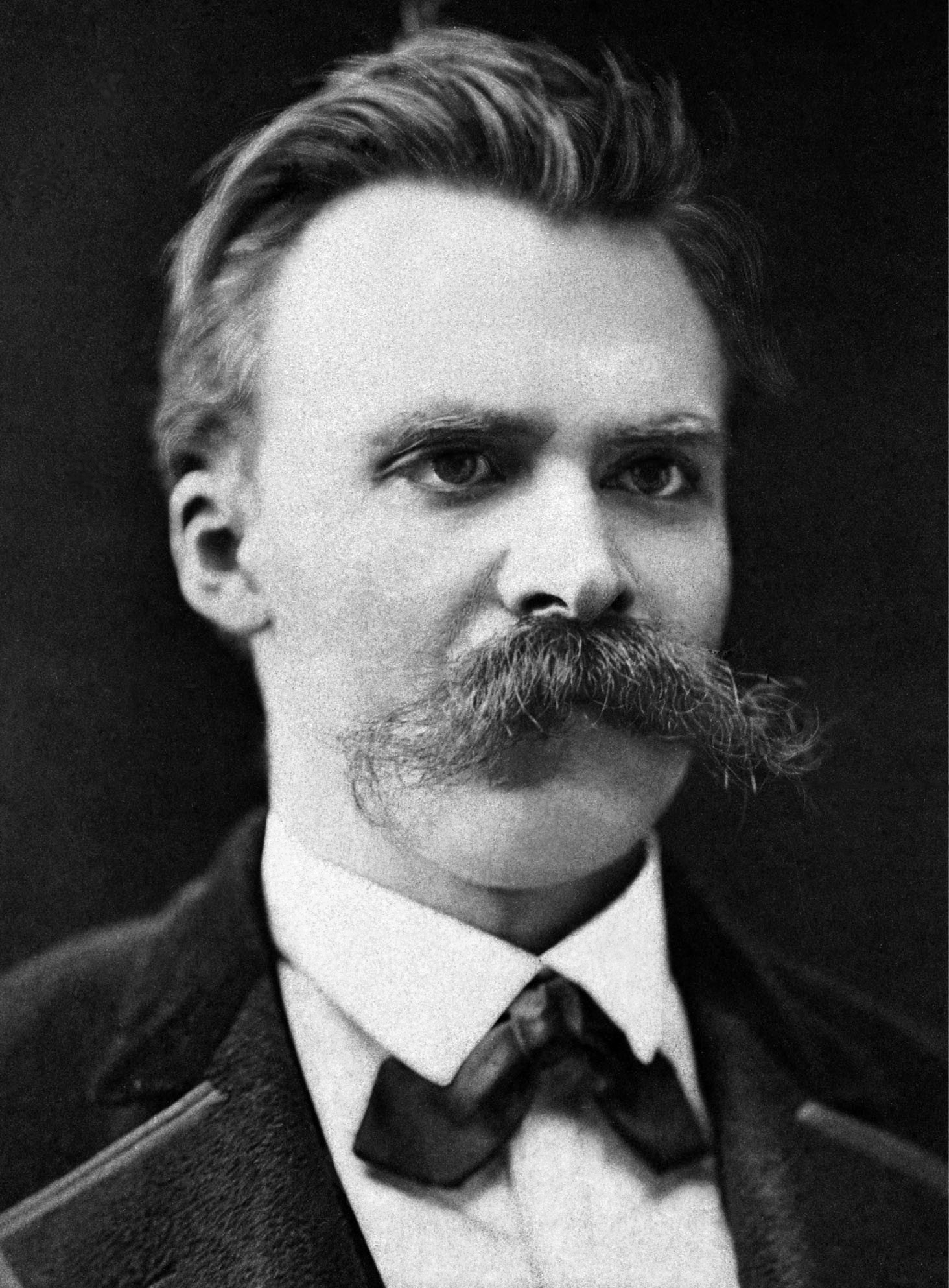
A photo of Friedrich Nietzsche
Friedrich Nietzsche describes with his philosophical works a world in which the very rebellions that Misotheism describes – against the gods, to favour the lived life on earth – would become unnecessary. Unfortunately, nowadays we do not love the world like Nietzsche had hoped. And as a result, there is no modern act analogous in power to rebelling against the gods. We neither believe in God nor in the earth.

In Thus Spoke Zarathustra Nietzsche makes what I consider his hope for what a modern version of Misotheism would look like. It would be, essentially, a reversal of the traditional one. Zarathustra, the prophet of the book, declares in section 3 of his Prologue that “To blaspheme the earth is now the most dreadful offence, and to esteem the bowels of the Inscrutable more highly than the meaning of the earth”. With Goethe we saw the most powerful and touching rebellion as moving from a focus on the divine to a focus on the earthly. In its place Nietzsche sees the most spirited (but here wrong) rebellion as one that rejects the earth instead. If Nietzsche’s project had been successful, he would be right. We would all be stunned and impressed by those who reject the earth for God, even as we mostly disagree with them.

It is not so.

Religious Terrorism as a Nietzschean Misotheism in practice

We do not believe in anything. What Nietzsche feared most of all, the descent into nihilism he saw as inevitable so long as we continued along Christian lines of thought, has come to pass in the West. We have lost our spiritual centre but have put nothing in its place. Of course, there are exceptions. Many of us now have a weak spiritualism and think of a kind of God up there, even if we cannot quite make him out. But this faith is personal, and rebellion against it is an act of mind, and not of body, as it is with Ivan, with Job, with Hyperion and Prometheus. It is less tragic to witness, and more simply sad. Few of us love the earth, because we do not have a connection to it. We are trapped in cities, desperate to survive, preyed on by systems far more powerful than ourselves.

But to rebel against these systems is nothing special either. Because nobody really supports them. Terrorism is perhaps the closest thing to a reverse-Misotheism in Nietzsche mould, but I have not one positive word for it (obviously). There are no positive angles to terrorism for anyone except the perpetrators: none of the hope and kindness of Ivan, none of the love of freedom and emotion of Goethe’s Prometheus. The power of Misotheism lay in the fact that when we rejected God we rejected him for something that in our hearts seemed even greater. With terror we reject the world for something lesser.

Conclusion

I wish I knew what the answer was to these problems of faith. I wish I knew a way to bring a kind of faith back. Not one that takes us from the world, but one that binds us to it, and to each other, more closely. At times I have felt like literature, truly great literature, can achieve this. I think of Levin in the fields, or Ivan again – these people made me want to live. They affirmed life, when nowadays most of us only live it. But literature only offers a kind of personal salvation. The only way to make people live, that I have found, is to get out and live yourself, and lead by example. Only then do we recapture some of the heroism, some of the bravery, that makes Misotheism in these great works of literature so powerful.

Thanks for reading. For more Dostoevsky, here’s Crime and Punishment; my review of Roth’s Job is here; as for thinking about the state of the modern world, Joker, Capitalist Realism, and Sally Rooney’s Conversations with Friends all have things to say.

If you enjoyed the piece and have thoughts of your own, please leave a comment. I’d love to hear what others have to say about the ideas I have discussed here.

Burning to the Last – Sándor Márai’s Embers

Sándor Márai’s Embers is the second work of Hungarian literature that I’ve read after Satantango, but I’m not quite sure whether “Hungarian” is the best word for describing this short novel of ageing and decline. For though Embers was published in 1942, its attention is focused back towards the past, when Márai’s country (he was born in 1900) was Austria-Hungary and not the dislocated Hungary it became after the Treaty of Trianon. The sheer nostalgia for a Vienna that once was, for a life that once was, is unmistakable. Márai had even once considered writing in German instead of Hungarian, in the same way that Kafka, another citizen of an empire that disappeared, felt compelled to choose between Czech and German. They made different choices, but a common sensibility, a common heritage, ties them, and Hofmannsthal, and Rilke, and so many others, together. They were once all Austro-Hungarians.

Sándor Márai (1900-1989), only recently was “discovered” by the literary establishment, but his incorporation is in full swing. Embers is his most famous work, it seems.

The Plot of Embers

In the castle there lives an old general. The General (his name – Henrik – we learn later, but the sheer formality and seriousness by which he lives means that the text rarely refers to him by it) lives with his servants, chief among them Nini, a 91-year-old who once served as his nanny and wet nurse. He has lived, almost without any contact with the outside world, for many years. People come to his estate to hunt in the expansive grounds, but they stay in the hunting lodge and do not see the master. The general’s wife died young, and his only friend disappeared 41 years ago. His life is one of looking back. We are told early on that “he thought only in decades, anything more exact upset him, as if he might be reminded of things he would rather forget”.

But the things that we wish to forget are often the things that keep us going. The novel begins when the General’s peace is at last disrupted by a letter, informing him that this friend will be coming for dinner that evening. The scene is set for a walk through the past, an untangling of confused memories, and a working out of something akin to the truth. But when life is almost at its end it is precisely truth, hazy and unpredictable, that can be the most valuable thing in the world.

The original title of Embers, A gyertyák csonkig égnek, is literally translated as “Candles burn until the end”. And indeed, most of the story takes place by the fire, and each chapter mimics the slow decline of life as the red glow grows dim, before finally going out. At first the General and his friend deal with their common past in the military academy and service, both in dialogue and in reminiscences, but with time they move ever closer to the present, and to the questions that have been tormenting the General for all those years that they were parted. These questions, as he himself says, are perhaps what have been giving him the strength to stay alive all this time.

Male Friendship

It is a friendship that needs to be worked out. Konrad, the returning friend, tried – the General is sure of it – to kill the General on the day of a hunt, 41 years before the novel takes place. He tried to do this, perhaps, because of a secret relationship with the General’s wife. The day after the hunt Konrad disappeared and the General’s wife ceased talking with him. The General wants to understand what happened, and why, but as the one-sided interrogation is carried out by the fire – Konrad almost never speaks, even to defend himself – we get the strange feeling that the General is trying to save himself, just as much as he’s trying to save his friendship.

The novel is unusual in the focus it lays upon friendship, particularly male friendship. I can’t think of many other books that do so. Destructive forces, even love, always seem to take precedence over the banalities and subtleties of friendship when it comes to novels. No doubt because they’re much more dramatic. But friendship is an important topic, even if it’s one that is already in a way outdated in the way we encounter it in Embers. The two kids meet at a military academy, where they spend every day and night together. And though they have different backgrounds – Konrad is poor, while Henrik is wealthy – and share different worldviews – Henrik is martial and serious, while Konrad loves music – the friendship that springs up seems built to last forever.

The intensity of the arrangement is hard to understand for people who haven’t experienced something similar. I’m lucky, perhaps, in that I went to boarding school, and know the sort of thing Márai describes here. Of course, many of my friends were friends only through common experience, a weak bond; but for those friends who were friends for deeper reasons, the length of time we spent together means that even now, when we are all separated and scattered across the world, we remain close in a way that is hard to describe.

Friendship’s Decline

The General and his friend’s relationship is both the second sort, and not. Certainly, at first glance the friendship between the two of them seems to rely only on common experience. But that’s not true – there is a sense that they also have a shared internal world, which even though their interests are mismatched is nonetheless enough to bond them tightly. They make vows of chastity, and promise other monkish feats. The problem is that as time passes divisions between them grow, and what was once unimportant becomes unavoidable and painful.

Chief among these divisions is the problem of money. Though Konrad is at the prestigious military academy and a nobleman, he is there only because his parents are starving themselves for his sake. He says that whenever he spends money he is “expending a portion of their lives”, and though Henrik tries to understand this, their difference in backgrounds grows harder to bear. Henrik lacks the imagination for understanding – he is a military man. And once the two finish at the academy and start working, stationed near Vienna, their differing sensibilities become a further obstruction to understanding. Henrik goes carousing and lives the life of a young officer. Konrad, delicate and musical, cannot. And though he feigns indifference, “one could hear in his voice the need of a thirsty man yearning to drain life dry”. With time such feelings only get worse.

Music is also another point where the boys’ divisions are obvious. Henrik doesn’t understand music. He feels cut off from Konrad whenever the other listens. But for Konrad music is liberation: “When he listened to music, he listened with his whole body, as longingly as a condemned man in his cell aches for the sound of distant feet”. Music connects Konrad with Chopin, who is mentioned several times in the book as a figure of mixed identity, having a French father and Polish mother. Konrad and the General’s wife are both artistic and uncertain in their origins. Unsurprisingly, an affair forms, and it is for that reason that Konrad may have wanted to kill his friend.

End of an Era – Closed Spaces and the Politics of Embers

Embers takes place not long before its publication in 1942. But war is hard to hear through the castle’s walls. One thing I noticed early on is the use of space in the novel. The General’s world is one of closed spaces. He is out of touch with the times. In this he is very reminiscent of Stevens in The Remains of the Day. Just as Stevens (unknowingly) hides within Darlington Hall to avoid facing a world that has changed, so too does the General in the castle. He looks at portraits from the past and thinks of how good things were – “absolutely dedicated to honour, to the male virtues: silence, solitude, the inviolability of one’s word”. Yet he also keeps most of the castle closed down, unvisited, to avoid facing the memories locked within those rooms. And though he hunts, he never leaves the estate.

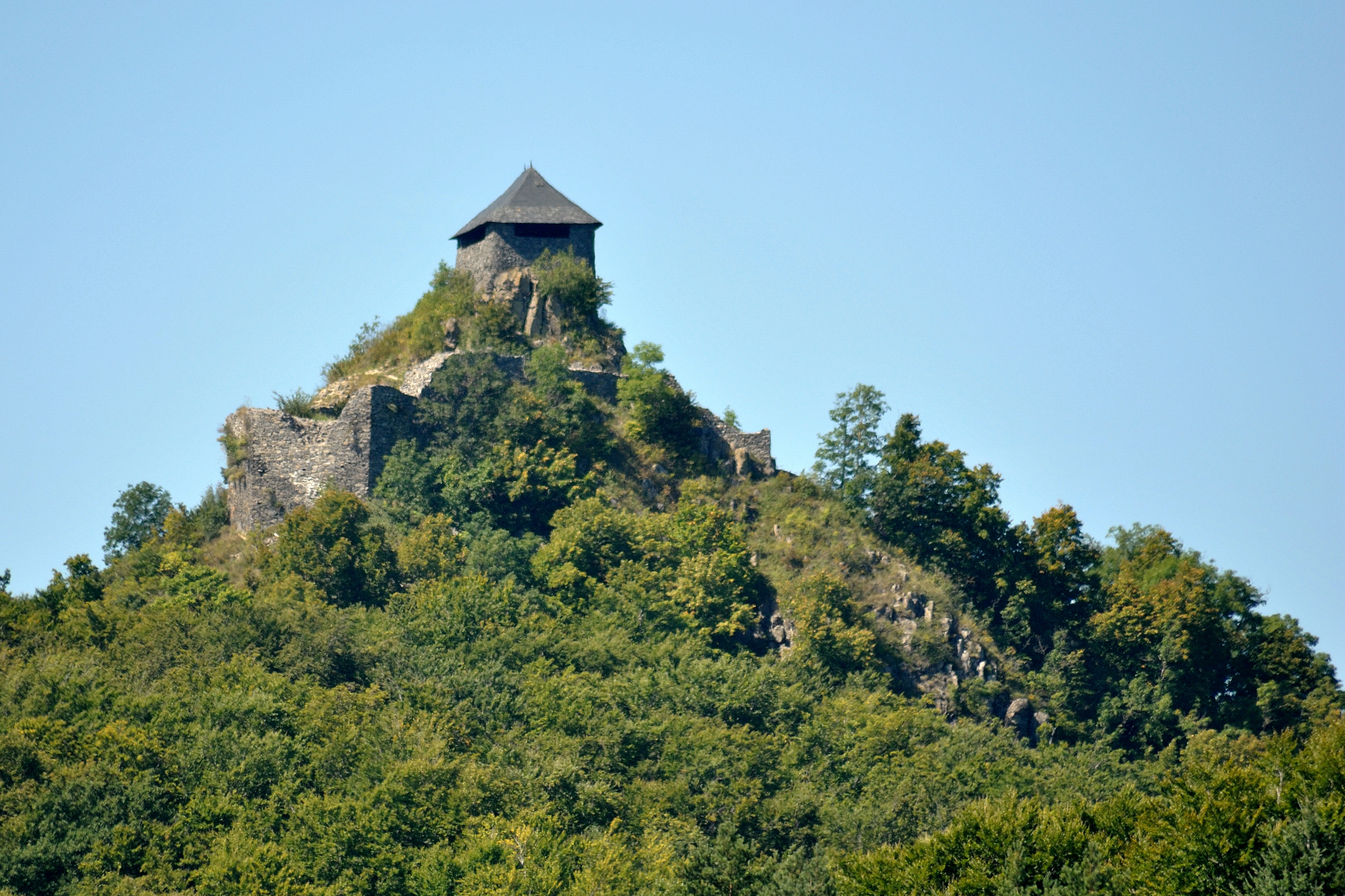
A castle from Hungary
A castle in Hungary. I liked Embers’ use of closed spaces to show both the isolation of the General, and his attempts to keep his homeland alive inside him. Photo by Puffancs CC BY-SA 2.5 HU

Like Stevens, he relies on silence to deceive himself. “Everything… had fed into his very bloodstream the tendency never to speak of whatever caused him pain but to bear it in silence”. Even his friendship with Konrad is described as “hermetic”. For Henrik the Austro-Hungarian Empire has not ended because within his own person – in the values he chooses to embrace – he can keep it alive, and because within his castle he can believe it still is safe. As much as he wants answers from the past, it’s seems more to complete a picture of it than to change the present.

Konrad is almost the exact opposite of the General in all this. His music serves to break down barriers. Music, of course, is a universal language. It connects him first to the General’s mother, herself a Frenchwoman, and then to the General’s wife. Only the General and his father cannot understand it – their focus is on the physical, rather than the sublime. When Konrad disappeared, he moved to England, and from there to the tropics to serve in the Empire. He doesn’t seem to have any loyalty to his past country. But he has come back. The General says this is because their friendship has remained strong, even through the years of separation. That’s true. But it’s also true that Konrad is just as trouble as the General is by the past. In his case, by the failure of his relationship with the General’s wife.

For both men, the evening is a way of working out what happened – both are old, and both are ready for the peace that can only, perhaps, be attained by resolving a lasting uncertainty.

Conclusion

Embers is not a long novel. Forty-one years of separation take up little time if all that time is spent in waiting. But though it’s short, it’s densely and beautifully written – hence why I’ve tried to include plenty of quotes. The ideas of friendship, of trying to hold onto the past, are just as relevant today as they were when the book was written, and leave plenty of food for thought. If you can find yourself a copy, it’s well worth the short time it will take you to read it.

The conclusion to Embers is also especially worth pondering. If you’ve read the novel, please do leave a comment, as I’d like to see what others made of it.

An Autobiography of the Spirit – Kazantzakis’s Report to Greco

Report to Greco was pretty much the last thing the great Greek author Nikos Kazantzakis wrote, and though it is complete in and of itself, it was only really a first draft. It is an autobiography, but not of the sort that most of us are used to. In spite of a fascinating life full of adventure and travels, in Report to Greco the focus is very much on the internal adventures of the mind. Kazantzakis explores the spiritual discoveries, challenges, and epiphanies that made him who he was as a person and, equally importantly, as a writer. It is a beautifully written book, challenging and rewarding in equal measure, and easy to recommend to one tormented by those accursed questions: what must we believe, and what must we do?

I loved it. For the truth is, except for the pressures of reading lists and friends’ recommendations, I read for the same reasons I live – to find a justification for my life, and a way of looking at the world that redeems it and all its suffering. In this journey many writers have helped me – Tolstoy, Dostoevsky, Whitman, and Rilke come to mind – but no author of fiction, in a single book, has been so determined to find answers as Nikos Kazantzakis in Report to Greco.

“My life’s greatest benefactors have been journeys and dreams. Very few people, living or dead, have aided my struggle.”

At times the dominant force is Nietzsche, at times Homer or Bergson or Buddha or Lenin. To go through Report to Greco trying to plot the exact nature of Kazantzakis’ growth is a fool’s errand. He contradicts himself, forgets himself, and repeats himself. As we ourselves do, in our own development through life. To read this book is to be bourn along a river whose current and banks are ever-changing. The journey is more important than the specifics precisely because it is Kazantzakis’ attitude that is most memorable here. In Report to Greco he demonstrates how life can truly be lived according to the injunction memorably stated by the dying Tolstoy “Search, always keep on searching”.

A photograph of Kazantzakis's gravestone
Kazantzakis’s grave in Crete. Photo by Frente (CC BY-SA 3.0)

It is not enough to know that Kazantzakis had engraved on his gravestone: “I hope for nothing. I fear nothing. I am free”. It is not even enough to know his intellectual forebears. It is necessary to know the attitude that could guide a man’s life such that at the end of his days he truly could believe in those words and rest. That story of a life is Report to Greco’s gift to us.

The Structure and Messages

Report to Greco is not really an autobiography, and trying to read it as one is a little foolish. Comparing it even to Kazantzakis’s Wikipedia page is going to lead to a lot of confusion. In spite of the book’s length and variety, it seems that there remained a huge amount of Kazantzakis that he nonetheless conceals, or else thinks is not worth writing about – “rinds they were. You tossed them into the garbage of the abyss and I did the same”. The book’s introduction by Kazantzakis’s widow, Helen, explains that as Kazantzakis lay dying he was nonetheless remembering still more events, still more travels, which would have made it into a second draft. These passed away with him. But so much is here that we have little to complain about.

Report to Greco begins in Kazantzakis’ home in Crete. It talks of his quiet mother and warlike father, and of ancestors on both sides. The teachers who influenced him, the schoolfellows who first accompanied him, and later disappointed him, are all described lavishly. I have not been to Crete or even Greece, but after Report to Greco and Zorba the Greek I feel like I need to go soon. Still, Kazantzakis doesn’t stay long in his homeland. Soon he begins the travels that make up the majority of the book. To Italy, to France, to Germany, Austria, Russia, the Caucasus, Jerusalem… the list is almost endless. And certainly, if Kazantzakis had lived longer, no doubt it would have been. His companions are monks and priests and poets and thinkers. Their conversations range widely, but always reflect Kazantzakis’s occupation with the big questions. What must we do, and what must we believe?

From everyone he gets a different answer. From the monks on Mt Athos he gets one, from the monks on Mt Sinai another. The revolutionaries of Russia give him faith in humankind – at other moments it disappears. At times God exists, at times a void. And when we reach the end of the book I’m not sure we’re all the wiser as to what Kazantzakis actually believes, except for in those big ideas that would seem cheap without the whole of Report to Greco to serve as their explanation and justification.

A young Nikos Kazantzakis. Report to Greco doesn’t follow a strict timeline, but flits between spiritual events in the author’s life to showcase his development.

Of freedom he writes:

“love of liberty, the refusal to accept your soul’s enslavement, not even in exchange for paradise; stalwart games over and above love and pain, over and above death; smashing even the most sacrosanct of the old moulds when they are unable to contain you any longer”

And then of his own life there is this cryptic message:

“I was becoming a sea, an endless voyage full of distant adventures, a proud despairing poem sailing with black and red sails over the abyss.”

God is not important, because “the very act of ascending, for us, was happiness, salvation, and paradise.” But God, perhaps, lurks at the end. The achievement of Report to Greco is to make God irrelevant by showing how much of His creation can be enjoyed and savoured by us while we are still among the living. Affirmation requires a creator, but it doesn’t require a Beyond at all.

Travel and the Language of Affirmation

Report to Greco is a journey of the body as well as of the spirit. In some way, the journey of the latter needs the journey of the former. Through different people, and through different books, Kazantzakis comes to flourish. But as I reader I loved the places too, and though this is not a travel book, Report to Greco still has a lot to say about the locations Kazantzakis passed through during his life. We get the sense that places were inhabited by their ideas and beliefs just as much as they were by people. As he heads towards Mt Sinai Kazantzakis writes of the place: “This arid, treeless, inhuman ravine we were traversing had been Jehovah’s fearsome sheath. Through here He had passed, bellowing.” I too have had the experience, in the Himalayas and the desolate Pamir mountains of Tajikistan, of feeling a spirit passing in the wind.

Kazantzakis’ language also contributes to the feeling in Report to Greco of being closer to these big questions. His prose is always straightforward, and his images are influenced by his upbringing on Crete and his love of the Classics. These images reflect the rawness of his passion in searching for answers, and drag us after him. Our own images are often cliched and soulless and keep listeners and readers from truly feeling the truth of our own feelings, our own spiritual upheavals.

A photo of the top of Mt Sinai. Kazantzakis describes the monks of the area at length in Report to Greco
If you are going to try and track down a god, what better place to start than here? Mt Sinai. Photo by Mohammed Moussa CC BY-SA 3.0

Meanwhile, who can read something like this without feeling its power, even if you do not believe it? – “Away, away! To the wilderness! There God blows like a scorching wind; I shall undress and have Him burn me.” Or his words on a statue: “Just as a hawk when it hesitates at the zenith of its flight, its wings beat and yet to us it appears immobile, so in the same way the ancient statue moves imperceptibly and lives”. I myself can scarcely differentiate a hawk from any other such bird, or the trees in the forest. I lack that knowledge, that experience.

On his own style Kazantzakis writes “In vain I toiled to find a simple idiom without a patchwork of adornments, the idiom which would not overload my emotion with riches and deform it.” Kazantzakis’s regular use of such natural images is part, I think, of the whole thread of affirmation in Report to Greco. He lives in this world more closely than I do, and by using the world in his images he shows the value he finds in it. The riches are in the world, not in the virtuosity of the language he uses to describe it. As a result, the language is breath-taking because it’s the product both of love and of experience. Few modern writers have both, at least where nature is concerned.

A Few Complaints

There are problems here, and things that are out of date. The contradictions and repetitions in Kazantzakis’s spiritual development would probably be cut by a harsher editor, even though they likely reflect what he actually experienced. The fact is, a repeated epiphany loses much of its value to a reader. Still, I like the way that the current structure demonstrates just how we can reach the same conclusions from many different circumstances. In some way that reinforces what I feel to be one of the book’s underlying messages: it is the attitude we take to things rather than the specific experiences we have that count for becoming who we are.

Less easily looked past are the instances of old-school sexism, which is really just a little boring. (“Women are simply ornaments for men, and more often a sickness than a necessity”) This is a man’s spiritual journey, and it often feels like women are excluded from the peak Kazantzakis is climbing towards. All the same, the sexism here isn’t as bad as it is in Zorba. Much worse, however, is the tacit defence of Stalin. Report to Greco was written in the years immediately after Stalin’s death so there’s really no reason for Kazantzakis to be so silent on Stalin’s atrocities – in the Soviet Union Khrushchev hadn’t exactly kept quiet himself. I also cannot believe that Kazantzakis wasn’t aware of them either, since he travelled so widely in the Soviet Union. All he has to say, however, is these words, given to his female companion at the time.

“Lenin is the light, Trotsky the flame, but Stalin is the soil, the heavy Russian soil. He received the seed, a grain of wheat. Now, no matter what happens, no matter how much it rains or snows, no matter how much it fails to rain or snow, he will hold that seed, will not abandon it, until finally he turns it into an ear of wheat.”

Well, this, and a little story about Stalin’s bravery while he was a revolutionary in Tbilisi. Isn’t that great? The irony, probably not deliberate, is that Stalin might have had a much easier time growing his seed if he didn’t actively cause huge famines in modern-day Ukraine and Kazakhstan. Genocide doesn’t grow fruits, and I’m disappointed Kazantzakis leaves any dark from his portrayal of Stalin. It would be better not to mention him at all if this bad taste in the mouth is all we’re offered. Kazantzakis’ love of the Revolution’s ideals is perfectly understandable – the chapter taking place in Russia has a particularly memorable moment where Kazantzakis witnesses a large parade and feels a great unity with his fellows. But it’s a real shame he didn’t think Stalin could be separated from his revolutionary origins.

Conclusion

There are many reasons to read Report to Greco, but enjoying it demands an open mind. The book rewards those who are willing to let themselves be bourn across time and space through Kazantzakis’s life. If we ourselves are not searching for answers, Kazantzakis’s desire to find them will no doubt seem somewhat foolish. But if we are, then even if we don’t agree with his conclusions – and why should we? – we will appreciate the spirit that drove him to reach them. Kazantzakis’s attitude towards life is what inspires me most of all. The German-language poet Rilke wrote in his Letters to a Young Poet that we must “live the questions for now”; Kazantzakis shows what such a life can look like. This is the great gift of Report to Greco. The task now, for all of us searchers, is to go out filled with the same faith that animated him and find our own.

And then perhaps, we may come to have upon our headstones the same words that lie on his. “I hope for nothing. I fear nothing. I am free”.

Have you read Report for Greco? What did you think of it? Let me know in the comments below.

For more Kazantzakis, look at Zorba the Greek here. For more affirmation of human existence, look at Platonov, Shalamov, and Rasputin. If you want more old school beauty and simple living, look at Satta’s Day of Judgement.