Passion Put to Use: Richard Holmes’s This Long Pursuit

Richard Holmes is an extremely dangerous writer. He is dangerous to your wallet and to whatever fixed notions of a literary canon you may have. My copy of This Long Pursuit, a kind of companion volume to Footsteps, which I reviewed earlier, was a gift from my friend James, who is between blogs at the moment. The British are the main focus of this volume of biographical essays, though Holmes spends time with French-language writers too.  And as ever, Holmes is circling around that historical sweet spot, somewhere between 1750 and 1850, when the Romantics were busy being Romantics.

But “Romantics” not only in the sense of poets – though here we have Keats, and Coleridge, and Shelley – but in the sense of a worldview. Scientists are not excluded, and nor are the many women who have historically been locked out of the pantheon. Holmes, with his sympathetic biographer’s eye, makes everyone interesting. And in this lies his greatest strength – he makes us aware of the value of biography. Perhaps even more so than literature itself, biography teaches us that everyone, great and small, has an exciting history of their own. He makes us look at the world and people around us, and care.

Confessions

This Long Pursuit is broken up into three sections. The first of these, “Confessions”, is Holmes at his most personal. Firstly, he reminds us of his biographical principles. The first is “the Footsteps principle”, which states that “the serious biographer must physically pursue his subject through the past”. Footsteps saw Holmes tracing Stevenson among the French countryside; This Long Pursuit has him chasing Coleridge, though without any opium, through England, and Keats and Shelley through Italy. As readers, the text that Holmes presents is heavily influenced by this principle – we have a sense of the subject’s world as something lived in, precisely because Holmes has done just that.

The second principle is that of “the Two-Sided Notebook”. What this means is that Holmes devotes one half of a notebook’s page to the objective facts of his quarry, as he researches them, and the other half to the impressions and feelings that come to him as he does the work. This creates a subjective and objective biography, and the resulting work is a synthesis of these two strands. But their very existence means that reading Holmes is never dull or clinically lifeless as certain academic texts undoubtedly are. 

In the five essays of “Confessions” Holmes explores directly what a biography is, or ought to be. It is a thing that asks us “What was this human life really like, and what does it mean to us now?” It is not simply about trying to work out the past as fact, but rather there is an element of “imaginative faith” involved, for otherwise we would never realise what the past means to us now. Elsewhere he talks of biography’s “humanist ambition” – it aims to inform us of “a common human nature”. Holmes’s style, with regular quotations from the primary sources, serves this idea well. We always have a feeling that the people he is writing about are alive and are being brought back to life before our eyes. But not as pedestal-bound demi-gods so much as human beings.

Restorations

“Restorations”, the second section, is about precisely that. Holmes takes figures who have faded over time and recovers them, as best he can, from obscurity. And in “Restorations” his focus is on the women of the age. I remember reading a scathing review on Goodreads of Footsteps, in which the author denounced Holmes as a terrible sexist because of some off-hand remark that only became offensive a few decades after the book was written. It is ridiculous because focusing on such petty details obscures the great spirit underlying Holmes’ work in both Footsteps and This Long Pursuit – namely, to treat the inhabitants of the past with respect and justice. He rescues people like Madame de Stael or Zélide who I may have heard of but certainly wasn’t planning on reading, simply by engaging with them and relating their value.

One of the things I found most disheartening was the way that many of these women had been famous in their time, but had had their respect worn away by centuries of men deciding who was worth reading. Holmes goes from popular science, with Mary Somerville, to literary and philosophical reflections with Mary Wollstonecraft. He focuses on the heroism of these women at a time when they faced huge difficulties to finding success, but found it anyway. When describing the scientists, Holmes writes that “precisely by being excluded… they saw the life of science in a wider world”. For example, I had no idea that popular science writing in English was essentially the creation of a woman, Mary Somerville!

But Holmes does not shy away from darker themes either. His essay on Mary Wollstonecraft is particularly shocking. Wollstonecraft, who is famous for her “A Vindication of the Rights of Woman”, is perhaps the coolest of the characters featured here. But she had a difficult life, as Footsteps made clear, and an even less pleasant afterlife. Holmes describes how her husband, the naïve but well-meaning William Godwin, wrote a biography of her that was so honest it scandalised society and ruined her reputation for over a century. If this seems like an exaggeration, Holmes finds some choice quotes to back his assertion up. I particularly “liked” one newspaper’s comment that the biography was “the most hurtful book” of 1798. Ouch.

Afterlifes

Going back to the past in search of a new way of looking at people does not only extend to those who have been almost forgotten, though when we deal with canonical figures there is much less urgency. In the final five essays under the heading “Afterlifes” Holmes deals with the classic figures – Keats, Coleridge, Blake – who had sat out of the earlier sections. But rather than go over the lives once more, he is more interested in how their lives were treated once they were beyond the grave. This is all fascinating stuff. The case of Shelley is a good example. His tragic death and classic Romantic death by drowning became a biographical leitmotif. People could no longer look at his life except as something tending towards an early grave, giving it a sense of predeterminism that in reality it lacked. This rather obscures who Shelley really was, at least in Holmes’s eyes.

He traces the first biography of William Blake and the figures, male and female, who made it possible. (I had heard of Anne Gilchrist in connection with Walt Whitman, but I had no idea that she had also wrote part of the biography that perhaps saved Blake from being forgotten forever). He explores the joy of friendship that animated Humphrey Davy and Coleridge’s scientific experiments together, and the ebb and flow of the painter Thomas Lawrence’s reputation.

Conclusions

And he does all this with grace and humour! The entirety of This Long Pursuit is a joy to read – as a writer Holmes is every bit a match for his subjects. Of the Scot, Oswald Lord Nelvil, he writes that his is “a name truly redolent of damp tweed”. One of Blake’s old friends is described as “a well-meaning but gushing middle-aged raconteur, who embroidered freely on the facts”. And then there is this magnificently pithy description of a mental crisis Thomas Lawrence underwent in 1797: “What exactly this involved remains obscure, except that he embarked on a strangely melodramatic affair with both of Sarah Siddon’s daughters simultaneously, and then threatened to commit suicide”.

Holmes, better than any historian, makes the past and its characters alive. And in so doing he does something more than just entertain – he teaches us. This quote from Coleridge is perfect for describing what makes This Long Pursuit special: “Little is taught by contest or dispute, everything by sympathy and love”. Holmes’s sympathy and love for his subjects makes us more engaged than even the most incisive monograph ever could. I finished the book determined to read Keats, Coleridge, Blake, Zélide, Madame de Stael, and all the rest as soon as possible. This is why Holmes is so dangerous. He shows us that reading and learning are truly never-ending processes. That there is always someone new to discover, another writer or life worthy of attention. Every single one of these essays bursts with passion. And Holmes’ passion is absolutely contagious. Read it!
The Patrick Melrose Novels – Edward St Aubyn

It was my birthday on Friday, and what better way to celebrate than to think about another book, or rather series of books, that deals with growing up as one of their main themes. The Patrick Melrose Novels were recommended to me by a novelist I know, and it was an excellent choice. The series takes the life of its hero, Patrick, from the age of five right up to middle age. Born in the early 1960s, Patrick’s life runs in many ways parallel to those of my parents and their generation. And not just in terms of age, but also in terms of class and wealth. Patrick is, like my father was, a man living in the shadow of inherited wealth. Yet like the rest of his generation, he witnesses a changing of the times, where what we can get from our parents ends up not being quite enough.

What I liked about the series is the way that it speaks to my own experience of the world. I have no wish to defend the upper classes of England, but what these novels show is a seedier side to their lives that moves beyond the traditional targets of vapid cocktail parties, selfishness, and wasted potential. Patrick Melrose is sexually abused by his father and given precious little kindness by his mother or other people around him. In his twenties he is a drug addict, and as an adult he is constantly at war with alcohol. The failures of these people are not just failures to care about those beneath them, but failures to care even about each other. At the heart of Edward St Aubyn’s novels is an engagement with the upper classes on their own terms, with a kind of cautious sympathy.

In looking at these people’s failures, he’s willing to ask where did we go wrong?

Never Mind – Patrick Melrose #1

At the centre of the Patrick Melrose series lie questions of identity. Who are we, and how did we become them? Never Mind, the first novel in the series, takes us to France, where Patrick Melrose is just a boy of five. With the exception of Mother’s Milk, all of these novels take place over a single day, with memories used to fill in details. On the day of Never Mind there is a dinner party at the Melrose residence, at which two couples will be attending besides the organisers. The novel focuses on Patrick’s father, David Melrose, who is a larger-than-life figure. He wears “an inattentive expression, until he spotted another person’s vulnerability”. Though at one point one of the characters describes him as heroic, the word “villainous” is much more apt. David is a tyrant and a sadist. His enjoyment of the world comes through his controlling it.

We can look for the reasons why he is like this in Never Mind, and there are plenty. He doesn’t work and is bored. He hasn’t earned his money, which he has through marriage to his wife, and perhaps is bitter. His own father was an equal tyrant, crushing David’s dreams of becoming a professional musician. All of these are potential explanations, but in the end, we’re left feeling unsatisfied by them. David subjects Patrick to sexual abuse, and Patrick himself is the product of his mother’s rape – these are not things which even a difficult childhood can excuse. The challenge, reading through the series, for us as for Patrick, is to come to terms with the past, to understand David without forgiving him, or at least to accept him.

The character of David is best described by Nicholas Pratt, one of the other guests of the party: “Such people, though perhaps destructive and cruel towards those who are closest to them, often possess a vitality that makes other people seem dull by comparison.” This too, that David is “good fun”, is no excuse. But within the novel it explains his magnetism. David derides morality, he derides everything, and that grants him a kind of power over the world. Nicholas Pratt is a more traditional representative of his class, a man who does nothing and is at this stage on his fourth of fifth wife. An embodiment of the “boys-will-be-boys” attitude, he sees very little wrong in David. After all, a little cruelty goes a long way in hardening kids up. I remember my own character-building showers at prep school, where there was no hot water.

Alongside Nicholas there is his girlfriend, Bridget, who is there only for his sexual gratification and is herself in her late teens. Though she’s from a good family, she’s a fine gradation of class lower than the other characters, and they spend most of the novel ignoring her or mocking her. Then there is a philosopher, Victor Eisen, who seems to enjoy “ironically” the company, and his own girlfriend, Anne, who had worked for the New York Times.

Of these characters it is Anne who stands out. She alone takes an interest in the young Patrick. In a key image at the end of the novel she comes and sits with him on the stairs while the rest of the adults are having their party. She does not stay for long, and we are left with a sense of what could have been. The Patrick Melrose series is in a way the consequence of missing out on kindness when it is needed. Patrick’s own mother stays inside, continuing to eat. When he needed it, there was nobody there for him.

Anne is also unique because among all of the women of the story, she alone appears to work. Part of the prevailing attitude of the characters in these novels is an unpleasant sexism, which leaves the women trapped at home and unable to develop anything except alcoholism. Anne alone has managed to make something of herself, and it means that she is able to see their world from the outside, and understand just how rotten it is.

Bad News – Patrick Melrose #2

The second novel of the series sees Patrick Melrose aged 22 and addicted to heroin and everything else he can put inside him. He is in New York, collecting his father’s ashes. I did not like Bad News that much. Patrick is a mess and so, in a way, is the novel. I wasn’t a huge fan of the American setting. Though we have a few British characters, including Anne and George Watford (a chum of David’s), in general Patrick’s associates are fellow sufferers of addiction. The whole novel is rather unpleasant to read as a result. Edward St Aubyn himself had a heroin addiction, and I do not doubt the veracity of his descriptions. But still, it brings me no pleasure to read about the intricacies of needlework. Unlike Never Mind, which was funny and sad equally, Bad News is rather too sad to be funny, most of the time.

The addiction is significant, of course. I struggle with addiction myself, though thankfully not to heroin, just as my father and his father struggled with addiction. Addiction is often a way of avoiding something not fully worked out. It is a way of forgetting, even when you don’t want to: “His past seemed to turn to water in his cupped hands and to slip irretrievably through his nervous fingers.” St Aubyn writes well about addiction, it’s just not a subject that he can make particularly funny. And with Patrick’s refusal to think seriously about stopping, and his general early-adult angst and assholery, the novel as a whole was rather frustrating.

Some Hope – Patrick Melrose #3

Some Hope is a much better book, and is perhaps my favourite among the five. Patrick is thirty now, and clean. The central event of the book is a dinner with Princess Margaret at the home of Bridget (now married to George Watford’s son) and subsequent drinks evening. This lets St Aubyn let loose with the full force of his satire, and the novel is really rather funny.

“He moved in a world in which the word ‘charity’, like a beautiful woman shadowed by her jealous husband, was invariably qualified by the words ‘lunch’, ‘committee’, or ‘ball’. ‘Compassion’ nobody had any time for, whereas ‘leniency’ made frequent appearances in the form of complaints about short prison sentences.”

Here the focus is the selfishness, the insularity, the stupidity, of certain members of the British ruling class. Patrick Melrose is now old enough to look with a certain degree of ambivalence on his own people. At the party he meets Anne again, and she apologises for not staying with him on the stairs when he was a child. There is also a moment where Belinda, Bridget’s own daughter, ends up waiting on the stairs and struggling herself, only to have Patrick come and keep her company. Some Hope is a novel where we see development, rather than decline, as we did in Bad News. At one point a girl admits to Patrick that she’s been sleeping with his best friend, hoping to make him jealous. But instead of trying to win her back, Patrick says he’d rather stay friends with his own friend. Suddenly we’re growing up.

Mother’s Milk – Patrick Melrose #4

Mother’s Milk puts us back into decline. Patrick is in his early forties, with two children, Robert and Thomas, an alcohol problem, and a wife, Mary. Patrick has finally got a job as a barrister, though he doesn’t have any money. The novel takes us to Lacoste, where the family home featured in Never Mind is located. Patrick’s mother, Eleanor, is still alive, but she is in a nursing home, having suffered several strokes. Unfortunately for Patrick, Eleanor enjoys trying to make the world a better place, and she has given up the family home for most of the year to be run by a religious foundation seeking out-of-body experiences. Patrick would rather like the house for himself, since it is all that he has to remember his childhood by and is worth not a little money. And so, the novel is in some way a succession crisis between Patrick and the leader of the spiritualists, Seamus.

Patrick’s children and his failed marriage provide some amusement, but I struggled to enjoy the scenes of alcoholism, since I saw a lot of my own father in Patrick at those times. But all of that is to St Aubyn’s credit – he knows his subject matter really well. And unlike in Bad News, he does not present a purely negative, depressing, world. He gives a sense of hope, of progress:

‘Do you want a drink?’ asked Patrick.

‘Oh, no. I don’t drink,’ said Nancy. ‘Didn’t you know? I watched it destroy Daddy’s life. But do help yourself if you want one.’

Patrick imagined one of his children saying, ‘I watched it destroy Daddy’s life.’ He noticed that he was leaning forward in his chair.

‘I might help myself by not having one,’ he said, sinking back and closing his eyes.

At Last – Patrick Melrose #5

At Last is the end – Eleanor has finally kicked the bucket. If in Some Hope Patrick begins to come to terms with his father’s life, in At Last it is his mother whose life he comes to terms with. In spite of her constant charitable endeavours, Eleanor never managed to care for her own son. Not only that, she knew that David was raping him and stood by without intervening, from her own cowardice, or whatever. Early on in Never Mind Nicholas asks: “Is every woman who chooses to live with a difficult man a victim?” And that is the question we have to answer. Patrick is now not drinking, but there is still some final coming-to-terms-with-everything that he has to do. I’m glad that the series ends on a high note, with a novel that is just as funny as its predecessors, while also tying things together.

General Remarks

It is difficult to talk about a series of books in a short blog post, even though the series fits into a single paperback. Some things in The Patrick Melrose Novels are worth emphasising, just in passing. St Aubyn has a fantastic ear for a certain style of speech, one that you occasionally still hear among grandmothers and grandfathers in country houses and castles all over England. Not only that, he knows how to write a great sentence. Most enjoyable of all, he knows how to write a funny sentence. I don’t think I’ve ever laughed as much while reading a book as I have here. Yet these are also clever books. At their heart is a serious engagement with serious questions about identity, about money and class, and about families .

I do not think that alone these books would be quite so effective as they are bundled together, though. Their focus on a single day makes development difficult unless you read the books one-after-another. And without development, without its possibility, these novels are simply about Patrick Melrose – an asshole who has perhaps deserves our sympathy, but most of the time not necessarily anything more.

Conclusion

I am now twenty-three years old. One foot in the grave, as I have jokingly remarked to a couple of friends. But a good age to read The Patrick Melrose Novels at. The questions which I ask myself, as a member of the British upper (middle) class, as the son and heir to both a glorious tradition and a difficult and sad one, are reflected here with no small urgency. My own generation is the generation of Patrick’s children. We are another step on from his own. The inherited wealth is drying up, the immorality is becoming harder to stomach, and coasting by on connections is a little harder than it once was. But the problems the series identifies, and some of the solutions, remain just as relevant as the monstrous characters who populate its pages, many of whom it seems I know in real life too.

In the end, I can be grateful for what little progress has been made. And I can be grateful that St Aubyn has so wonderfully written of his own slice of the world and its age. One day I hope I will manage to do the same.

A Gay Old Time? Maurice by E. M. Forster

Perhaps my first feeling, on starting E. M. Forster’s Maurice, was one of excitement. This novel, published only after Forster’s death and taking the sexual development of a gay man as its subject, is so unlike everything else I have ever read that I couldn’t help but be excited about it. But Maurice is not just a novel about a gay man, for there are today many such novels – what makes it stand out, and stick in my memory, is the immediacy of it. There were so few clichés, so few reference points for Forster to have in mind while writing it in the early 20th century, that Maurice has a remarkable freshness to it. Just as the characters are discovering themselves, so too is the novel itself trying to discover a way of doing its story justice. And luckily that’s exactly what Maurice manages to do.

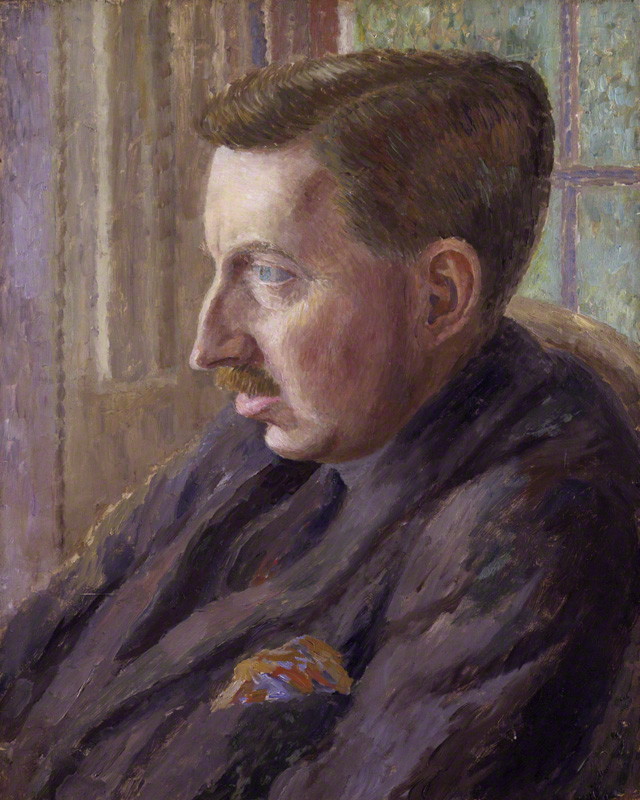
A portrait of E. M. Forster
E. M. Forster, author of Maurice, only showed the novel to a few trusted friends during his lifetime. He hoped that once he was dead it would be possible to publish it; he had his wish.

School Days

Maurice begins with prep school, the first stage of private education in England, which takes boys, and occasionally girls, and raises them from the age of about eight till they are thirteen. It is about as cosy an environment as one could hope for. I remember my own prep school days fondly, and as my school was of the traditional sort, I found in Maurice much to prompt a kind of déjà vu. The first chapter is the only chapter set at prep school, but it sets the foundations for the novel just as such schools set the foundations for the lives of the rich and privileged the world over. Our hero Maurice Hall goes for a walk with one of his teachers, and as he is soon departing into public school, the teacher thinks to do a little explaining of the birds and the bees to him:

“To love a noble woman, to protect and serve her – this, he told the little boy, was the crown of life.”

Maurice is not a hero in the traditional sense, for there is little about him that is heroic. He is average, normal. Nothing about him stands out. He has a “niche that England had prepared for him” ready and waiting. There is only one problem – he is gay. And though he crams himself, as best he can, into the niche, working at his father’s old firm and going to Cambridge, Maurice is the story of how even a little individuality can cause your entire pre-made individuality to collapse, with potentially catastrophic consequences. For Maurice is always being told how things ought to be, whether it’s that love is between a man and a woman, or that he ought to “grow up like your dear father in every way”.

So much isn’t bad, per se. Having our identity imposed on us from outside is fine, provided that that identity is compatible with our internal understanding of ourselves. But as Maurice discovers his sexuality, he learns it goes against his assigned role as head of the family and respectable citizen, and from this thought alone he finds himself turning against the society that had once nourished him.

Clive and Maurice

He finds other sustenance with Clive Durham, a student he meets at Cambridge. Maurice does not know he is gay, but he finds himself at a dinner with a student, Risley, who definitely is. Forster conveys this subtly, rather than openly.  Risley “used strong yet unmanly superlatives” – by expressing himself fully, Risley has fallen out of the niche “man” that is valued by so many. Maurice is curious – he does not understand his own desires – but he decides to go to Risley’s rooms. There he meets another student, Clive Durham, and together they spend time in Durham’s rooms that evening, listening to music. They are not “together”, but Maurice finds himself “strok[ing] Durham’s hair”. A quiet intimacy is forming between them, but as far as Maurice is concerned this is simply manly friendship.

Durham has something else in mind. He gives Maurice Plato to read – a coded action that unfortunately Maurice is too stupid to understand. When Durham finally tells Maurice that he loves him, Maurice falls back on his training: “Durham, you’re an Englishman. I’m another. Don’t talk nonsense”. Englishness, in Maurice, becomes another layer of restrictions upon the full expression of the characters’ desires. But luckily, Maurice comes to realise his mistake. He cries, he goes back to Durham and confesses how he feels. And now the narrator tells us he “became a man”, not in the sense that society puts forward, of starting and ruling a family, but in the sense of becoming master of his destiny. And for a few moments all is well in the world.

The Gentry Under Threat – Durham and Penge

But it cannot last. I feel Durham’s character and story is actually the most one interesting in Maurice. Born as the local squire, he has an estate, Penge, that since his father’s death he now owns. Compared with Maurice, who is simply a well-off middle-class fellow from the suburbs, Durham is under a far greater pressure to conform. His estate will be lost if he does not marry and have offspring, and his respectability in the village will be lost if he has any whiff of non-conformity, sexual or otherwise, about him. For a man who wants to go into politics, this pressure is doubled.

And so one day suddenly Durham turns on Maurice. He declares that he is not gay any longer – their relationship was never physical, only intellectual, so it seems possible – and marries “Lady Anne Woods”. In other words, he marries well. And since the girl has no sexual education, because the 1910s were not a good time for women either, Durham’s own sexual problems can be brushed under the carpet safely, and a sensible marriage concluded. His house and lands are both “marked, not indeed with decay, but with the immobility that precedes it”. But through the marriage, disaster is temporarily averted. Maurice gains extra poignancy when we know what Forster could not – that the First World War is just around the corner, and even Durham’s best efforts may turn out to be for naught.

It’s not clear whether Durham is actually not gay, or whether he’s forced himself to believe he isn’t. In either case, he attempts to help an unwilling Maurice with his own condition. When we compare the two men, it’s hard not to find things to envy about Durham. While Maurice eventually rejects his niche, Durham steps proudly into it, and though seen from the outside it is filled with snobbery and “the worldliness that they combined with complete ignorance of the World”, nonetheless, he seems to be happy.

Durham’s story is interesting in part because it cannot have been unique, and it is a great loss that the subject was not touched by the great writers of the 19th century. But it’s also interesting because unfortunately it remains relevant to this day. A few of my own friends within my class face similar problems to Durham. Though my own generation is much more tolerant, many of our parents (aged between fifty and sixty) and grandparents are still unwilling to countenance the idea that we might not fit perfectly into the niches they have prepared us. I have watched my own friends and acquaintances pretend, lie, and run away from the truth, hoping for a better season. And though progress is there, I can already see that not all of us will have a happy ending.

Not So Classy – Maurice the Man

Maurice is engaging in part because Maurice is decidedly normal, and thus relatable. He is not intelligent, and when faced with his “condition” he is unable to find some justification or solution through thought alone. He cries out, after asking the family doctor for help:

“What is it? Am I diseased? If I am, I want to be cured, I can’t put up with the loneliness any more”

His situation is tragic because he is not strong enough to fight it. He goes to another doctor and suffers hypnosis, but without any success. Not only has he internalised the homophobia of his time, he has also internalised a great deal besides. He is a classist pig, and a misogynist. I’m not sure I would like to drink tea with him if he came round for dinner. Reading Maurice is in some way also, therefore, an antidote to the occasional suggestion these days that one part of our identity, such as our sexuality or skin colour or class, can somehow override all others and smooth over our failures.

Love at Last? Alec

Maurice is, however, forced to confront at least a few of these prejudices when he meets Alec Scudder, a groundsman at Durham’s estate. At first class prejudices keep them apart, but eventually Maurice is overtaken by lust, and the two spend the night together. Their relationship is fraught with difficulties, because Alec can blackmail Maurice – an accusation of homophobia would destroy his reputation – and because Maurice himself resents him for it: “the police always back my sort against yours”. But eventually, they find a path that works for them, and in doing so they turn their back on society. A game of cricket provides the particularly English metaphor. We are told that when “two are gathered together majorities shall not triumph”.

That is the hopeful message that Maurice chooses to end with. And for its hope the book became unpublishable, as Forster writes in the “Terminal Note” at the end. By not punishing his heroes with suicide or unhappiness, he condones their deviance. Honestly, I was surprised to be faced with such an ending. Perhaps it’s just my experience of 19th century social novels (Anna Karenina, Anything by Fontane, even Henry James), but I’ve come to expect unhappiness to be inevitable when someone goes against society. In a way it’s heartening to be reminded that there are other possibilities too.

Conclusion

But simply going against convention does not make Maurice good, just like writing about gays doesn’t make it ipso facto interesting. Unfortunately, I found the latter part of the novel to be the weakest part. Honestly, I had the impression that Maurice and Alec were together because they both wanted to pursue a sexual relationship, and not because of any real human compatibility – and this struck me as not a good sign for their future beyond the pages of the book. And actually, that thought, which I can’t be alone among readers in having, probably undermines the book’s very message – that it is possible to go forth alone, so long as you have any-old partner.

In the “Terminal Note”, written in the early 1960s, Forster mentions “a change in the public attitude [to homosexuality]… from ignorance and terror to familiarity and contempt”. I am glad that the attitude has changed yet again since then, at least on the whole, and for the better. But we should not forget that many people, even today, deal with similar pressures to Durham, to conform according to the expectations of their families. Not all of us have an estate to inherit, but all of us have parents who have an idea for what they’d like us to be like, and not all of them are as flexible as perhaps they should be.

Anyway, I liked Maurice. Give it a read if you’re looking for something different from the usual early 20th century fare.