The World-Ending Fire – Wendell Berry’s Essays

Wendell Berry is a farmer and writer from Kentucky. He’s in his eighties now, but he still works on his land as he always has done, using horse-drawn tools and old methods. The World-Ending Fire collects his essays, ranging in topic from politics to death, books to the environment. They are all tied together by their focus on localism and attachment to place. Without a real connection to your land you will struggle to live a good life, and you will struggle to live a sustainable life. That is his message, repeated over the course of the book in essay after essay. Slow down, pay attention, and enjoy the simple things. It is a relatively fashionable view now, but Berry has been living it and writing it for over fifty years.

Welcome to Kentucky

Berry has lived in the same place for a long time. When he was young, he did travel about, and even briefly lived in Europe, but all that’s behind him now. He has his home, his community in Kentucky. And for Berry it is the most important place in the world. In The World-Ending Fire he is always praising the ideal of community, where people help each other, tells stories, and share things. And here it is convincing where elsewhere it would surely get on my nerves because Berry actually lives this life. In essays like “The Making of a Marginal Farm” and “Horse-Drawn Tools and the Doctrine of Labour Saving” he really goes into some detail about how it is to live a largely self-sufficient existence. Berry writes with a pencil, only during the daylight hours. One of his most famous essays describes his refusal to buy a computer.

A photo of Wendell Berry standing in front of some solar panels.
The man himself. Solar power is, for Wendell Berry, the ultimate energy source, because it is completely sustainable. And a life is a good life where we leave more than just ashes behind us. Photo by Guy Mendes, CC BY-SA 3.0 https://creativecommons.org/licenses/by-sa/3.0, via Wikimedia Commons

This simple life is under threat by the industrialisation of farming, by consumerism, by strip mining and plenty of other things. About half of The World-Ending Fire is diatribes against the unpleasant parts of modernity, and about half a paean to the things modernity seems to be trampling – community, responsibility, and kindness. Many of the essays repeat each other, but I find it hard to ignore the validity of Berry’s message. Below I’ll go over a few of its key points.

Scale and Limits

One of my favourite essays here is “Quantity versus Form”, a short piece originally written for a conference. It tells the story of an old friend of Berry’s who sold her things and went to a nursing home. When they meet there, she is at peace and ready to die. But she then stays alive at the hands of her doctors, and when Berry and she next meet, she is but a shell of her former self. Medicine has kept her alive, but for what? Berry’s target in this piece is not modern medicine, but its application. In the past, he argues, there was an ideal of “a whole or complete life”, whereas now we think only of “a long life”. And these two ideas are incompatible, because they carry with them two different views of the world.

The complete life is one summed up by Lord Nelson’s words at Trafalgar, “Thank God, I have done my duty”. It is a life bounded by duty, by obligations – in other words, connected with others. Nelson perceived his duty, fulfilled it, and was happy to die. He felt no need to experience any more, to see any more. He achieved completeness, and that was enough. Berry points out that though few of us will be admirals, almost all of us will – or should – take part in a community, be part of a family, follow one’s calling, and enjoy things like food and drink and company. If we do all of these things, death need not be something worth fearing, because we can rightly be said to have lived properly and need ask nothing more.

In contrast to this limited life, a life searching after length will always be disappointing. There will always be something to miss out on and therefore a reason to hate death. Berry is not against experiences, but he is against a worldview that does not acknowledge human limitations. When we deprive ourselves of a sense of our limits we encourage a similarly laissez-faire attitude towards the world around us. We start to exploit resources as we try to stave off our inevitable passing. And no amount of resources will be enough, because our deaths will always come. If we choose to limit ourselves, to accept death (I’m pretty sure Berry and Heidegger have a couple of things in common on this point), then life will be much more meaningful. We will be able to give it completion and die satisfied.

Memory

There are different types of knowledge, Berry reminds us in “The Way of Ignorance”, and that which is empirically verifiable is only one of them. Time and again Berry makes us think about memory, and what kind of knowledge that is, and what value it might have. In “Damage”, one of the shorter and better essays, he describes the damage he accidentally causes to his land with a bulldozer. It is a terrible thing, he writes, to directly contribute to the destruction of the natural world. But Berry also finds in the scar left by the bulldozer on the ground a positive element – for it has affected him. So long as he remembers about the damage, he will not repeat it. And as long as he takes part in a community, that knowledge of destruction will be common to all – and destruction will be avoided.  

One of Berry’s keenest laments in The World-Ending Fire is the loss of cultural memory that comes from leaving the communities in which you were born and watching the communities disintegrate. Almost all of us know that strip mining is a dangerous process that destroys the landscape, or that farming by insecticides and computers may not be ultimately the healthiest approach. But without participating in a community where that knowledge is experienced, rather than simply known, we do not feel it in quite the same way. And this lack of feeling, stemming from a kind of ignorance, ultimately leaves a space for tolerance: when we do not witness destruction while getting benefits from it (such as the gold circuitry in our phones), we are liable to forget the destruction or else to accept it. In a community, we have shared knowledge of destruction, and cannot so peacefully accept its results.

Reading and Writing

Berry also laments the loss of reading, which he connects with the rise of television. Again and again in The World-Ending Fire Berry comes back to the classics, because the classics are sustainable – unlike modern technology, they are never superseded. And in the classics Berry finds plenty to support his arguments in these essays. Marlowe’s Dr Faustus illustrates a piece on our fossil fuel consumption, while Milton’s Satan makes us think about human limits. Unlike science, which encourages a belief in limitless progress (because so far it has happened, and all it has cost is the destruction of nature and the climate), literature is by nature bounded. A play is just a play, a poem cannot grow new cantos once its author is dead. But just as Berry thinks a life can be beautiful and valuable while lived within limits through using those limits well, so too can literature.

After all, in hundreds of years we have not run out of sonnets to fit into their assigned fourteen lines. The importance of completion, rather than insatiability, is what Berry takes away from many of the works he quotes. In the past, it seems, writers understood that too much knowledge would lead to our destruction. Berry is not against progress, but he is deeply conservative. He’s concerned about the pace of progress, and I think he’s right when it comes to some of his targets.

A Few Points of Dissent 

The essays of The World-Ending Fire were written over a period of about fifty years, and their order in the book is not chronological (I’m not sure what it is, however). The essays don’t need to be chronological, though, because Berry does not appear to change his mind – but then again, the world he attacks does not change much either. I remember reading his essay “Think Little”, about some faults in the environmental movement in America, and being surprised (and a little depressed) when I finished it to see it was written literally fifty years ago and not more recently. The problem, reading The World-Ending Fire, is more that Berry repeats himself quite a bit. His worldview is wonderful, and he defends it nobly, but in his essays he never seems to develop. It does mean that eventually you get a little tired of him.

I’m also not sure that his solutions are as fully explored as they ought to be, either. I have no problem with Berry using a car while avoiding computers – he knows the limits to his lifestyle. What I do have a problem with is the suggestion that everyone can move into the countryside and start farming. There are too many people in the world now for that to be a sensible or effective solution. I do not know about topsoil or any other specifically ecological problems like strip mining, but I do know that while technology may not be able to save humanity, it’s the only thing that has a chance to save us from ourselves. Just moving to the countryside and adopting an agrarian isn’t a workable solution because nobody, Berry included, can convert enough people to that approach fast enough.

A picture of the Kentucky River, Surrounded by trees.
The Kentucky River. “The Rise” takes us down it, while many other essays in The World-Ending Fire reflect on its decline due to pollution. Photo by Schwaltz, CC BY-SA 3.0 https://creativecommons.org/licenses/by-sa/3.0, via Wikimedia Commons

It is a frightening path that we are heading down, and I don’t enjoy being young while going down it. But it’s mildly heartwarming to see (as part of an internship I’m doing) just how the companies of the world are reducing their emissions, and how people really are taking things relatively seriously now. We have destroyed so much, and we will destroy yet more in time, but there is a chance that the likes of carbon capture and storage will give us an opportunity in the future to change for the better. At the moment I don’t think Berry’s “alternative” is a solution that has any chance of solving things. We need time, and technology is the only thing short of a higher power that can buy us it.

Perhaps my greatest disappointment with The World-Ending Fire, though, is just how few essays describing Berry’s own life on his farm are included. To his credit Paul Kingsnorth’s essay choices are mostly well considered, but this omission is in no way minor. It amounts to a grave fault in the book’s structure. We spend three hundred and fifty pages listening to Berry praise his life without really getting a sense of what that life is. How can we trust him without that? The essays that I enjoyed most in The World-Ending Fire were not those that told me how to live, but rather showed me how I could live. “A Few Words for Motherhood” is a beautiful rumination on the beginning of an animal’s life, while the final essay, “The Rise”, uses a narrative of canoeing down the Kentucky River as a way of thinking about pollution and limits.

It is these essays that I will remember and read again, and not those that are purely diatribes.

Conclusion

My criticism of The World-Ending Fire does not mean I did not like it. I would not have read the whole book if I hadn’t found such enjoyment in it. Berry is a wise man, and a kind one. His words and values are things that I hold close to my heart, and I think that others ought to hear what he has to say. I will be picking up this book again, not to find something new, but to find something old. I will flick through it in search of a reminder of who I ought to be and how I ought to live.

“Every man is followed by a shadow which is his death – dark, featureless, and mute. And for every man there is a place where his shadow is clarified and is made his reflection, where his face is mirrored in the ground. He sees his source and his destiny, and they are acceptable to him. He becomes a follower of what pursued him. What hounded his track becomes his companion.”

These are powerful words for an unoriginal idea, but they are words I will carry with me going forward as I try to follow my own calling. Nothing in The World-Ending Fire is original, as Berry freely admits. But original or unoriginal, the knowledge contained in these essays is valuable and not known nearly widely enough. It is a guide to a life that is better, more sustainable, more filled with grace. One day I hope to live it.
The Joys of Youth: Boris Vian – Mood Indigo / Froth on the Daydream

Oh, how wonderful it is to be young and happy, rich and idle. Such is, in some sense, the first impression I got from the French writer Boris Vian’s novel, Mood Indigo (after one of its film adaptations), originally translated as Froth on the Daydream. The work is absurd, and at first glance meaningless – people hop on clouds, the sunlight makes pleasant sounds. For the first third of the book I had thoughts of dropping it and getting on with something serious. Who actually likes to read about happy people? Certainly not me. And especially when that happiness is located in a world of absurdity, where nothing seems to matter or have a connection to our own world… in short, the book started to annoy me.

But Vian is playing a game in Mood Indigo. His characters are indeed happy, their world is indeed absurd. But this is just the setup. Because soon enough, a rot appears under the joyous façade, and all that was wonderfully absurd now becomes terrifyingly absurd, and the initial messages the book trumpeted now struggle to sustain themselves once things have started going wrong. And they go very wrong in this book. In the end, Mood Indigo moves on from its silly initial impression to become a brilliant reflection on mental health and more.

Our Colourful Cast of Characters

The silliness of Mood Indigo is in evidence from the very first words – “Colin finished his bath”. It is a meaningless phrase; its lack of drama subverts our expectations for what an opening line normally looks like. Our hero, Colin, is joined by Nicholas the butler and cook, Chip his friend, and Alyssum and Chloe to make up our main characters in Mood Indigo. They have silly names and lead silly lives. Colin has a lot of money and does nothing all day except enjoy himself. His world is yellow – the colour of positivity, of energy. Sunbeams flood his house with joyous sounds (as part of the way everything is connected in Mood Indigo, even normally soundless things all make noises).

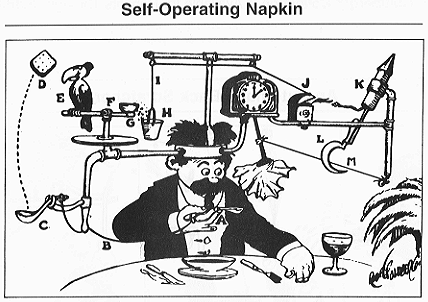
The overall impression, come to think of it, is similar to a children’s television show. Colin not only eats strange things, such as an eel found in his sink, but he also has a huge store of Rube Goldberg machines, including a drinks mixer that doubles as a piano. Everything is possible in this world, and everything is positive. Colin’s great anxiety is over finding himself a girlfriend – both he and Chip are in their early twenties. Other than that, we might say that “life is but a dream”.

A Rube Goldberg machine. Colin has lots of devices that make his life exciting and pleasurable.

Things Go Wrong

Until it isn’t. At a party Colin meets a young lady, Chloe, and falls in love with her. His courtship of her is, as with everything else, an extreme affair – the world reforms itself to suit his new mood of infatuation. He finds that a “street led straight to Chloe”, and when they are together they can literally step onto clouds to enjoy themselves. In a moment of kindness Colin gives Chip part of his fortune – Chip doesn’t have money of his own – so that Chip can, in his turn, marry Alyssum, another friend of theirs. In the meantime, Colin and Chloe celebrate their marriage. It’s a wonderful, expensive, lavish affair – Vian enjoys describing everyone’s clothes in Mood Indigo – marred only by the sudden death of a music conductor when he falls from his perch in the church. But we don’t pay such things any mind. Death doesn’t bother us.

On their honeymoon Chloe begins to get sick, and it is here where Mood Indigo becomes really interesting. At first it’s a sickly, overly happy story about young love – but now darkness begins to creep in. Chloe has a disease of the lungs. There is a waterlily in her right lung, and the only way to save Chloe is to surround her by other flowers in the hope that they will scare the waterlily away. It is not a cheap affair, and Colin spends more and more of his money in trying to save Chloe from her illness. But nothing seems to have any effect, and soon Colin finds himself running low on funds and forced to find work for himself. Meanwhile, Chip and Alyssum’s relationship is also under strain – Chip hasn’t used Colin’s money on the wedding, as planned, but on his obsession with the writer, Jean Pulse Heartre, instead.

Objects and Objectification

Chloe’s illness, and Chip’s increasing obsession – he spends his money on everything possibly connected to Heartre, from books to old clothes the writer might once have worn – both mark the novel’s decline from its cheery beginning into gloom. Both of these events are also important because the decline in Mood Indigo can be partly explained as stemming from its treatment of people and objects. What I mean, is that in some way the novel is an argument against objectification, overt and covert. We can think about this through the example of Chloe’s illness. Chloe’s personality is pretty non-existent in Mood Indigo. She is simple, concerned only with objects – at one point she says she wants to buy: “things and things and things”. Every time she is described its by reference to her beauty – at first this annoyed me, but now I see it was deliberate.

“Chloe’s such a pretty girl,” one character says of her. “I can’t imagine her being ill.”

Chloe is treated like an object by everyone around her, and in a way it kills her. Colin loves her, but the treatment she gets is all through objects – in the end, she is left fading away on a bed, surrounded by plant pots. It is a strange image, but a striking one – she is literally being destroyed by beauty. Chip’s case is similar. In his obsession with objects connected with Heartre, he neglects the human he is supposed to love – Alyssum. All of the girls in Mood Indigo, by the way, have names connected with flowers (Chloe is from the Greek word for fertility). And like flowers, the girls are left to blossom and then die, without the water of true affection. They are never treated like people, like individuals with personalities.  

Money and Emptiness

Connected with objects is the way money is used in Mood Indigo. At first it seems to be a source of liberation for Colin, letting him do whatever he wants. He goes ice skating and kills people (by accident) without facing any consequences. He goes to parties and meets pretty girls. The characters of Mood Indigo seem to enjoy the fullness of youth. Chip, when he gets Colin’s money, is able to pursue his passion for Heartre without any limits. Chloe is able to buy all the things she wants. But as Mood Indigo continues the emptiness of their lives becomes harder to avoid.

Chloe’s things are worthless once her illness takes hold, and Chip’s passion soon morphs into an addiction, excluding everything else in his life which once he had valued. Finally, as soon as Colin’s money starts running out, his entire house and world begin shrinking, growing dark and unhealthy in reflection of his inner state. By spending, by not paying attention to the consequences of their actions – most noticeably they random deaths of the early parts of Mood Indigo – the characters avoid trying to grow, to develop themselves or find a real and lasting happiness.

Boris Vian, the French author of Mood Indigo, was a multitalented person, producing not just novels but also songs and poetry. He was an important figure in the French jazz scene, connecting American artists with their French counterparts, and knew how to play himself. Source: Photomaton Archives Cohérie Boris Vian” (propriétaire du cliché), CC BY-SA 3.0, via Wikimedia Commons

Conclusion

It is a wonderful thing to be young, to be rich and live irresponsibly. At least it seems so, while it’s happening. The horrors of the world, its terrifying absurdity, barely affect us or our happiness. Mood Indigo perfectly captures that mood of joy. But the novel goes further, in showing us that under our pleasure there lurks someone else’s pain, that the happiness we think we have is often bought at the price of someone else’s. Ultimately, happiness comes in part from choosing not to see the world. During Chloe and Colin’s honeymoon, at the last stage of Mood Indigo’s “happy part”, Chloe finds herself unable to look through the window of their car onto the world outside – the sight is too distressing. Fortunately, there is an easy solution. You can just put a filter on the window, see only what you want to see, and everything will be okay.

Ultimately, Mood Indigo is about the dangers of easy solutions, of turning the world into your playground, of treating others as objects and shirking responsibility. You will have a great time, at least at first. But soon enough something will happen that you could not have predicted – like an illness – and you will find how little you are prepared for the world hiding behind your dreams. I wasn’t expecting to like Vian’s novel, but I did. It’s intelligent, fun, and has much more to say than I have written about here. I’m grateful to my girlfriend for recommending it.

The title of Mood Indigo comes from a piece by the legendary (and repeatedly namedropped in Mood Indigo) jazz artist, Duke Ellington. Here’s a version on Youtube.

Temptation and Pride in Tolstoy’s Father Sergius

Although I’ve been having a go at Tolstoy lately, I still admire him, and would probably rank his writings above those of anyone else. Unfortunately, Tolstoy’s novella, “Father Sergius”, is another one of those frustrating prophet-Tolstoy pieces, so today’s post will be stained once again with disappointment. It shouldn’t be, in a way. Father Sergius, like Hadji Murat, was not published while Tolstoy was alive. Tolstoy shied away from publishing both works because they revealed too much about himself – at least, I remember reading that view somewhere among the criticism on Hadji. But whereas Hadji Murat revealed that Tolstoy still knew how to write cracking fiction even after he was old, “Father Sergius” reveals that Tolstoy was an awful egotist who thought he was better than everyone else. Because that’s basically what the novella is about: Tolstoy, Tolstoy, Tolstoy.

Leo Tolstoy, at about the time he was writing “Father Sergius”. The story was finished in 1898.

I recently read George Orwell’s essay on Tolstoy, “Lear, Tolstoy and the Fool”. To my knowledge, Orwell hadn’t come across “Father Sergius”, but the two pieces go together quite well. Orwell argues that the lives of Tolstoy and King Lear are curiously similar. Both were men who, in their old age, renounced their power, but then became bitter and angry for it. Both Lear and Tolstoy practiced self-denial – something normally associated with saintliness and goodness – for selfish reasons. In renouncing their earthly power, both men aimed to gain spiritual power and with it a greater sway over hearts and minds. Tolstoy gave up his copyrights, he neglected his fiction, but he did not give up the idea that he ought to influence people. Quite the opposite, as the torrent of moralistic pamphlets he produced evidences.

In short, Tolstoy’s renunciation was incomplete. Or, as Orwell puts it, “if you live for others, you must live for others, and not as a roundabout way of getting an advantage for yourself.”

What does all this have to do with “Father Sergius”? Quite a lot, actually. Tolstoy’s novella is essentially a dramatization of this conflict. Our hero, Father Sergius, becomes a famous monk, but he remains unsatisfied with his life. Though he is supposedly serving God, he finds that in reality he is serving other people – the people who come to his refuge, the other members of his monastery. And of course, he is also serving his own pride. But, as with Hadji Murat, “Father Sergius” is also the story of how its central character reaches enlightenment of a Tolstoian sort. What happens?

A Bad Breakup – The Opening of “Father Sergius”

D’ya ever have that thing where you go off and become a monk just because your girlfriend turned out to have had a previous partner? Nobody? Tolstoy, with his many children with peasant girls, of course knew a thing or two about previous partners. But after his religious conversion he became very anti-sex, which we can see most clearly in The Kreutzer Sonata, but which is also on display in “Father Sergius”. Our hero is Prince Stepan Kasatsky, a young man at the story’s beginning, but one who has already risen almost to the peak of society. Apart from his one weakness, sudden bursts of rage (amazingly, Tolstoy suffered from this also), he’s a model man. He is the best at everything he tries, and has rather gotten used to that feeling of superiority. True, he’s not admitted to the very highest reaches of society, but otherwise he can’t complain.

He has a good role in the military, and has made an excellent match to a young lady. But here is where his problems start. What he doesn’t know is that this girl has been the lover of Nicholas I. In the second chapter we’re taken into her garden, a little while before the wedding. Everything seems perfect – even the nightingales are a-twitter. But “Mary” (a foreignized name in Russian literature almost always means something’s wrong) is in a state. She needs to admit to her past before the marriage, but it’s hard. Eventually manages to work up the courage, but Kasatsky is not willing to give her a hearing at all. (I’m pretty sure if the Emperor of all the Russians wanted to bed you, you didn’t have much choice in the matter). He gets up, gets angry, sells his estate, leaves his job, and becomes a monk.

As you do, of course.

Monk Days

Why does he become a monk? There are two reasons, we’re told. The first is that it lets him “stand above those, who thought they could look down on him”. The second is a real religious feeling, which is mixed up with pride and a desire to be the best. Anyway, Kasatsky becomes Father Sergius, but his problems do not end there. One day, while helping at a service, he is recognised by some ladies, who point him out to each other in French. Then, after the service his superior calls him round back to chat with a general who used to know him. Father Sergius is angry at the fact that even being a monk doesn’t save him from the people he was trying to escape. What is worse, the monks themselves aren’t as good as they’re supposed to be. There’s only one thing for it – to become a hermit!

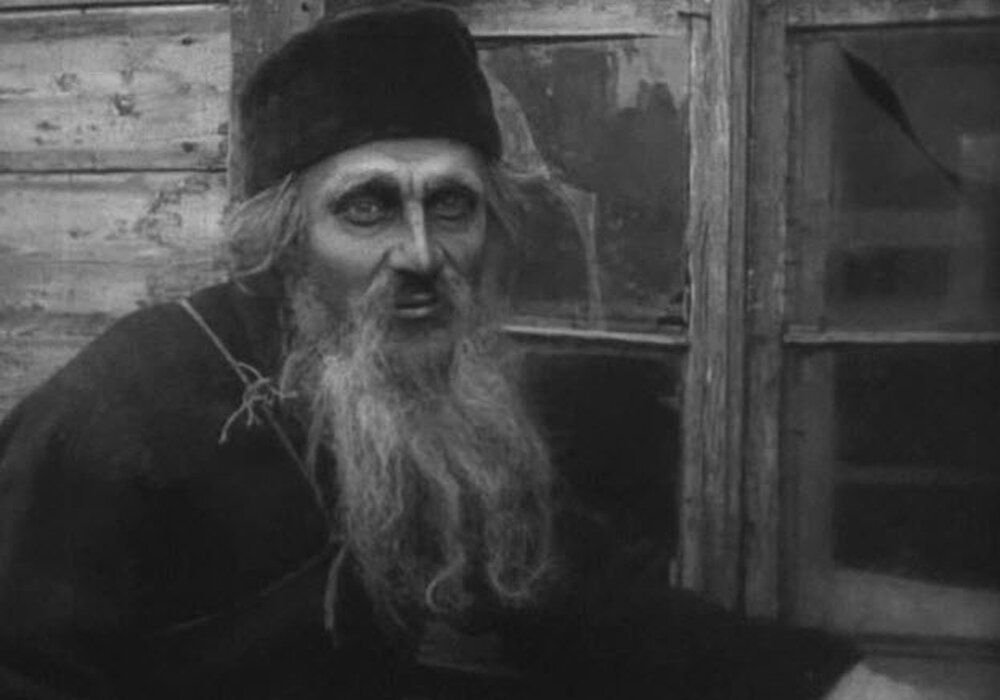
A still from the 1918 film adaptation of Father Sergius.

A Hermit and his Temptation

Father Sergius gets permission to go to another monastery, further from civilization, and there he occupies the quarters of a recently deceased hermit. All seems well, and a few years pass. But one night a group of revellers is passing by, and one of their company, Makovkina, a young lady, decides to go and see Father Sergius, whose old identity they are all familiar with. Makovkina comes up with a plan to seduce him. (As you do). Anyway, she makes her way to his rooms and asks for shelter, saying she’s lost. At first, Father Sergius can’t believe she’s real – he thinks she’s an apparition, or else the devil. (“For the devil always appears as a woman”). But eventually, he lets her in.

Father Sergius has been a hermit all this time but he is still weak to “lust”. This woman causes a resurgence of his old feelings. Her power is that she is a normal human being. Her laughter, “cheerful, natural, kind,” has an effect on him. But normal human beings are evil people, Tolstoy would have us know, and this woman is a temptress! There is a great moment here, when the woman is drying herself and getting warm (Father Sergius refuses to see her more than he needs to), and we only hear her, just as Sergius does. It’s nice to remember that Tolstoy does know how to write.

Anyway, Father Sergius knows he has to see her, but he’s scared he will be unable to defeat his lust. So what is the logical solution? He cuts off his finger with an axe. Of course, when you have cut off your finger you end up a little distracted, with the result that temptresses can’t bother you. He goes in to see her, with his hand bleeding, like some axe murderer from a horror movie, and says: “dear sister, why did you want to destroy your eternal soul?” Amazingly, instead of being terrified, she leaves the hovel, changes her life, and becomes a nun. Cool, huh?

A Healer in Need of Healing

Time passes. Father Sergius acquires a reputation as a healer. And his isolation is brought to an end. Instead of living on simple food, his monastery now ensures he eats properly and is kept healthy. He has a constant stream of visitors, but in all of this he feels a growing dissatisfaction. He is being driven away from God and among the people:

“He had become like a place where once there had been a stream. “There was once a weak trickle of living water, which quietly flowed from me, and through me. That was the true life… but now I have had no time to gather water, for the thirsty are always coming, closing in and pushing at each other. They have crushed everything – now there is only dirt left.””

Father Sergius doesn’t like the people he meets, and it’s not clear that he can actually heal them either. They come to him “with their selfish demands”, and he gives them what they want. One day a merchant comes to him, wanting him to heal his daughter. He agrees. But when she comes, alone, she seduces Father Sergius instead. The next day, acting on plans he had made long ago, Sergius flees the monastery.

Flight

Tolstoy also fled a life that didn’t satisfy him. He died at the railway station at Astapovo, that being as far as he could get from his family before his body failed. “Father Sergius” was written over ten years before Tolstoy’s death, but the idea of fleeing was not a new one for him, just as the suicide Sergius also considers wasn’t either. Sergius goes to an old acquaintance, Pashenka, who he had treated unkindly as a child. He discovers her living poorly, surrounded by family, and struggling to survive. But the meeting brings an epiphany to him. “I lived for people under the pretext of serving God, while Pashenka lives for God, imagining that she’s living for people.” This final revelation allows him to live freely as an unknown wanderer, before eventually he is stopped by police and sent to Siberia for not having identity documents.

And there he lives happily ever after.

Tolstoy and The Holy Life – Identity and Truth

There are some interesting bits and pieces in “Father Sergius”, but they are ideas more than the story itself. One of the main themes in the story is that of identity. “Father Sergius” as a title is not a reflection of Stepan Kasatasky’s ultimate identity, but only an intermediary stage in its development. When Kasatsky first becomes a monk people often refer to his past by using his pre-monastic name, such as the women in the church or else Makovkina. Later he becomes “Father Sergius” the healer. But he is not a holy person – the story’s title is in fact ironic: “He now had no love, no humbleness, not even any purity”, he thinks after becoming well-known.

When he eventually flees, he destroys all of those past ideas of himself and returns to his own childhood. Pashenka calls him “Stiva” (the familiar version of “Stepan”), marking a new stage in his development. Finally, once he is a beggar, he answers the question of his identity by saying he is simply “a servant of God”. At last, he has removed all those connections with his past that made him a selfish person, and he is “free” to enjoy himself.

In connection with the subject of identity, “Father Sergius” also contains a persistent critique of organised religion. This is perhaps unsurprising – Tolstoy was excommunicated by the Orthodox Church in 1901, a few years after he’d finished “Father Sergius”. In the story the other monks are just as concerned about power, fame, and wealth as everyone else. More importantly, though, they are not shown to be in touch with any real kind of faith, either. Father Sergius himself regularly prays, but there is no sense that his prayers are answered until he finally leaves the monastery after his night with the merchant’s daughter.

Conclusion

Overall, I’m not sure I’m glad I read “Father Sergius”. I had expected something like Hadji Murat or “The Death of Ivan Ilyich”, where Tolstoy manages to squeeze in a moral message into a brilliant story. “Father Sergius” is a moral with a story attached, and there’s plenty to dislike here. In particular I hate the misogyny underlying Tolstoy’s depiction of women, something which is even stronger than the general atmosphere of misanthropy that pervades the story. There’s so little positivity here. The moral that we should serve God/our hearts rather than other people is, I suppose, okay, but when it’s combined with such dislike for humanity it’s hard to take seriously.

It’s like Tolstoy forgot that God (in Christian cosmology) created the world and wanted us to enjoy it. The whole thing’s just stupid. Alas, just as Orwell suggested, once Tolstoy gained his new faith, he didn’t seem to realise that he often appeared a fool. He would have been a lot more convincing, both as a writer and as a moral writer, if he had a little more self-awareness.

Anyway, if you’re after Tolstoy, go read Hadji Murat, or Anna Karenina, or “The Death of Ivan Ilyich”, or War and Peace. And if you’ve read them already, read them again, and again, and again.