One Big Misunderstanding
I recently finished Vladimir Nabokov’s Strong Opinions, a collection of the author’s interviews, essays, and letters-to-the-editor. Since the pieces were all short and written with some degree of accessibility in mind, it became my bedtime reading for a few days. The first thing of his that I read was “Lolita”, which stumbled through aged fourteen without understanding a word and thus thinking for most of it that Lo was having the time of her life.
Following that magnificent misunderstanding of Lolita, Nabokov’s interviews in isolation were what I read next. I was at an age and in an environment where I was wholly convinced of the sanctity of the Canon while at the same time not really able to say what exactly it was. I was open, in a sense, to an authoritarian or at the very least authoritative figure who seemingly knew what was what and wasn’t shy about letting me know. It’s probably for the same reason that Harold Bloom appealed at that point, even though I didn’t understand him either when I actually tried reading him. Nabokov in these sits on his great-writerly throne dispensing fireballs and lightning and very, very occasionally, a glimmer of praise.
Back then that all was very attractive – it gave me opinions so that I didn’t need to bother forming my own, and it told me what was worth reading so that I didn’t have to read either. But now, having read other writers’ (and critics’) essays, binged the back issues of the Paris Review’s “Art of Fiction”, and done a little growing up, the book that had I read it six or seven years ago might have seemed the masterwork of an assured genius, now appears in a much less pleasant light.
Structure
As I mentioned above, the book is made of interviews, letters-to-the-editor, and a few essays. The former make up most of the book, and stretch from immediately after the publication of Lolita until Ada’s own completion. The letters meanwhile include such banalities as Nabokov’s witticisms on the moon landings. While Lolita, being the most popular and enduring of his novels, takes up the main part of the interviews even long after it has been published, the essays that end the book are concerned with another book of Nabokov’s – his translation of Pushkin’s Eugene Onegin. The collection, it is important to note here, is one organised by Nabokov during his own lifetime – each interview, for instance, is introduced by his comments explaining the circumstances of each meeting – and for that reason it’s fair also to say that these two works are what he considers to be his primary legacy, and indeed he says as much. I’ll tackle both the interviews and essays in turn.
The Interviews
These were on the whole pretty fun, and what I was here for. Though I had read a few before, I scarcely remembered them. It also doesn’t help that Nabokov repeats himself. He has a number of metaphors and images that he uses again and again for two reasons. The first of these is that as with the rest of us, the things that are at the forefront of his mind are often similar from year to year, even if his vocabulary is undoubtedly marvellous (I quite wanted to go through it again just noting down every new and exciting word of his), and so when they are stacked side by side these interviews become a little like paintings at an art gallery. What beauty and power they have individually becomes blurred and dulled by company of equals. The same is true of Nabokov’s metaphors.
The other problem, though, is that these aren’t interviews in the strictest sense. Nabokov admits in his preface that “I think like a genius, I write like a distinguished author, and I speak like a child” (was there ever a more blatant instance of praising with faint damning?) and so what he does instead of speak unprompted is get his questions in advance and prepare answers to them on flashcards. It means that the whole selection has a slightly odd feeling of unreality to it – this is obviously not who Nabokov actually is in speech, but nor is he entirely who he is in his fiction either. It has an uncomfortable artificiality to it.
The Interviews: Humour and Judgement
But they are fun, and by this term I mean that they appeal in a few different ways. One of those is that the interviews are actually pretty funny. I love the hilariously awful punning of things like “I differ from Joseph Conradically” or my personal favourite “Off the Nabocuff” – things that if I said them in person I would be met with a sigh and awkward smile but when written down Nabokov almost seems to get away with. Beyond the puns there is the casual tone, such as when he calls himself “the shuttlecock above the Atlantic”, or talks of the indifferent audience he has to face whenever he lectures. All this is simple and mindless, but things become a lot more complicated when the humour is derived from his judgements about others – and it is regarding his judgements of others that the centre of my distaste for the book lies.
I imagine at least a few people read this book to know what Nabokov thinks of other writers. It’s certainly why I read the interviews all those years ago, and it remains an almost unacknowledged reason for why I still read a lot of things by other writers, especially ones that I admire. I want the literary gossip – who’s in, and who’s out. Nabokov is very good at deciding who is passé and out of style. Conrad is obliterated whenever there is a chance – “I cannot abide Conrad’s souvenir-shop style, bottled ships and shell necklaces of romanticist clichés” – and anybody who writes any fiction occupied by ideas is doomed to disdain. Hemingway is merely the author of “something about bells, balls, and bulls”, though Nabokov admits to liking “the wonderful fish story”. The authors of the Soviet period are also crushed by Nabokov’s own iron fist.
Praise is left for Joyce, Kafka, Borges, and Beckett, among others. But the greater part of the interviews are concerned with criticism of fellow writers, and here it goes hand in hand with witticism rather than analysis, much to its own discredit. Aside from comments about Conrad’s childishness and sentimentality there is very little explanation of why Nabokov didn’t actually like him. Meanwhile, when praise is given it is rarely a simple matter either: Nabokov’s desire to belittle Hemingway’s output is made clear through his language (and since he wrote everything for these conversations down beforehand, Nabokov’s language is absolutely worth a little close reading) – instead of naming The Old Man and the Sea or Fiesta, Nabokov refers to them by their topics, suggesting that their names were not good enough to remain in his memory. This is in contrast to somebody like Kafka, whose “Metamorphosis” (which Nabokov refers to as “The Transformation”, a little closer to the German “Verwandlung” original) is named, or Joyce’s Ulysses. Where praise comes, it is carefully and cunningly formulated so that Nabokov never seems to be praising outright anybody he wouldn’t consider to be his equal (thus Kafka and Joyce are worthy in his mind, whatever he may state in faux-humility elsewhere). We get little from reading these parts except for a list of literary friends and enemies.
Of course, perhaps you can say that it’s wrong to expect analysis from an interview – I’d grant that. But mere witticisms are far less helpful than even the pithiest of analytical comments.
The Interviews: the Nabokov Show
For those people interested in Nabokov himself, these interviews admittedly do contain a wealth of information. On his compositional methods: “The pattern of the thing precedes the thing. I fill in the gaps of the crossword at any spot I happen to choose. These bits I write on index cards until the novel is done. My schedule is flexible but I am rather particular about my instruments: lined Bristol cards and well-sharpened, not too hard, pencils capped with erasers.” He includes a detailed description of his daily routine too, but for those who seek the secrets of success there is likely only disappointment: Nabokov spends a lot of time walking, drinking tea, and playing Russian Scrabble.
We also learn what he read as a child, and what has fallen in and out of fashion with him as he has aged: “Wells, Poe, Browning, Keats, Flaubert, Verlaine, Rimbaud, Chekhov, Tolstoy, and Alexander Blok” are his childhood’s occupation, while “Housman, Rupert Brooke, Norman Douglas, Bergson, Joyce, Proust, and Pushkin” gain ascendency once he is into his twenties, thirties, and forties. We are told that Lolita only survived being incinerated after an intervention by his wife, Vera, and a little bit about his life in Berlin and France before he reached America. Biographical details, simply put, but nonetheless interesting if that is to your taste.
The Interviews: A Cutting Edge
Nabokov wrote, by common admission, pretty good fiction, and when he wants to in these interviews he can well deploy that power of insight which contributes a great deal towards his reputation, just rarely. It is here too, that his strong opinions are most useful, for they allow him to say boldly what others might not. He is at his most interesting when discussing themes also addressed in his novels and stories. When discussing how we view reality he imagines it in a series of steps: “reality is a very subjective affair… a lily is more real to a naturalist than it is to an ordinary person. But it is still more real to a botanist”. He also talks about memory, the ways that the past changes as we grow older and begin to focus on different aspects of it – “The more you love a memory, the stronger and stranger it is”. Less interesting is his dismissal of Soviet fiction in its entirety as mere banality – though much of it was, his answer lacks a lot of nuance and could conceal from a reader the value of what was produced in the Soviet Union in terms of writing. One thing I did agree with though was his statement about Osip Mandel’shtam, the Russian poet, whose death in the camps Nabokov states makes his poetry look better now than it would do otherwise, good as it is. This is close to my own experience of him too, but I’m keeping my mind open since I’ve not read as much as I’d have liked to.

The Onegin Affair – Introduction and Background
The interviews at their best are a collection of witticisms and occasional insights into their author’s talent and creative process; at their worst they are rude an unfounded criticisms of others with nary an analysis in sight. The majority of the essays in the second half of the book deal with Nabokov’s translation of Eugene Onegin, and unfortunately they are much oftener similar to the bad interviews than to the good ones. Nabokov’s version of Pushkin’s novel in verse was first published in 1964, and included as an appendix a section on prosody differences between English and Russian – for both works (“Notes on Prosody” was published separately later) he met with fierce opposition, and responded equally fiercely. His own translation was written in accordance with his own views on the act of translation, expounded among the interviews and in the essays too. That view was one of extreme literalism. Nabokov wanted every word to be translated exactly according to its meaning, so that works translated from a foreign language ought to sound strange, precisely because they are not being adapted or smoothed over for their new audience. It makes them clunky but according to Nabokov also much more correct. It’s not a debate to get into here, but needless to say the style of his version of Pushkin’s work raised a few hackles among academia and the wider public.
The Onegin Affair – the Nature of the Defence
Nabokov, way back when, used to be good friends with the literary critic Edmund Wilson. During the course of the affair things between them got a little heated, and a sort of mangled retelling of all this is possible by looking through the essays and following up a few of the references within them. The key essay is the fourth one, “Reply to my Critics”, which is “a magazine article of explanation, retaliation, and protest” but mostly the latter two. Nabokov takes to task a huge number of minor denizens of the academy who have been critical of him, before rounding on Mr Wilson in particular. Wilson, in his own article, had begun by stating that he and Nabokov were old friends, but ones whose affection was “sometimes chilled by exasperation.” Nabokov, nonetheless, rounds on him. Where Wilson suggests he has “an addiction to rare and unfamiliar words” Nabokov arrogantly responds that “it does not occur to him that I may have rare and unfamiliar things to convey”. Elsewhere, he compares him to “some seventeenth-century pedant discoursing on high and low style”.
But beyond these criticisms of tone and personality, Nabokov also states that Wilson has no right to complain about his writing because Wilson is actually bad at Russian – which as a language learner is among the most offensive things you can be told. Nabokov acts in such a way that leaves no room for misinterpretation – he says himself that “my facts are objective and irrefutable” even as they are simply more and more opinions disguised as facts by a grandiose prose style. He is rude and, if not often wrong, then at least far less “right” than he seems to think he is. When Wilson tried to make things good again between them, saying that his article was “more damaging” than he had intended, Nabokov, instead of accepting the apology merely rubbed salt in the wounds by saying “his article, entirely consisting, as I have shown, of quibbles and blunders, can be damaging only to his own reputation”. In one of the letters-to-the-editor written later, Nabokov once more dismisses the possibility of making up with his old friend, writing “I am aware that my former friend is in poor health but in the struggle between the dictates of compassion and those of personal honour the latter wins.” The very next year Wilson was dead.
This may all sound ridiculous. In a sense, after all, I’m just criticising Nabokov’s personality. But when we read interviews and essays, at least outside of an academic context, part of their appeal comes from the way they somehow contain the essence of their authors. Nabokov’s personality does not appeal to me – I would even go so far as to say that he should little appeal to anybody. He is cruel, insistently so, and arrogant beyond all measure. He may well have assembled this collection hoping to impress his readers, but anyone with unclouded vision will instead see whatever idol they’ve constructed for him crumble with each passing page. We rarely read fiction for the personality of a work’s creator (excepting, for example, the Beats) because the text is rarely so autobiographical that we cannot move beyond the author’s experience, if the work is good enough, into something exciting and more universal. But here Nabokov’s personality is overwhelming, and overwhelmingly toxic. Other essays just take aim at differing people who have annoyed him over the years, such as Robert Lowell and Maurice Girodias, and are just as tiresome.

Rays of Light
For that reason, the best parts of the book are where Nabokov is doing something similar to telling a story and his own person takes a back seat. One of the letters-to-the-editor recounts the death of his father shortly after the family had arrived in Berlin. At the end of the book Nabokov details some expeditions in search of rare butterflies. In both instances we can enjoy the texts as independent of the personality created them. Another time where the book takes a turn for the better, and for me the most frustrating moment, is in the article on the Russian poet Vladimir Hodasevich (Khodasevich). It is a rare incidence of praise, and the only essay here that he translated from the original Russian work he did before coming to America. It includes the line “even genius does not save one in Russia; in exile, one is saved by genius alone”, which sounds rather good if nothing else. But it is annoying because essays like this, where Nabokov turns your eyes towards writers you hadn’t considered or even heard of, are almost non-existent here. In one of the interviews he famously declares Andrei Bely’s Petersburg as one of the four great masterpieces of the 20th century, which almost singlehandedly brought about that book’s revival and appreciation in the West. But again, that’s two new authors after a whole book’s worth of vitriol.
Conclusion
It is not easy to do, by any stretch of the imagination, but once one tears oneself away from the fancy prose style and the enchantments of his undoubtedly beautiful and charming language, the book offers far less than perhaps might be expected, based on Nabokov’s colossal reputation. The revelations are few and far between, and not even the sparkling of nice words can disguise the insipid cruelty of which he gives every indication of being proud. We may read criticism to watch our literary temples be torn down as much as we want to see them be built up, but Nabokov rarely undermines the foundations of what he attacks – instead he simply slings mud and insults at them until the walls are stained brown, but ultimately left easy enough to wipe clean. Rarely do we learn why things are bad, only that Mr Nabokov thinks they are. We do get the odd bit of insight into Nabokov’s life and times, but that’s not enough to redeem the book. It is a failure underneath the prose.
If you are after analysis, take a look at his lectures or book on Gogol’. If you are after style and an entertaining story that is not dripping with nastiness, he wrote plenty of fiction to keep you busy. But this… this is just a disappointment. Better to stay away.
For Nabokov in a much more enjoyable guise, I have a piece on Pnin, over here.
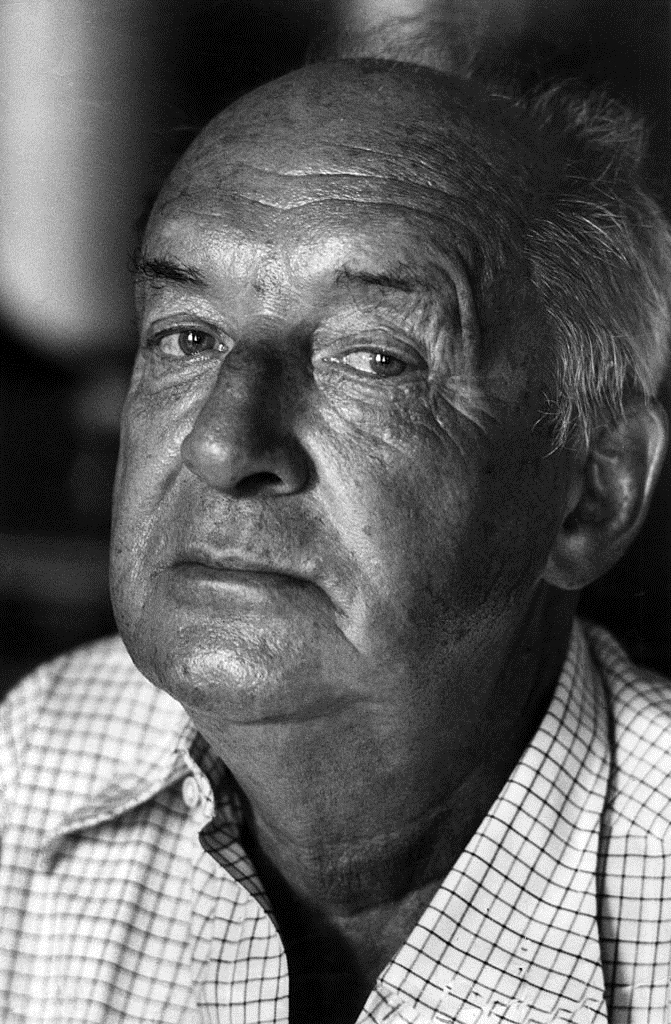
Picture of Vladimir Nabokov by Walter Mori (Mondadori Publishers) is in the public domain.
Portrait of Alexander Pushkin is by Orest Kiprensky and in the public domain
Photo of Montreux is by Nserrano and used under CC BY-SA 4.0 (https://creativecommons.org/licenses/by-sa/4.0)